


American flag styling with a patterned blade
This American flag folding knife brings together a red, white, and blue handle and a blade covered in flowing gray patterns. The handle provides the bold color, while the blade adds finer visual detail through contrasting light and dark lines. Together, they create a distinctive design for buyers who appreciate patriotic styling and decorative pocket knives.
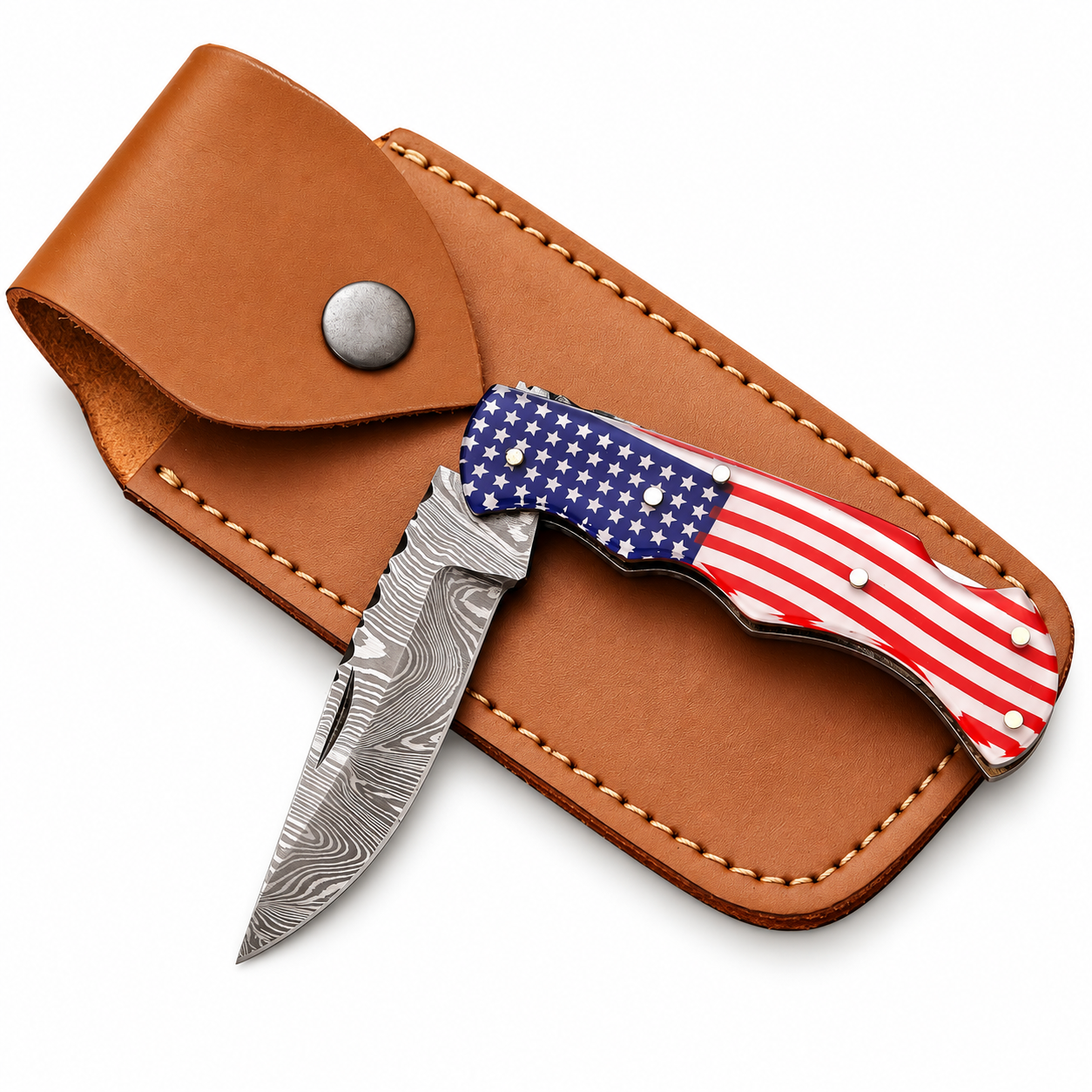
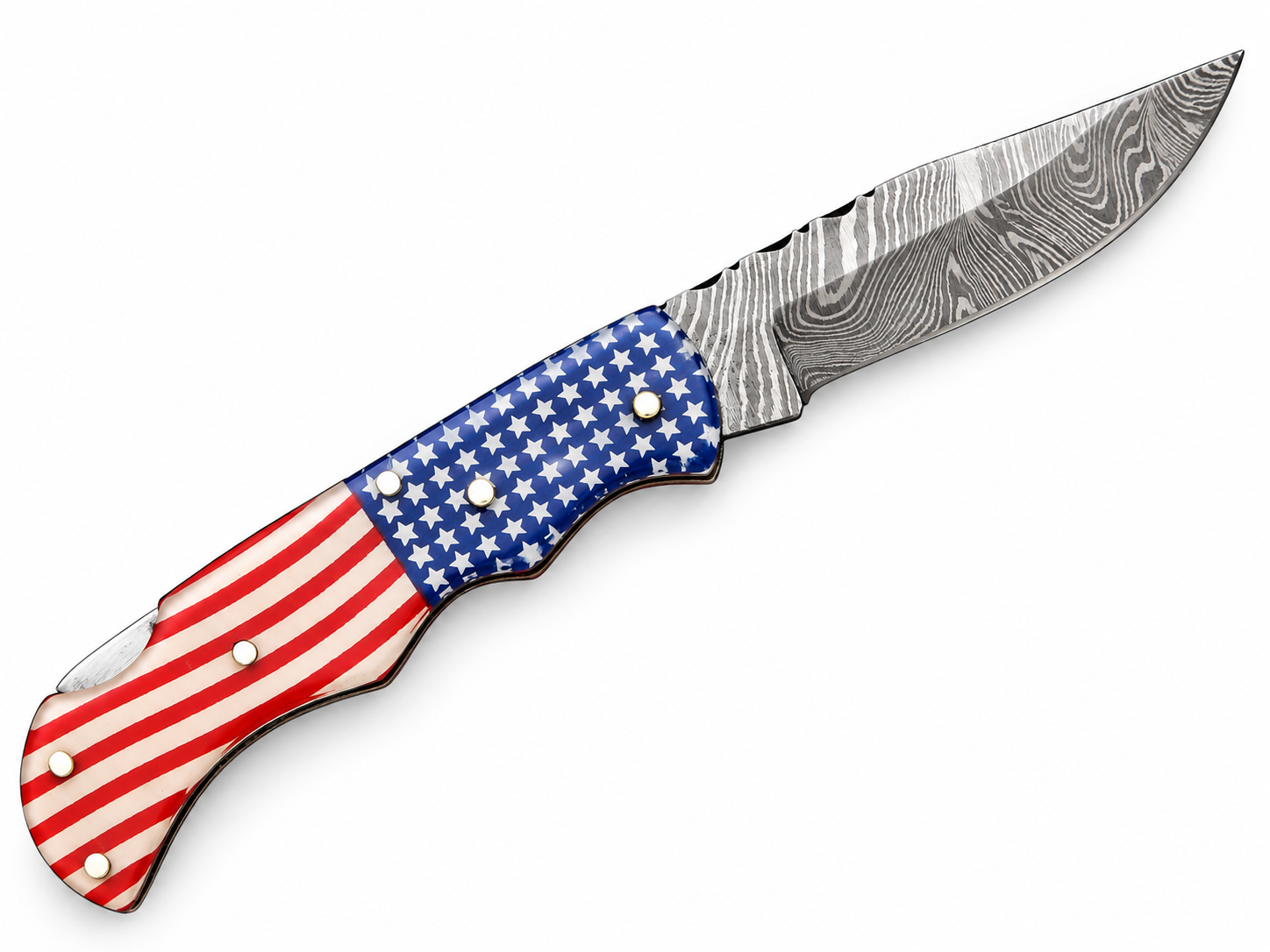
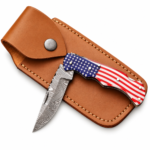
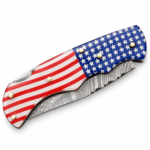
The photograph shows the knife with its blade partly open, resting over a tan-brown pouch. White stars cover the blue section near the blade pivot, and red-and-white stripes extend toward the rounded rear of the handle. Small circular metal-colored fittings interrupt the flag design, adding contrasting accents across the visible side.
The blade narrows to a pointed tip and has a curved lower edge. Its visible face features a mixture of sweeping lines, closely spaced bands, and broader irregular shapes. A narrow opening groove is visible on the blade, while the handle has a shaped underside with several curved recesses.
The main appeal is the combination of recognizable flag artwork and detailed blade decoration. The image establishes those visual features, but it does not confirm the blade’s steel composition, the handle material, or the folding mechanism’s specifications.
A red, white, and blue handle
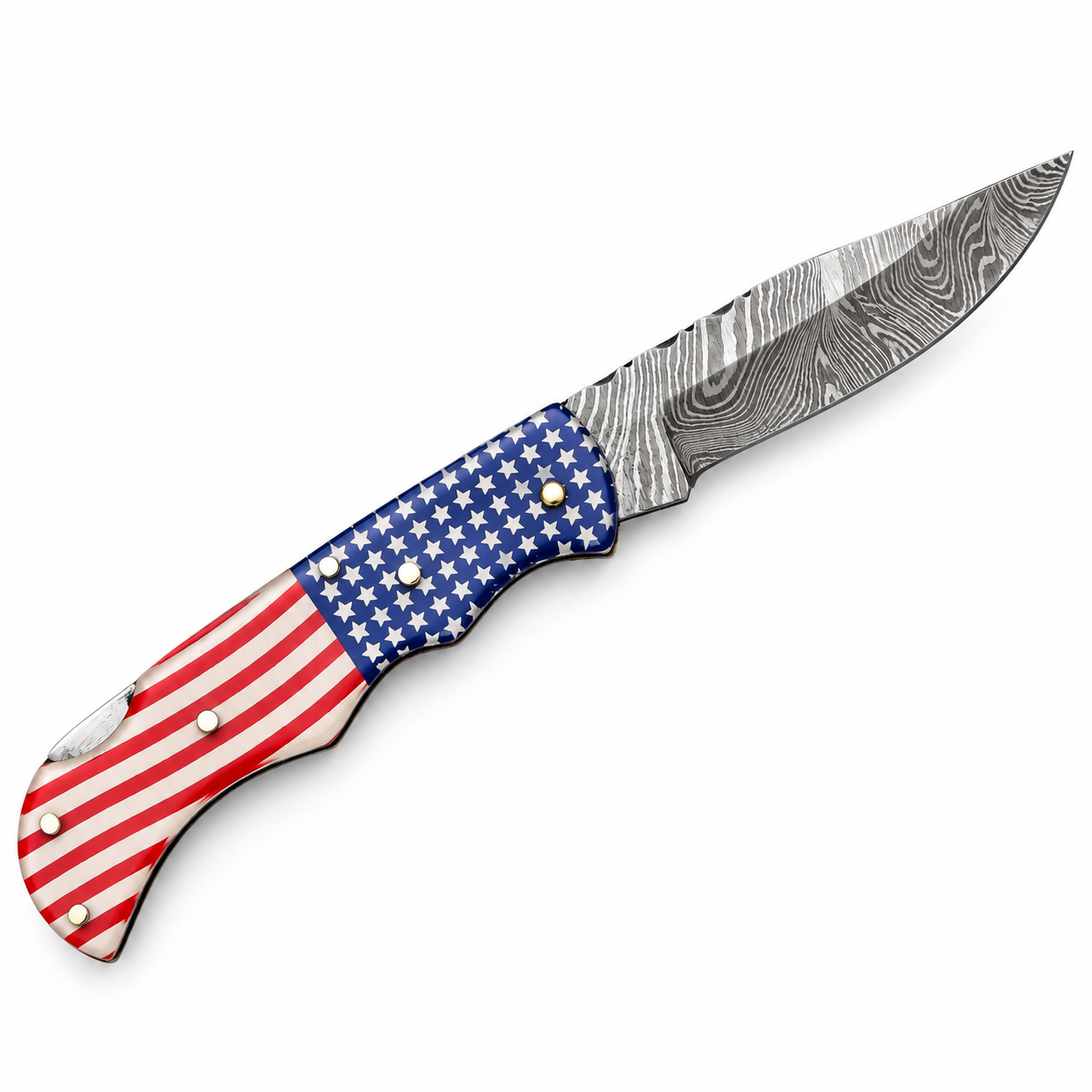
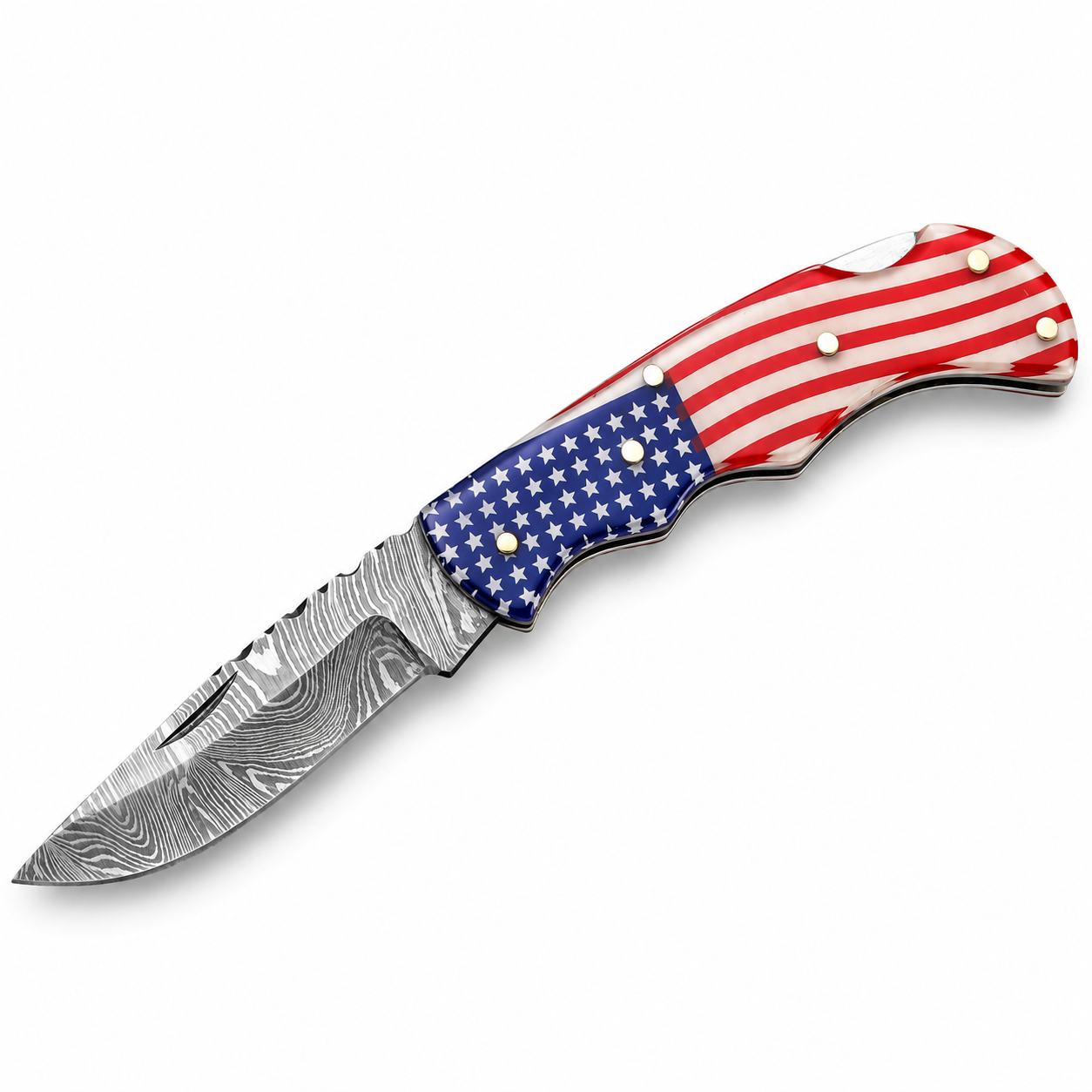
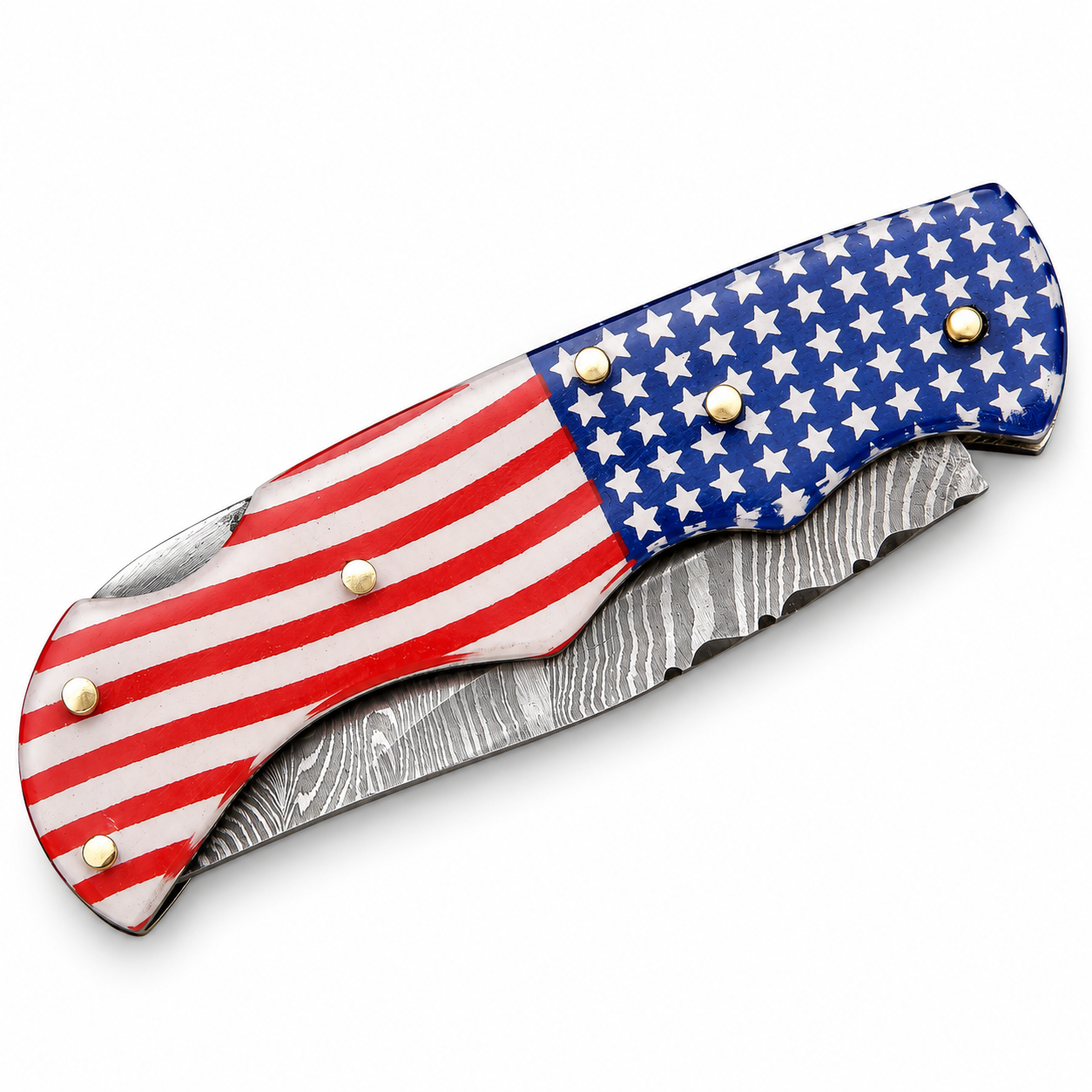
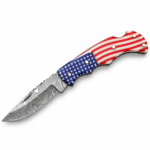
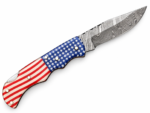
The flag design covers most of the visible handle surface. Its blue field sits toward the front, near the pivot, with rows of white stars arranged across it. The striped section continues through the middle and rear, following the handle’s curved outline.
This placement makes the design recognizable without relying on text or a large printed logo. The stars and stripes provide the identity of the handle, while the surrounding metal-colored edges define its shape. The result is a colorful appearance that remains easy to distinguish in the product photograph.
The handle surface looks smooth and reflective. Highlights are visible across the red-and-white section, particularly toward the rear. That appearance does not identify the material: resin, acrylic, coated materials, and other constructions can look similar in a photograph.
For buyers choosing primarily by style, the visible color arrangement is the useful detail. The handle presents an American flag motif rather than a plain finish, natural grain pattern, or single-color surface. Its design can appeal to someone building a patriotic-themed collection or looking for a visually distinctive folding knife.
Flowing detail across the blade
The blade has a silver-gray appearance with darker lines extending across its visible face. Some areas show close, nearly parallel bands, while others form larger curves and irregular shapes. The pattern changes direction along the blade rather than repeating as a simple uniform stripe.
This gives the blade a decorative appearance even without an engraved name or logo. The gray palette also provides a quieter contrast to the bright handle. Each part contributes something different: the handle offers color and symbolism, while the blade offers fine surface detail.
The pattern resembles the appearance often associated with Damascus-style blades. However, a photograph cannot confirm genuine pattern-welded Damascus steel or distinguish it reliably from a decorative surface treatment. For that reason, this listing describes the blade as patterned rather than assigning an unverified steel type.
If the blade material is central to your buying decision, request a specification for this exact product. The visible pattern can be appreciated on its own, but it should not be used to infer hardness, edge retention, corrosion resistance, or the number of steel layers.
A pointed profile and curved edge
The blade extends from a wider base into a narrower, pointed front. Its lower edge follows a continuous curve, with no visible serrations along that cutting edge. The outline gives the knife a traditional pocket-knife appearance while leaving space for the decorative pattern.
Near the handle, the blade has a more angular transition and visible shaping along the upper portion. These details add definition to the base of the blade. They do not establish a particular functional advantage or justify a heavy-duty performance claim.
The point and curved edge are visible design features, but their practical behavior depends on information outside the photograph. Blade thickness, edge geometry, steel grade, and heat treatment all affect how a knife performs.
For a buyer comparing appearance, the important distinction is that this is a pointed, plain-edge-looking blade rather than a broad rectangular blade or a visibly serrated design. For a buyer comparing cutting suitability, the specifications and manufacturer’s intended applications should guide the decision.
The folding format
The photograph shows the blade positioned at an angle to the handle, identifying the product as a folding knife. This format differs from a fixed-blade design, where the blade and handle remain permanently aligned.
A folding design allows a blade to close into its handle, but the supplied image does not show the knife fully closed. Closed dimensions, blade coverage, and the fit of the folded blade therefore remain unverified.
The image also does not establish whether the knife has a back lock, liner lock, slip joint, or another mechanism. A similar-looking supplier listing may mention one of these systems, but that information should not be transferred to this product without confirmation.
For anyone intending to use the knife regularly, the mechanism is an important part of the purchase. Ask for the exact opening and locking arrangement, along with a closed-position photograph. The appearance is clear from the supplied image; the operation needs its own supporting information.
A narrow blade-opening groove
A narrow recessed groove is visible on the blade face. It is consistent with the type of nail nick found on many manually opened folding knives, although the photograph alone does not confirm the complete opening method.
Visually, the groove forms a darker elongated detail within the patterned surface. It sits away from the edge and follows part of the blade’s length. This feature helps distinguish the pictured knife from designs that rely on a large circular opening hole or a clearly visible thumb stud.
Its presence should not be treated as proof of one-handed operation, assisted opening, or automatic deployment. Those are separate mechanical characteristics that require confirmation.
If opening convenience matters to you, a short demonstration or a clear supplier description will be more useful than appearance alone. The groove is visible, but the resistance, motion, and handling of the actual knife cannot be assessed from a still image.
Shaped handle contours
The underside of the handle has several inward curves rather than a straight edge. The front section narrows behind the blade, the middle changes width, and the rear broadens into a rounded end.
These contours are part of the knife’s visual character. They also influence the outline a buyer would hold, although comfort cannot be established from a photograph. Actual handle length, thickness, surface feel, and edge finishing will affect how the knife fits a particular hand.
The flag artwork follows this shaped surface rather than sitting inside a simple rectangular panel. Red-and-white stripes continue toward the wider rear, while the blue star field occupies the front. That arrangement helps the artwork remain integrated with the handle’s shape.
Buyers who prefer a defined handle outline may find this design worth considering. To assess fit more confidently, compare its confirmed dimensions with a folding knife you already find comfortable, rather than estimating size from the enlarged image.
Visible metal-colored details
Several circular fittings are visible across the handle, including one near the pivot and others through the middle and rear. Their light metallic appearance contrasts with the blue, red, and white surface.
A metal-colored border is also visible along parts of the handle perimeter. This frames the decorative surface and adds a thin line of contrast around the shaped underside and rounded end.
These details contribute to the overall appearance, but the image does not identify the metal used or the function of every fitting. It would be inaccurate to label them all as brass pins, stainless screws, or structural rivets without supporting information.
For an appearance-led purchase, the benefit is visual definition: the fittings break up the colored surface, and the perimeter helps outline the handle. For construction quality, additional views and material specifications would be needed to assess what sits beneath the decorative exterior.
The tan pouch pictured with the knife
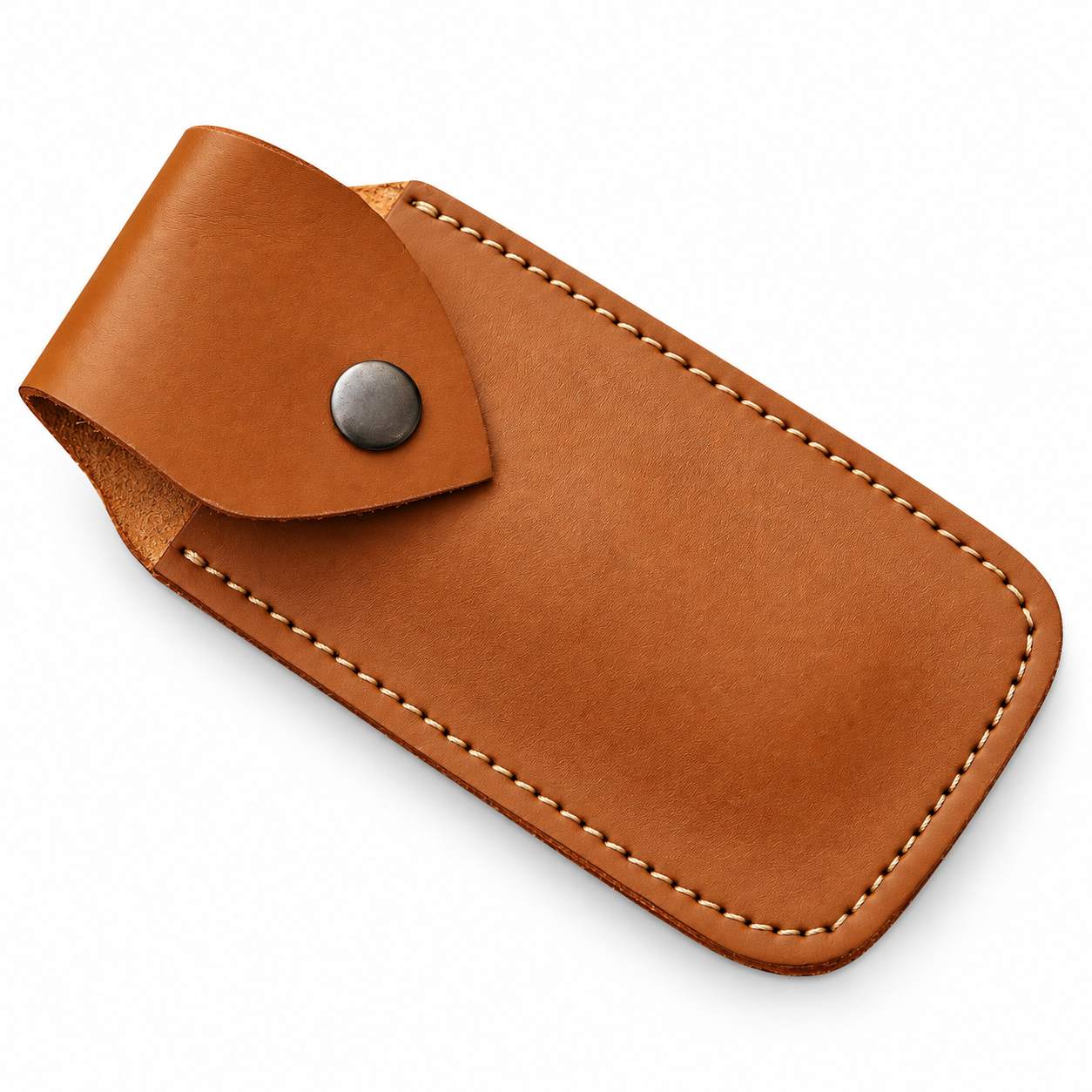
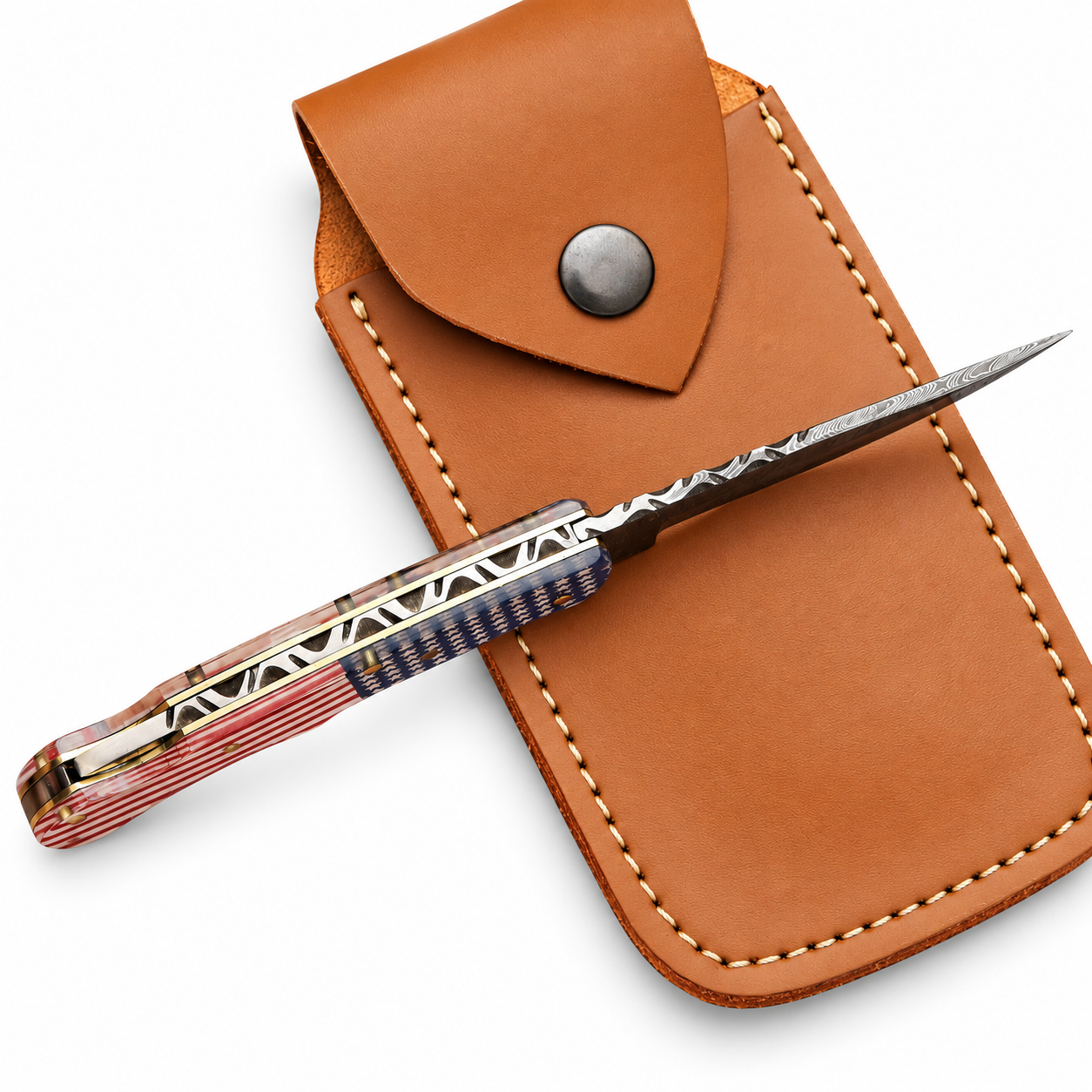
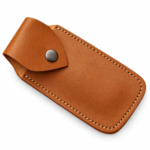
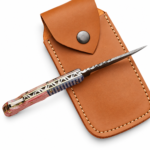
A tan-brown pouch appears behind the knife. It has a broad body, rounded lower corners, contrasting light stitching, and a curved flap with a round metal-colored snap.
The warm brown tone provides a neutral background for the brighter handle. The stitching follows the pouch perimeter and is clearly visible in the photograph. Part of the flap’s underside is also visible, showing a rougher-looking interior surface.
Although the pouch has a leather-like appearance, its material cannot be confirmed from the image. The photograph also does not prove that it is included in the purchase, that it fits the folded knife correctly, or that it has a belt attachment.
Treat the pouch as a pictured accessory until the package contents are confirmed. If it is part of the offer, useful details would include its material, internal dimensions, closure arrangement, and any carrying attachment on the reverse.
A design for patriotic-themed collections
The American flag motif gives this knife an obvious visual theme. It may appeal to buyers who collect flag-themed accessories, decorative folding knives, or products with red, white, and blue styling.
The design is recognizable even without lettering. This can make it suitable as a visual centerpiece within a themed collection, particularly where the handle artwork matters as much as the blade’s appearance.
The patterned blade adds a second element of interest. Rather than relying only on the flag, the knife combines bold handle colors with a detailed gray blade face. Buyers who enjoy looking closely at surface patterns may appreciate that contrast.
The American flag artwork describes the design, not the country of manufacture. It should not be interpreted as a “Made in USA” claim, a military affiliation, an official commemorative edition, or a licensed product. None of those associations is established by the supplied image.
Considering it as a gift
A folding knife with a clear visual theme can be a thoughtful option for an adult recipient who already enjoys knives or patriotic accessories. Here, the flag handle gives the gift a specific character rather than a generic plain finish.
The best match depends on the recipient’s preferences. Someone who enjoys colorful handles may appreciate the artwork, while someone focused on technical specifications will likely want to know the steel, mechanism, dimensions, and weight.
The tan pouch shown in the photograph may also be relevant to presentation, but it should only be described as part of the gift once inclusion is confirmed. Gift packaging, engraving, and personalization are not shown or verified.
Before ordering for a particular occasion, confirm the actual contents and delivery arrangements with the seller. The photograph offers a useful impression of the design; the complete gift experience depends on the supplied product and packaging.
Choosing for appearance or practical use
Different buyers will approach this knife for different reasons. A collector may prioritize the flag layout, the blade pattern, and the relationship between the colors. A practical user may place greater emphasis on the mechanism, steel, size, and edge.
The image supports the first group of considerations well. It clearly shows the visible side of the handle, the open blade, and the pouch’s front. It does not provide the measurements or testing needed for performance comparisons.
For that reason, this knife should not be described as suitable for demanding outdoor work, heavy cutting, or specialist tasks based only on its appearance. Its intended use and limitations should come from the manufacturer’s specifications.
If your main interest is the design, inspect the photograph for the details you like. If you also want a working pocket knife, use the technical information to decide whether this particular model meets your needs.
Dimensions and everyday convenience
No ruler or other reliable scale reference appears in the photograph. Blade length, overall open length, closed length, handle thickness, and weight are therefore not established.
These details affect how a folding knife fits into a collection, storage space, or intended carrying arrangement. A knife can look small in one photograph and substantial in another depending on cropping and camera angle.
Closed length is especially useful when comparing folding knives. Handle thickness and weight also matter for buyers who prefer a slimmer or lighter item. Neither can be estimated accurately from the front view.
No pocket clip is visible on the photographed side. That does not establish whether a clip exists on the reverse. If a clip, belt pouch, or another carrying feature is important, request a rear view and a complete specification rather than assuming the arrangement.
What the photograph shows—and what needs confirmation
The image provides a clear view of the product’s main styling. It shows a folding knife with a flag-themed handle, a pointed patterned blade, visible circular fittings, and a tan stitched pouch behind it.
It does not establish a brand, model number, country of origin, steel grade, handle composition, or lock type. There is also no verified information about blade hardness, sharpening, warranty, or included accessories.
Keeping these details separate makes the product easier to evaluate. The visible design can be described confidently without attaching technical claims that belong to a different supplier’s item.
A complete specification should relate to the exact knife being sold. Similar photos and similar product names are useful for finding alternatives, but they cannot confirm that two products share the same materials, mechanism, or quality.
Comparing similar flag-handle knives
When comparing alternatives, look beyond the presence of red, white, and blue. The placement of the blue star field, the direction of the stripes, and the shape of the handle all help identify a closer match.
For this knife, the blue section is near the pivot and the stripes extend toward the rear. The handle has several lower contours and a widened rounded end. Those details are more specific than the general label “flag knife.”
The blade is another important comparison point. This image shows a flowing gray pattern, a narrow opening groove, and a continuous curved lower edge. A plain black blade, a serrated edge, or a different opening feature would make another knife a less exact match.
The pouch should be compared separately. Its shape, flap, stitching, and snap may differ even where two knives look similar. A matching knife photograph does not automatically establish matching accessories or package contents.
Care and finish information
The correct care routine depends on the blade metal, handle material, and the process used to create the visible artwork. Those details have not been verified for this knife.
A patterned blade should not automatically be treated as stainless, and a glossy handle should not automatically be treated as resistant to solvents or abrasion. Appearance alone does not provide reliable care guidance.
Request the seller’s instructions for cleaning, drying, storage, and maintenance of the folding mechanism. If the pouch is included, obtain its material-specific care information as well.
For buyers who want to preserve the appearance, it is particularly useful to establish whether the flag design is printed, embedded, coated, or produced by another method. That information can help explain how the surface should be maintained without guessing from the photograph.
Personalization and available variations
The image shows one color scheme and one visible configuration. No alternative blade finishes, handle colors, sizes, or engraving options have been verified.
The American flag artwork already gives the handle a strong identity. Buyers seeking additional personalization should first confirm whether the seller offers it for this model and where any engraving or marking would be placed.
A customization option advertised by another supplier is not evidence that it is available here. Minimum quantities, setup charges, sample costs, and production time may also differ between standard and customized orders.
If you want the knife exactly as pictured, confirm that the selected variation corresponds to this handle design and blade pattern. Clear variation information is more useful than relying on a broad product title that may cover several different knives.
Visible features at a glance
- Folding knife shown with the blade partly open.
- American flag design across the visible handle.
- White stars on a blue field near the pivot.
- Red-and-white stripes extending toward the rear.
- Smooth-looking, reflective handle surface.
- Shaped underside with curved recesses.
- Multiple circular metal-colored fittings.
- Pointed blade with a flowing gray pattern.
- Narrow groove visible on the blade face.
- Tan-brown stitched snap-flap pouch pictured behind the knife.
A distinctive addition to explore
This American flag folding knife combines patriotic handle artwork with a detailed gray blade pattern. Its contoured outline, visible fittings, and contrasting colors give it a recognizable appearance for buyers who enjoy decorative pocket knives.
Review the confirmed materials, dimensions, mechanism, and package contents before ordering. If the stars-and-stripes handle and patterned blade suit your collection or gift idea, take a closer look at this design and choose the configuration that matches your preferences.





Reviews
There are no reviews yet.