

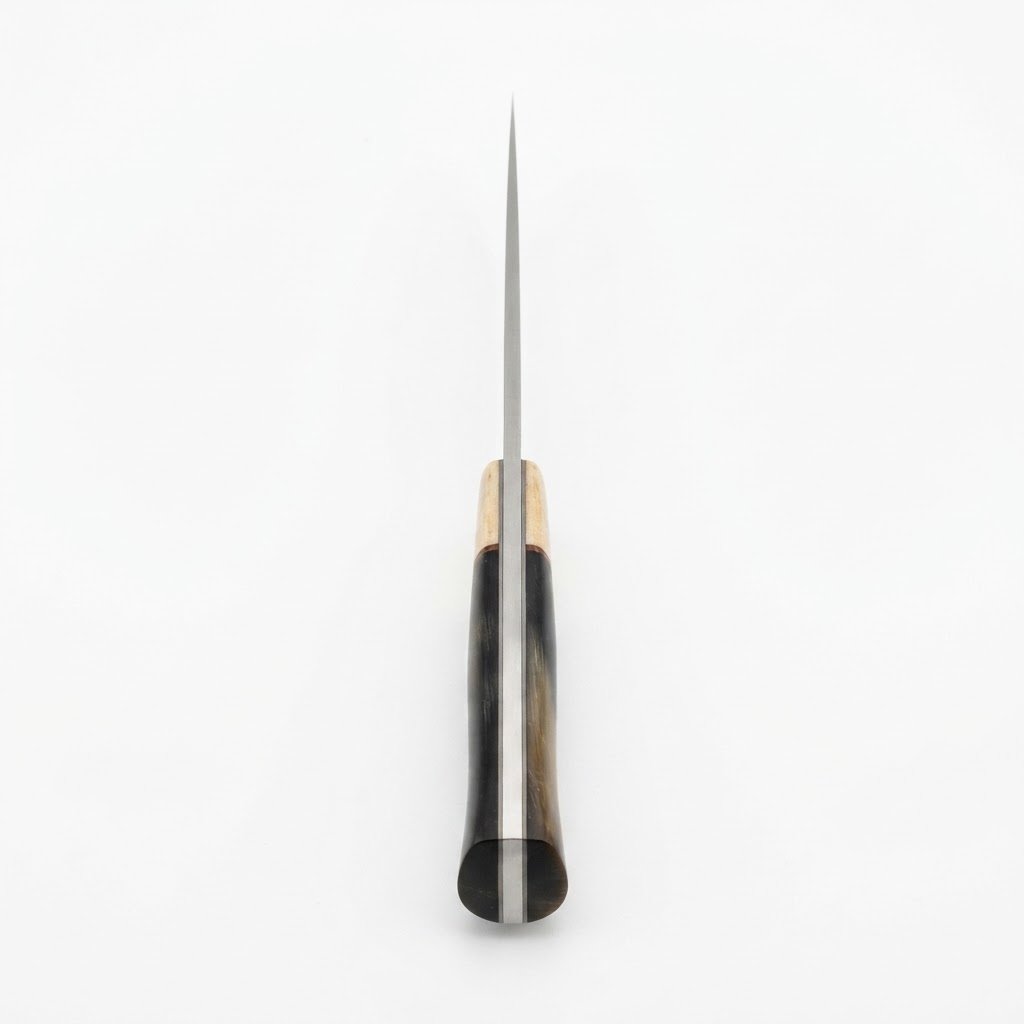
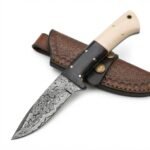
Black and Cream Handle Damascus Pattern Hunting Knife Features
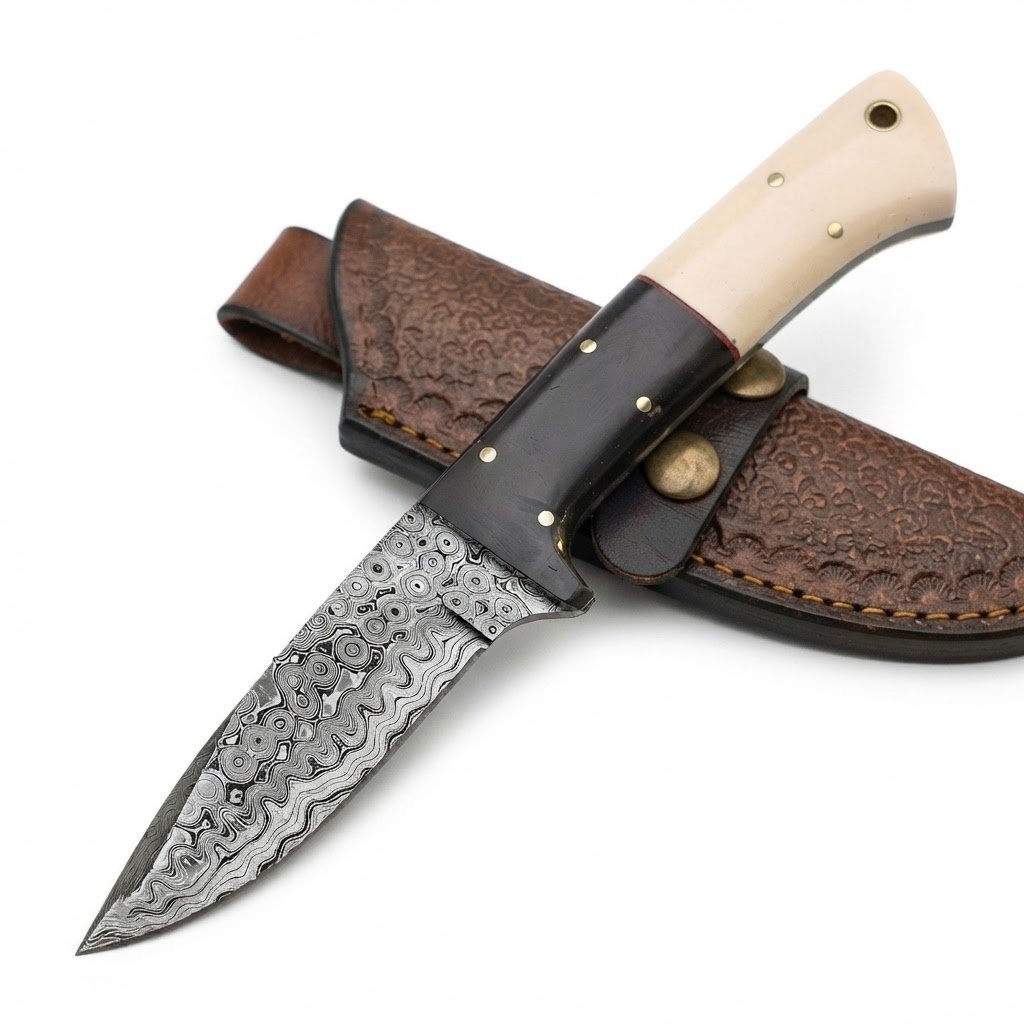
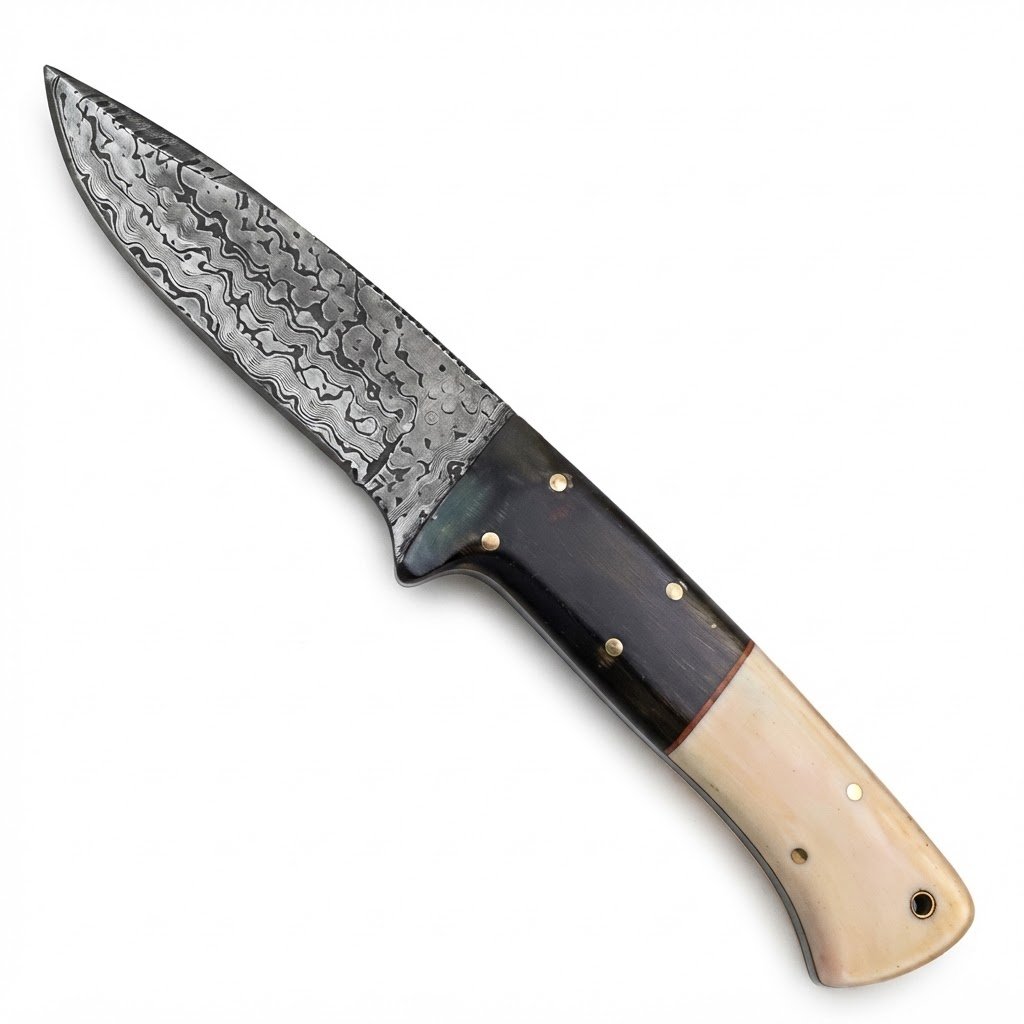
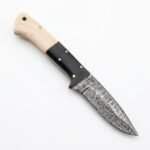
The black and cream handle Damascus pattern hunting knife combines the traditional appearance of an outdoor fixed-blade knife with an eye-catching patterned blade, contrasting handle sections, and a decorative brown sheath. Its design features distinctive circular and flowing lines across the blade surface, a dark lower handle section, and a light cream-colored upper grip.
The contrast between these elements creates a refined appearance suitable for customers who appreciate traditional hunting knives, outdoor knife collections, and decorative fixed-blade designs.
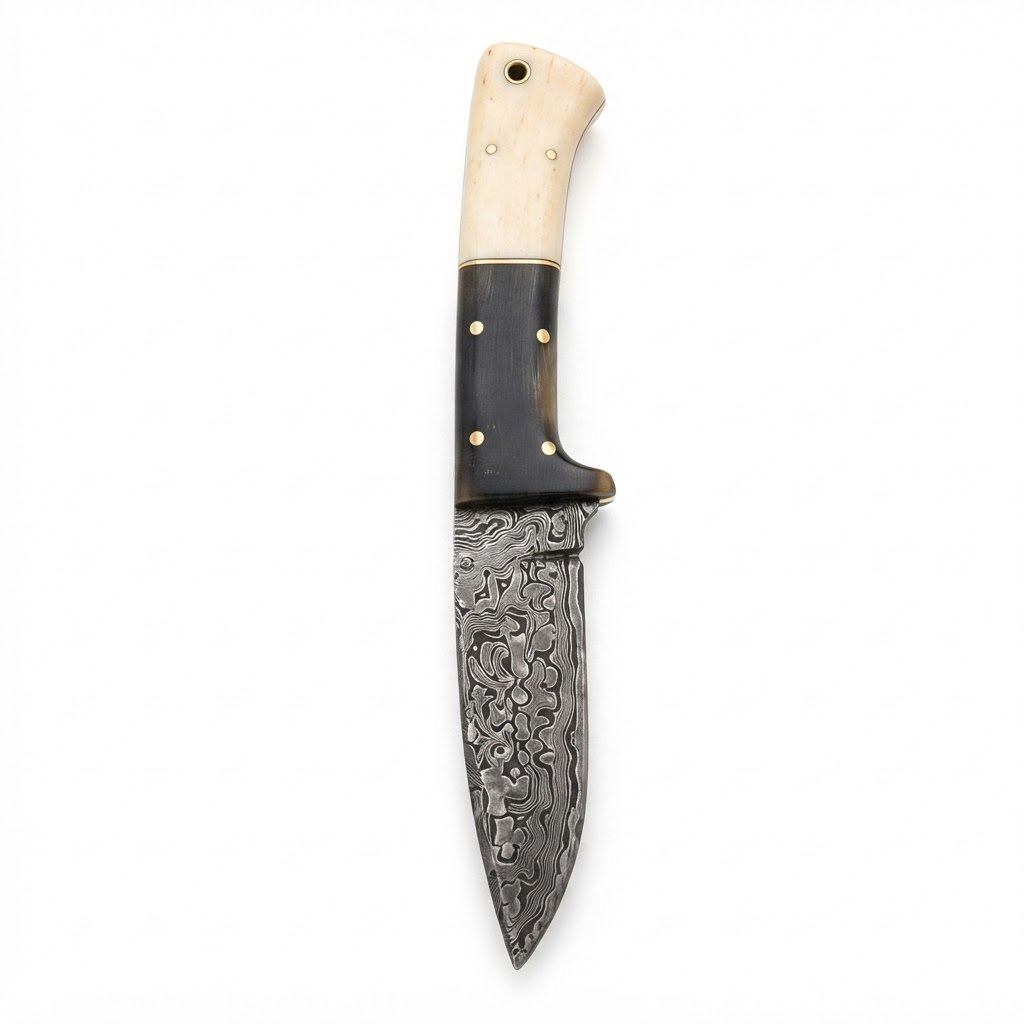
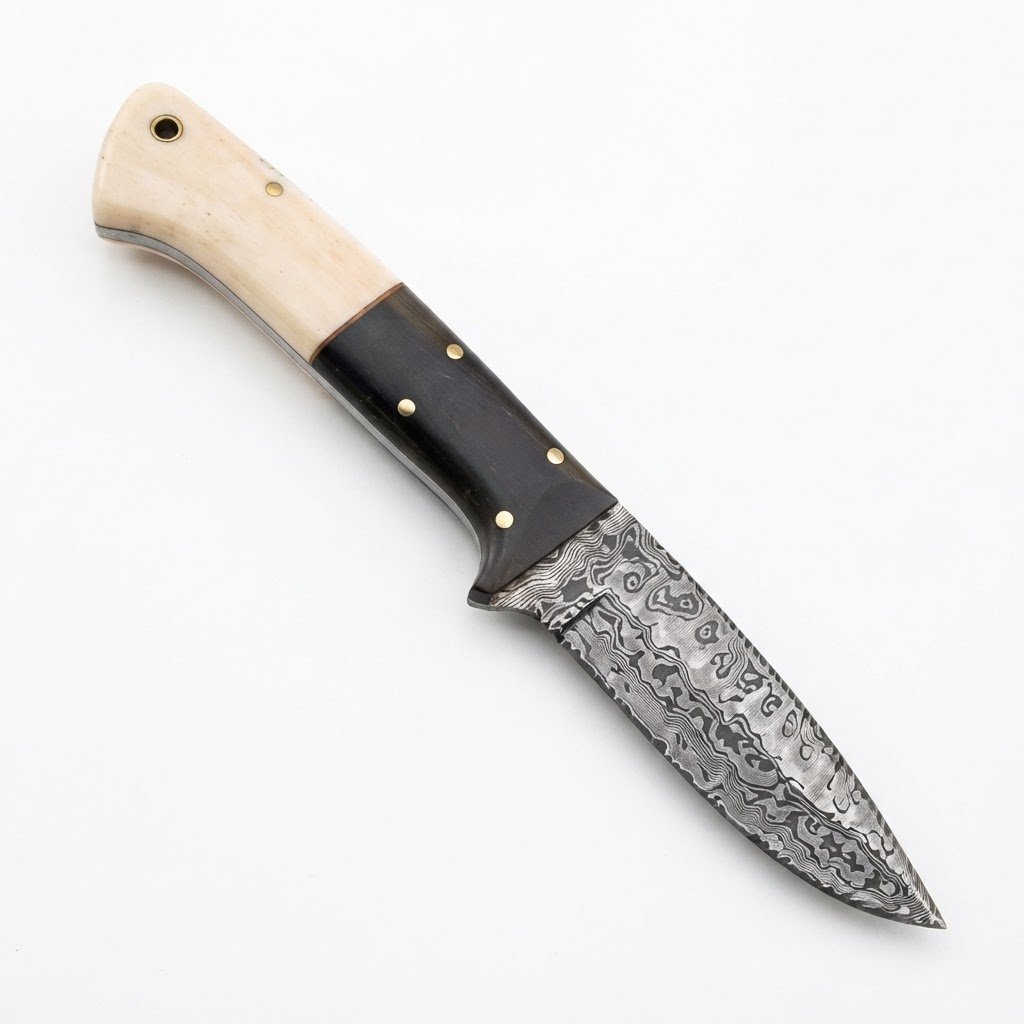
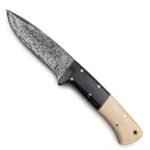
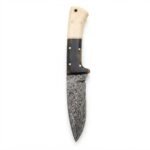
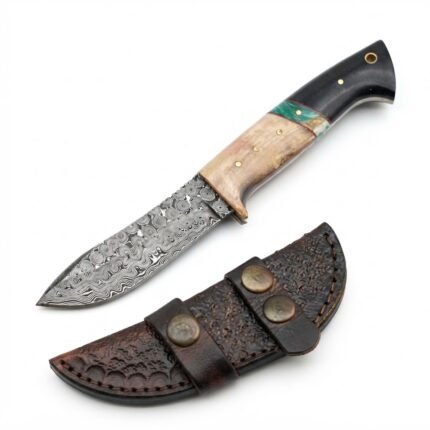
This knife features a pointed blade with a gently curved cutting edge. The handle follows a slightly tapered and curved profile, with its black and cream sections connected by a thin reddish-brown dividing line. Small metallic pins are visible along the handle, while a circular gold-toned lanyard opening appears near the end.
A brown sheath with embossed floral-style detailing is displayed behind the knife. The sheath features visible perimeter stitching and overlapping retaining straps with round metal fasteners.
Together, these details give the knife a distinctive appearance without relying on excessive decoration.
The steel composition, exact handle materials, hardness, dimensions, weight, and manufacturing method have not been verified. The description therefore focuses on the product’s visible design and characteristics rather than unsupported technical claims.
Distinctive Damascus-Style Patterned Blade
The most noticeable feature of this fixed-blade knife is its patterned blade.
Across the visible surface, the blade displays a combination of circular motifs, concentric shapes, and flowing lines. These details create an appearance commonly associated with Damascus-pattern knives.
The upper portion of the blade contains several circular and irregular motifs. Toward the lower edge, the pattern transitions into narrower wave-like lines that follow the blade’s general shape.
This variation gives the blade considerable visual character.
The pattern contrasts with the relatively simple handle surfaces, making the blade a central feature of the product’s appearance.
Circular and Flowing Surface Details
The blade pattern contains an interesting mixture of geometric and organic shapes.
Circular formations appear throughout the upper and middle areas, surrounded by smaller flowing contours.
Near the cutting edge, the patterns become more elongated.
These details create a layered visual effect.
The photograph does not establish whether the pattern comes from forge-welded steel layers, surface etching, or another manufacturing technique.
For accurate product information, the blade should be described as Damascus-patterned until the supplier confirms its construction.
Traditional Pointed Blade Shape
The blade has a pointed tip and a gradually curved cutting edge.
Its width is greater near the handle and narrows toward the tip.
This shape resembles blade profiles commonly associated with hunting and general-purpose outdoor knives.
The overall form is relatively compact in appearance compared with large survival knives or machetes, although exact size cannot be determined from the photograph.
The pointed profile contributes to the knife’s traditional appearance.
Its suitability for particular cutting applications depends on the confirmed blade geometry, composition, edge condition, and construction.
Blade Finish and Appearance
The blade has a silver and dark-gray patterned surface.
Fine lines and circular details cover much of the visible blade face.
Areas of darker shading help distinguish the patterned formations from the lighter metal.
The resulting appearance is more decorative than a uniformly polished blade.
The cutting edge appears as a lighter metallic line along the lower portion.
However, sharpness, edge retention, corrosion resistance, and durability cannot be established from the image.
Those characteristics require reliable manufacturing specifications and, where applicable, testing.
Black and Cream Two-Tone Handle Design
The handle is another defining feature of this hunting-style knife.
Its appearance combines a dark black section near the blade with a light cream-colored section extending toward the butt.
The two sections create a strong visual contrast.
The lower black section occupies approximately the front half of the handle, while the cream section forms the remainder.
The transition between the two colors is marked by a thin reddish-brown line.
This detail adds warmth to the otherwise neutral black-and-cream design.
The handle’s gently curved outline complements the blade’s profile.
Dark Front Handle Section
The front portion of the handle has a black or very dark charcoal appearance.
It extends from the blade junction toward the middle of the grip.
Several small circular gold-toned pins are visible in this area.
Their placement creates subtle metallic highlights against the dark surface.
The black section also includes a slight contour near the blade, contributing to the shape of the handle.
This area meets the patterned blade through a dark transitional section with a small guard-like projection.
The exact structural arrangement cannot be confirmed from the photograph.
Cream-Colored Rear Handle Section
The rear portion of the grip is light cream, with a smooth-looking surface and faint tonal variation.
This lighter section gives the knife much of its distinctive appearance.
Its neutral shade contrasts with the dark front section and the patterned blade.
Two small gold-toned pins are visible along the cream-colored portion.
A larger metal-lined hole appears toward the end of the handle.
The exact handle composition is unknown.
Although the surface resembles materials commonly used in traditional bone-style knife handles, the photograph cannot confirm whether it is natural bone, resin, wood composite, or another material.
Contrasting Handle Construction
The black and cream sections create a two-tone arrangement.
The thin dividing line between them adds another subtle design detail.
This combination makes the handle recognizable even when viewed separately from the blade.
The contrast may appeal to collectors who prefer traditional designs with restrained decorative features.
The handle also displays a gently curved shape that follows the natural outline commonly seen on fixed-blade knife grips.
Comfort and grip performance cannot be confirmed without physical examination.
Those characteristics depend on actual dimensions, surface texture, handle thickness, and individual preference.
Small Metallic Handle Pins
Several round metallic pins appear along both sections of the handle.
The pins have a warm gold-toned finish.
They are arranged in a simple pattern that follows the handle’s length.
Against the black section, they appear as small bright accents.
Against the cream section, they provide a more subtle contrast.
The pins contribute to the knife’s traditional appearance.
Handle pins may serve structural or decorative purposes depending on the manufacturer’s construction.
Without further technical information, their precise function should not be assumed.
Their visible appearance is nevertheless an important part of the product’s design.
Metal-Lined Lanyard Hole
Near the end of the cream-colored handle, a round opening with a gold-toned metal lining is visible.
This feature resembles a lanyard hole.
Lanyard holes are commonly incorporated into knife handles as an attachment point for a suitable cord or accessory.
The opening also adds a decorative detail that coordinates with the small metallic pins.
The photographed knife does not show a lanyard installed.
A cord, strap, or other attachment should therefore not be advertised as included unless confirmed by the supplier.
Brown Embossed Sheath Design
The photograph shows a brown sheath behind the knife.
Its dark brown coloring and textured surface complement the black-and-cream handle.
The sheath has a curved outline that follows the general shape of the blade.
A darker border surrounds the edges.
Visible stitching runs around much of the perimeter.
The surface features decorative impressions resembling floral and ornamental patterns.
This gives the sheath a traditional appearance.
Decorative Embossed Surface
The sheath’s brown exterior displays repeated ornamental impressions.
These details appear across its broad front surface.
The embossing includes curved and floral-style shapes, creating a textured appearance.
The decorative design complements the patterned blade without exactly matching it.
This combination gives the knife and sheath a coordinated visual style.
The photograph is consistent with a leather-style sheath, but it does not establish whether the material is genuine leather or a synthetic alternative.
Visible Perimeter Stitching
Stitching is visible along the sheath’s outer edge.
The stitches have a warm brown or golden-brown appearance.
They follow the curved outline of the sheath and create a contrasting border.
The stitching is particularly noticeable along the lower edge.
Its presence contributes to the sheath’s traditional appearance.
However, the photograph does not establish the thread composition, stitch method, or long-term durability.
Retaining Straps and Fasteners
Two overlapping strap sections are visible near the central part of the sheath.
Each has a round, brass-toned metal fitting.
These straps appear designed to help retain the knife in the sheath.
The photograph does not show the knife inserted, so the exact fastening arrangement and fit remain unverified.
For accurate product listings, the sheath’s retention method should be confirmed by the supplier.
Sheath Color Combination
The sheath features multiple shades of brown.
Darker areas appear around its edges and under the overlapping strap sections.
The embossed surface is a medium to dark brown.
This creates a natural-looking contrast that suits the traditional fixed-blade design.
The sheath’s visual character makes it an important accessory in the product presentation.
Fixed Blade Hunting Knife Design
Unlike a folding knife, a fixed-blade knife has a blade that remains extended from its handle.
This type of construction is commonly associated with hunting knives, outdoor knives, and general-purpose fixed-blade tools.
The photographed product has a visible blade and handle joined in a fixed configuration.
No pivot or folding mechanism is shown.
The fixed-blade silhouette gives the knife a traditional appearance.
However, identifying the product as fixed blade does not establish whether it has a full tang, partial tang, hidden tang, or another internal arrangement.
The tang construction must be verified separately.
Blade and Handle Transition
The blade widens near its junction with the handle.
A small projection appears beneath this transition, resembling a guard or finger-stop feature.
This creates a visible separation between the blade and grip.
The dark front section of the handle continues toward the patterned blade.
The combination creates a smooth overall design.
Exact construction and protective function cannot be established from the image alone.
Traditional Hunting-Style Profile
The blade and handle proportions resemble those found on traditional hunting-style knives.
The pointed blade and curved lower edge contribute to this appearance.
The contrasting handle sections add a classic visual element.
The decorative sheath reinforces the traditional styling.
This design may appeal to customers who appreciate the appearance of outdoor hunting knives.
Actual suitability for field use depends on verified material properties, dimensions, and construction quality.
Visual Features of the Damascus Pattern Hunting Knife
Several features distinguish this knife from simpler fixed-blade designs.
Its patterned blade contains circular and flowing surface details.
The handle uses two contrasting colors rather than a single continuous finish.
Small gold-toned pins provide subtle metallic accents.
A metal-lined lanyard opening appears near the rear of the grip.
The brown sheath displays embossed ornamentation and edge stitching.
These elements work together to create a distinctive product appearance.
Patterned Steel Appearance
The blade’s silver-and-dark surface is a central visual feature.
Its concentric patterns create a decorative appearance that differs from plain satin or mirror-polished blades.
The pattern also varies across the blade rather than repeating in an entirely uniform arrangement.
This gives the blade a visually complex design.
The actual steel layering and manufacturing process remain unverified.
Two-Tone Handle Styling
The black-and-cream handle creates a clear division between two color sections.
The dark portion visually connects the grip with the blade.
The cream portion provides contrast and lightens the overall appearance.
The small metallic pins add highlights.
The red-brown separating line provides a subtle finishing accent.
Coordinated Brown Sheath
The sheath complements the knife’s traditional styling.
Its brown surface contrasts with both the silver-gray blade and the light cream handle.
The embossed design adds texture.
The visible fasteners provide additional metallic accents.
Together, these details create an appearance suitable for display photography and traditional knife collections.
Suitable Customers and Uses
This knife may be relevant to adult collectors and enthusiasts interested in decorative fixed-blade knives.
Its appearance fits within traditional hunting-knife and outdoor-knife categories.
However, appearance alone should not be used to establish suitability for demanding applications.
Customers should verify the blade material, edge geometry, tang construction, handle materials, and intended operating conditions.
Traditional Knife Collectors
Collectors often consider blade patterns, handle materials, color combinations, and accompanying accessories.
This knife offers several notable visible details.
The patterned blade gives it an intricate appearance.
The two-tone handle creates visual contrast.
The embossed brown sheath adds another traditional element.
These features may make the product an interesting addition to a properly secured collection of fixed-blade knives.
Outdoor Equipment Enthusiasts
Fixed-blade knives are commonly found in outdoor equipment collections.
This model has the general appearance of an outdoor hunting knife.
Before using it for a specific activity, customers should confirm its construction and manufacturer-recommended applications.
Factors such as blade steel, corrosion resistance, edge characteristics, and sheath retention can influence suitability.
Decorative Knife Buyers
Some customers choose knives primarily for their appearance and collectible character.
The Damascus-style pattern and contrasting handle may appeal to this audience.
The decorative sheath also contributes to the overall presentation.
The product’s visual details can be appreciated without making unsupported claims about steel performance or manufacturing techniques.
Adult Gift Buyers
Traditional fixed-blade knives may interest adults who collect outdoor equipment or decorative knives.
The contrasting colors and accompanying sheath give this product a distinctive visual presentation.
However, a gift box or special packaging is not shown.
Any packaging arrangement should be confirmed before describing the product as a complete gift set.
Understanding Damascus-Pattern Blades
Damascus is a term used in the knife industry for several types of patterned blades.
Some products use forge-welded layers of different steels.
Others obtain a similar appearance through alternative processes or surface decoration.
A photograph of the pattern does not establish the underlying manufacturing method.
For this reason, the photographed product is best described as having a Damascus-style or Damascus-pattern blade.
Genuine Layered Steel Versus Decorative Patterning
A genuine layered steel construction involves specific manufacturing processes.
Decorative patterning may produce a similar visual appearance without the same internal structure.
Both can display flowing lines or circular motifs.
The photograph shows the pattern clearly but provides no documentation of its origin.
The product description should therefore avoid unverified claims such as a particular layer count, specific steel combination, or hand-forging process.
Steel Grade and Hardness
The exact blade alloy cannot be identified from its surface appearance.
Similarly, blade hardness requires technical information or testing.
Values expressed in HRC should only be included when supported by a manufacturer specification.
It would also be inappropriate to promise particular edge-retention or corrosion-resistance performance without reliable material information.
Customers comparing different knives should request these details from the supplier.
General Product Care
Proper care depends on the actual materials used in the knife and sheath.
The following guidance is general and should be supplemented with manufacturer instructions.
Cleaning the Blade
After appropriate use, clean the blade using a method compatible with its confirmed steel composition.
Remove moisture and residue with a soft cloth.
Avoid unnecessary exposure to harsh cleaning chemicals.
Some blade finishes may be affected by abrasives.
If the blade has an etched pattern, abrasive polishing may alter its appearance.
Protecting the Patterned Finish
The blade’s patterned appearance is an important visual feature.
Avoid aggressive polishing unless recommended by the manufacturer.
An unsuitable abrasive may change the contrast between light and dark areas.
The correct maintenance method depends on whether the pattern is etched, layered, or otherwise finished.
This information should be obtained from the supplier.
Handle Care
The handle combines dark and cream-colored sections.
Because their exact compositions are unknown, use care products only after confirming the materials.
Avoid prolonged exposure to unsuitable solvents or excessive moisture.
Wipe away light dust with a clean, soft cloth.
Store the knife in conditions appropriate for the confirmed handle materials.
Sheath Maintenance
The sheath has a brown leather-like surface.
If genuine leather is confirmed, care products intended for that type of leather may be suitable.
If the sheath is synthetic, different care methods may be required.
Avoid applying oils or conditioners without confirming the material.
Keep the sheath clean and dry according to the manufacturer’s guidance.
Safe Storage
Store the knife in a secure location inaccessible to children and unauthorized individuals.
Use a suitable blade cover or sheath when appropriate.
Make sure the blade is protected before handling or storage.
Avoid leaving a potentially moisture-sensitive steel blade enclosed in a damp sheath.
Follow applicable local rules regarding ownership, storage, transportation, and use.
Product Specifications
| Attribute | Description |
|---|---|
| Product Type | Fixed Blade Knife |
| Style | Hunting-Style Knife |
| Blade Appearance | Damascus-Style Pattern |
| Blade Color | Silver and Dark Gray |
| Blade Profile | Pointed with Curved Edge |
| Handle Design | Two-Tone |
| Handle Colors | Black and Cream |
| Handle Accent | Thin Reddish-Brown Divider |
| Handle Pins | Gold-Toned |
| Lanyard Opening | Visible, Metal-Lined |
| Sheath Appearance | Brown Embossed Leather-Like Material |
| Sheath Stitching | Visible Perimeter Stitching |
| Sheath Straps | Two Visible Retaining Straps |
| Blade Steel Grade | Not Verified |
| Damascus Construction | Not Verified |
| Handle Material | Not Verified |
| Sheath Material | Not Verified |
| Tang Construction | Not Verified |
| Blade Length | Not Verified |
| Overall Length | Not Verified |
| Blade Thickness | Not Verified |
| Weight | Not Verified |
| Manufacturing Country | Not Verified |
Important Details to Verify Before Ordering
Customers should review the product’s technical specifications before making a purchase.
Although the photograph shows the design clearly, several important manufacturing details remain unknown.
These include the actual blade steel, handle composition, sheath material, and exact dimensions.
The manufacturer should also confirm the tang construction and recommended applications.
Additional product images would be useful for examining the reverse side, blade spine, sheath interior, and handle construction.
Clear technical information helps customers compare products accurately and understand what they are purchasing.
A Distinctive Addition to Traditional Knife Collections
The black and cream handle Damascus pattern hunting knife stands out through its contrast of intricate blade patterns and simple handle surfaces.
The silver-and-dark patterned blade provides visual complexity.
The dark front handle section creates a strong connection with the blade.
The cream rear section introduces a lighter finish.
Gold-toned pins and a lined lanyard opening add decorative details.
The brown embossed sheath completes the traditional appearance.
Together, these visible elements create a distinctive fixed-blade knife suited to customers who appreciate classic hunting-style designs.
For collectors, the combination of blade pattern, two-tone handle, and ornamented sheath offers several points of visual interest.
For customers considering practical use, confirmed manufacturing specifications should remain the primary basis for judging suitability.
Explore this black-and-cream Damascus-pattern fixed-blade knife and discover its distinctive traditional styling.




Reviews
There are no reviews yet.