

Teal Accent Fixed Blade Knife with Cream and Black Handle
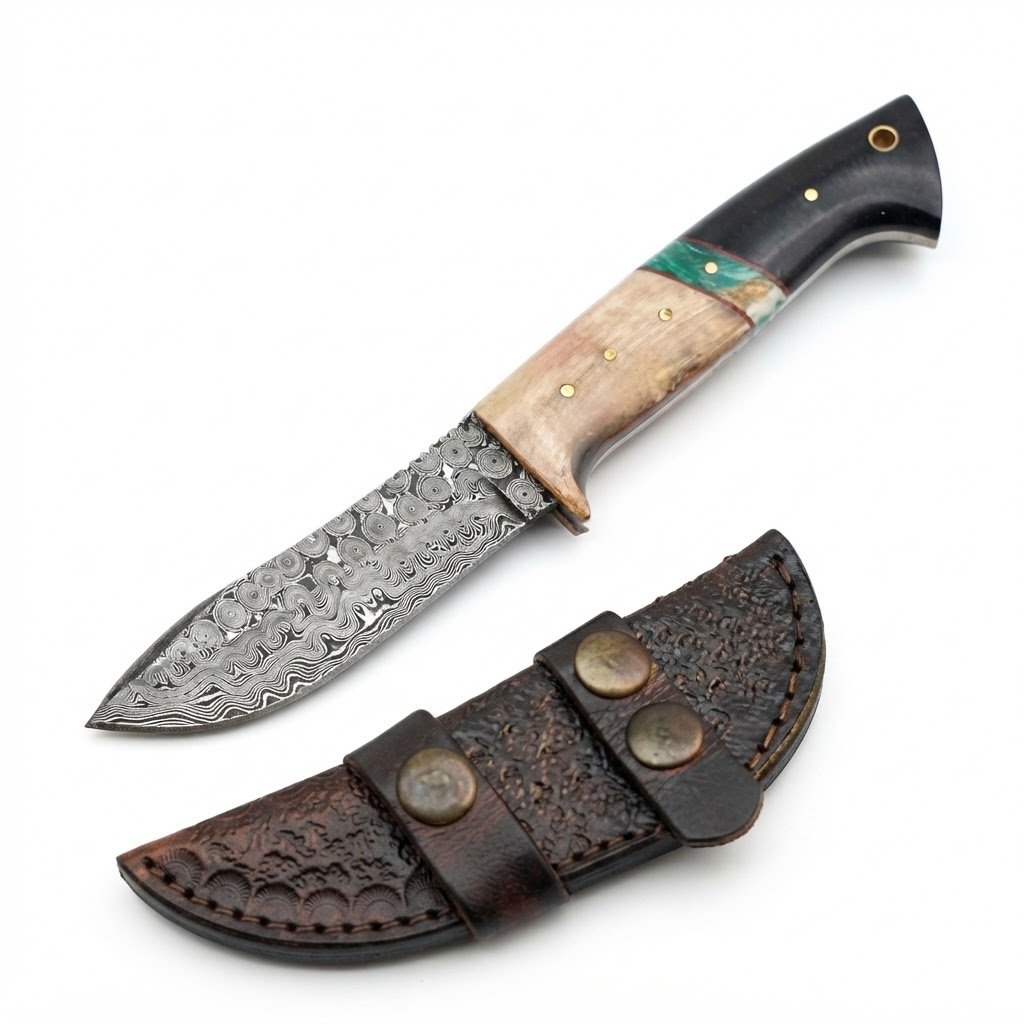
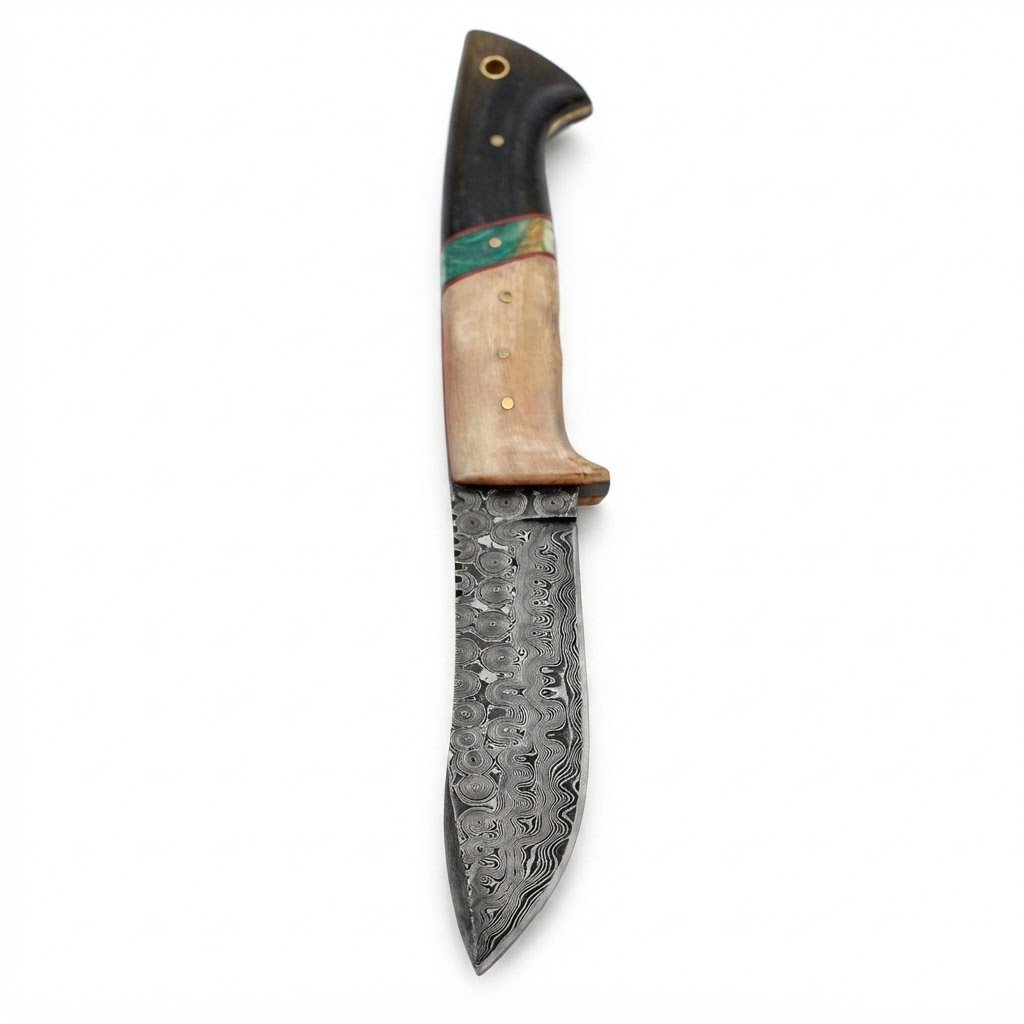
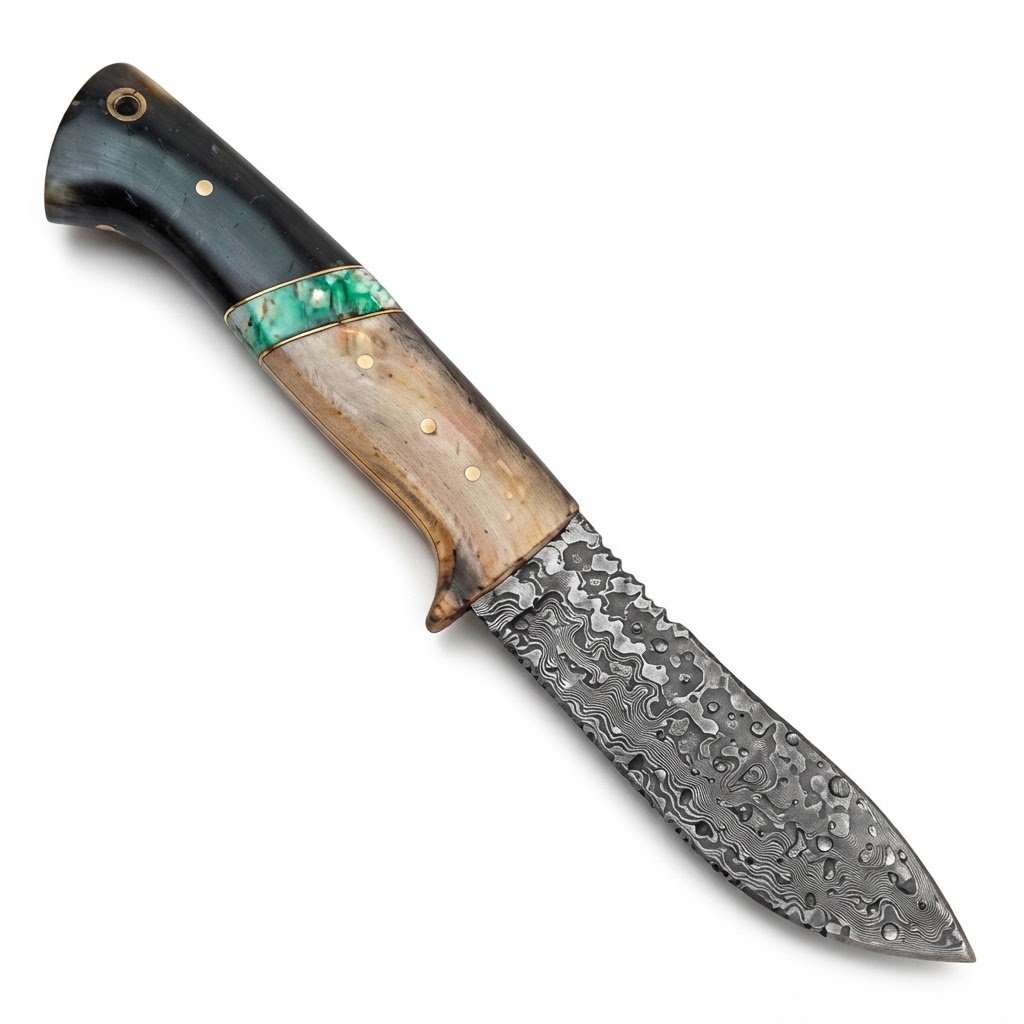
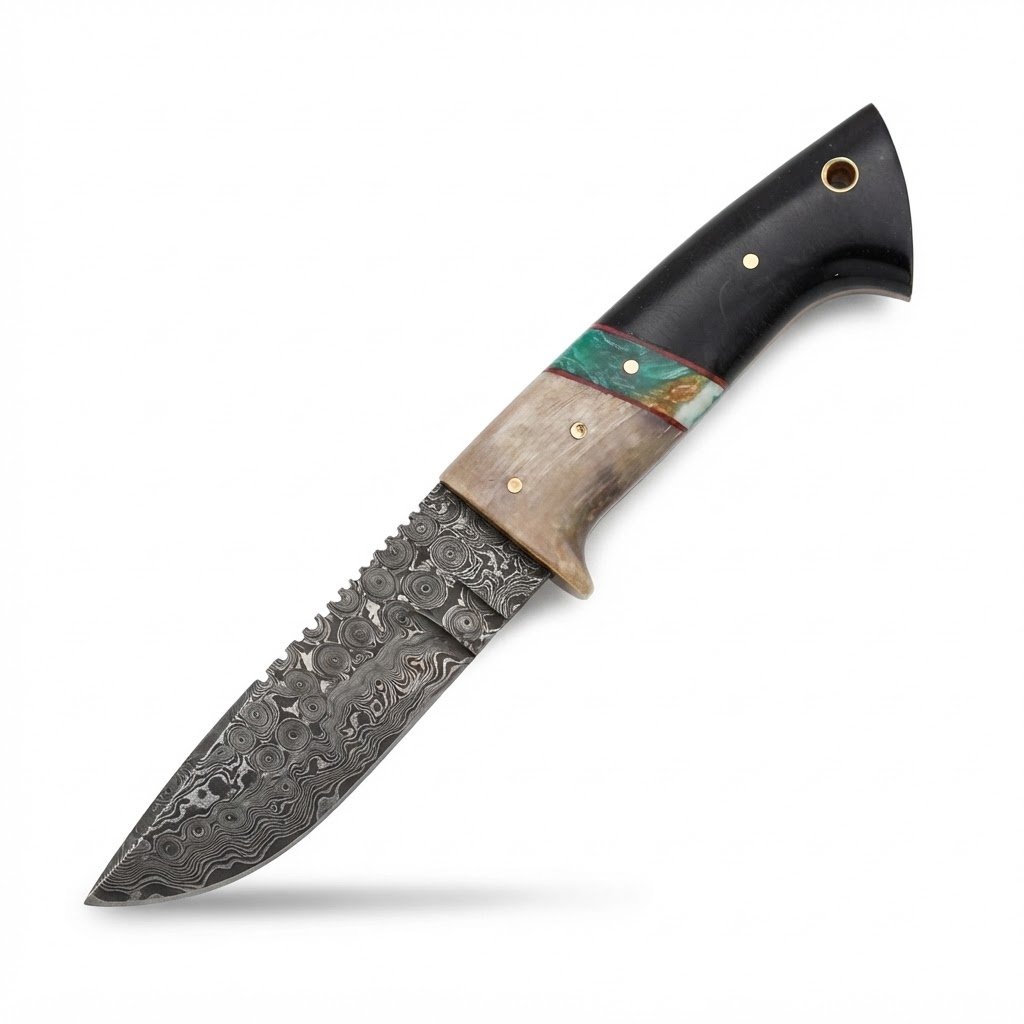
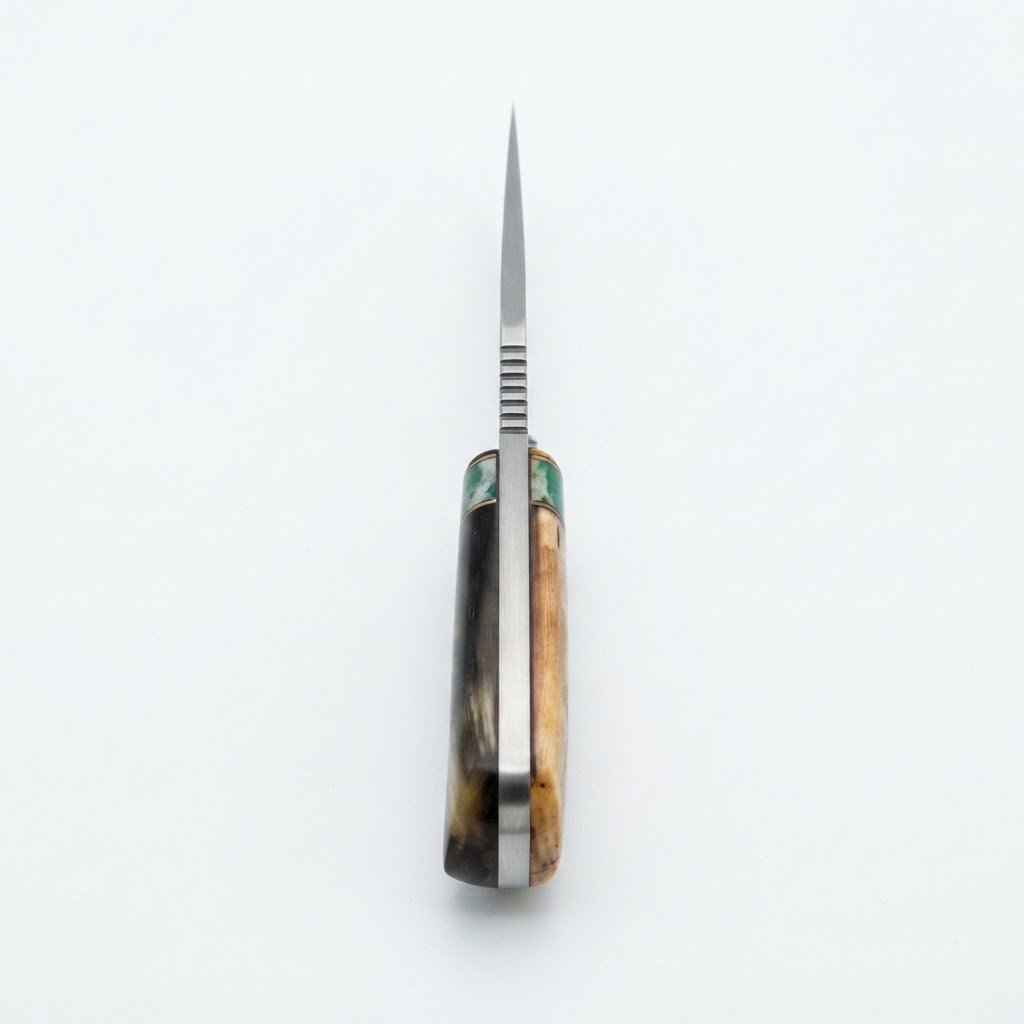
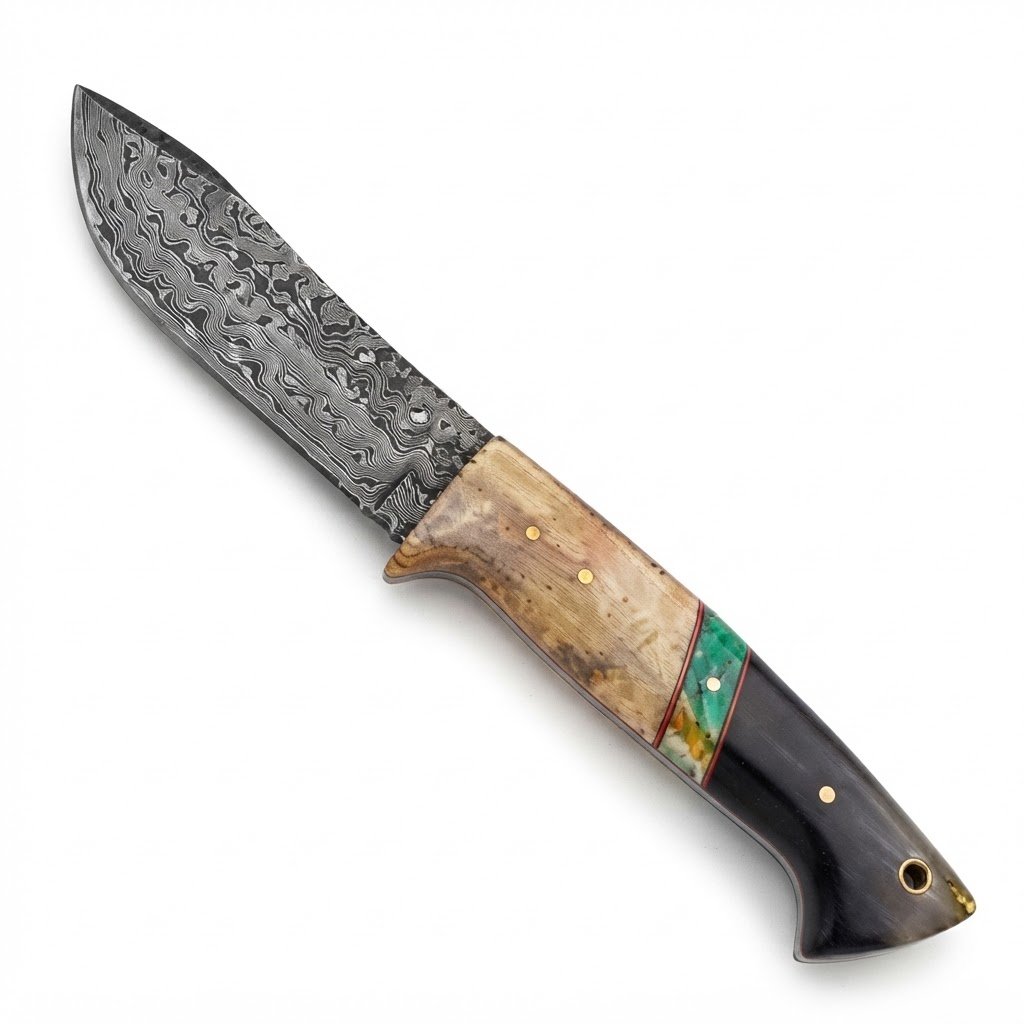
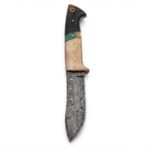
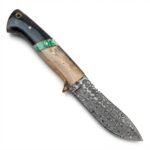
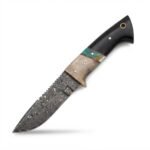
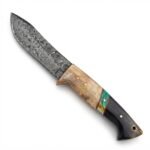
This teal accent fixed blade knife combines a patterned blade with a distinctive three-section handle. A pale cream-beige front leads into a mottled teal band, followed by a curved black rear section. Small gold-tone pins connect the contrasting colors visually, while a lined lanyard hole sits near the handle’s flared end.
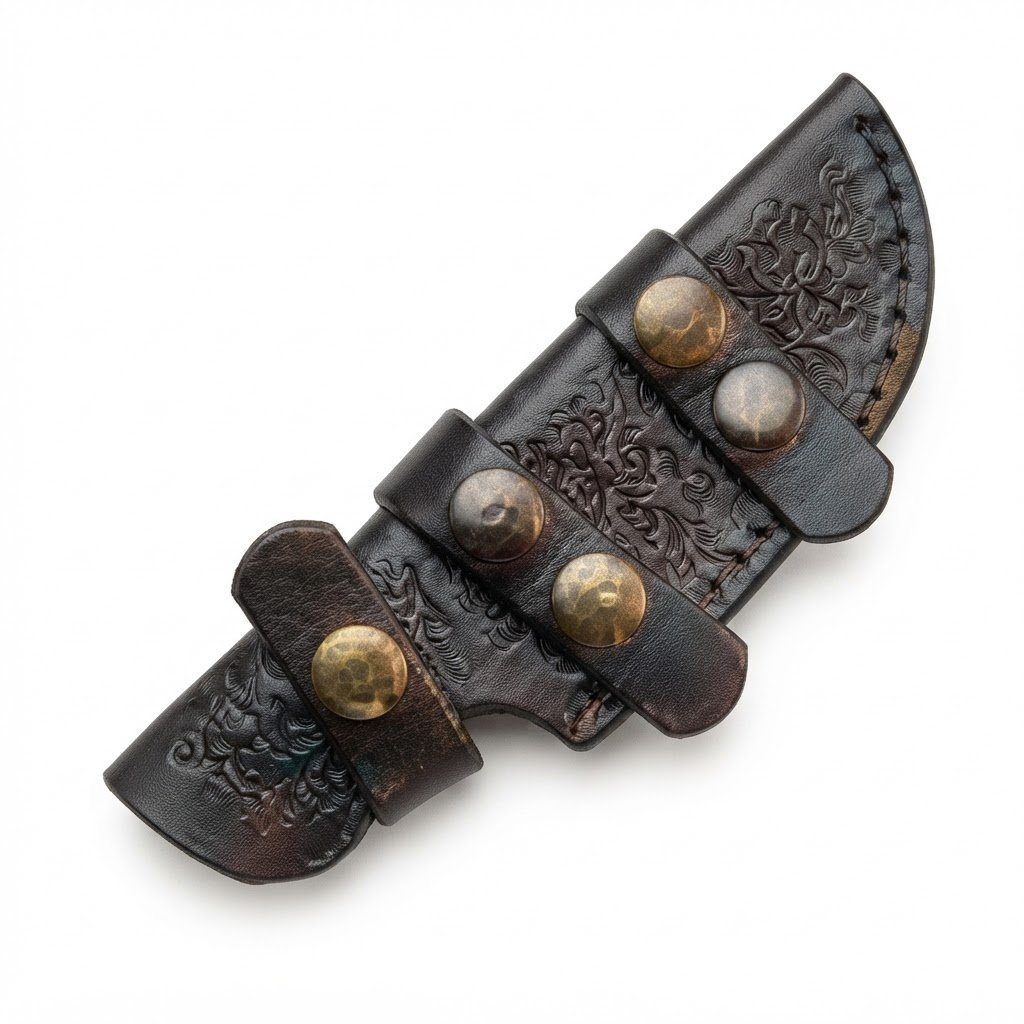
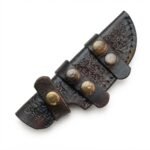
The blade adds another layer of detail through its circular markings and closely spaced flowing lines. Beside the knife, the photograph shows a dark brown decorated sheath with perimeter stitching, two straps, and round metal fastener caps. Together, the pictured pieces have a traditional-looking palette with a small, brighter accent at the center of the grip.
The design is visually distinctive without relying on visible branding. Its main points of interest are the blade pattern, the contrast between the light and dark handle sections, and the shape of the grip. The teal band provides a clear identifying detail that separates it from simpler two-tone designs.
The image establishes appearance, but it does not establish technical specifications. Blade composition, handle materials, dimensions, construction, and sheath inclusion need confirmation for the exact item supplied. The following description explains the visible features and the purchasing details that matter when comparing this knife with alternatives.
A Broad Blade with a Curved Plain Edge
The knife has a fixed blade with a broad rear section that narrows toward a pointed tip. The cutting edge follows a gentle curve, creating a flowing outline rather than an abrupt angular transition.
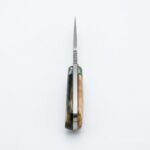
No serrations or gut hook are visible. The blade face remains largely uninterrupted, allowing its pattern to be seen across most of the exposed surface. Near the handle, a small lower projection marks the transition between blade and grip.
The blade is clearly separate from the handle in color and finish, but there is no folding joint or pivot. Its outline is consistent with a general fixed-blade outdoor-style knife. More specific task suitability cannot be established from shape alone.
The photograph also provides no reliable scale reference. The blade may look compact in relation to the handle, but its actual length and thickness cannot be measured accurately from this view.
For a practical purchase, those measurements are important. They help determine whether the knife’s proportions match your expectations and whether its design is suitable for the manufacturer’s stated purpose. The visible profile is a useful starting point, while the specification provides the information needed to assess function.
Circular and Flowing Blade Patterns
The blade’s upper area contains repeated circular markings with fine rings around darker centers. These forms vary in size and spacing, creating a detailed surface rather than a single uniform motif.
Lower on the blade, the circular forms transition into closely spaced wavy lines. These follow the general direction of the cutting edge and continue toward the tip. The contrast between light lines and darker areas makes the pattern easy to distinguish.
The result is a layered-looking appearance often associated with Damascus-style knives. That resemblance does not, by itself, prove genuine pattern-welded steel or identify the method used to create the finish.
The accurate image-based description is therefore a patterned blade with circular and flowing markings. A steel grade, layer count, forging method, or heat-treatment specification should only be added when confirmed for this exact product.
The pattern’s appearance also does not establish sharpness, edge retention, corrosion resistance, or toughness. Those are separate material and performance properties.
For buyers who appreciate decorative blades, the visible pattern offers clear aesthetic interest. For buyers who also prioritize metallurgy, the next step is to review the documented construction rather than relying on the photograph to answer both questions.
Cream-Beige Front Handle Section
The front portion of the handle has a pale cream-to-beige appearance with warmer brown areas and subtle streaking. Its surface is not a single flat color; the variations give it an organic-looking character.
This lighter section occupies most of the grip nearest the blade. Three gold-tone pins are visible along it, creating a simple line of small accents across the pale background.
The lower outline curves inward near the front, forming a noticeable recess behind the blade. Farther back, the handle becomes more continuous before meeting the teal band.
Although the material has a natural-looking appearance, the photograph does not confirm bone, horn, wood, resin, or another substance. It should not be labeled camel bone, stabilized wood, or any specific material without supplier documentation.
Describing the color and markings gives customers an accurate impression of the pictured knife without turning a visual resemblance into a material claim.
This front section also establishes the lightest area of the handle. Its contrast with the black rear gives the knife a recognizable two-tone foundation, while the teal band adds a third color between them.
A Mottled Teal Accent Band
The teal band is one of the most distinctive details in the image. It sits between the cream-beige front and the black rear, creating a narrow but noticeable color transition.
Its surface contains green-blue areas mixed with lighter cream and warm brown patches. This mottled appearance gives the band more visual variation than a solid strip of color.
Thin reddish-brown dividing lines are visible along its boundaries. These help define the band against the neighboring sections and add a subtle warm accent around the cooler teal tones.
A single gold-tone pin sits within the band. Its color matches the other pins and visually connects this smaller section with the rest of the handle.
The photograph does not establish whether the band is stone, resin, dyed material, or another component. In particular, its turquoise-like color is not evidence that it contains turquoise stone.
For customers choosing by appearance, the band provides a useful identifying feature. When confirming an order, the mottled teal treatment should be matched to the supplied product rather than replaced by a generic description such as “green handle.”
Curved Black Rear Section
The rear of the handle is black or very dark charcoal, with visible highlights following its curved surface. It contrasts strongly with the pale front section and gives the handle a darker finish at the butt.
The outline broadens toward the end, creating a flared shape. Along the lower edge, the grip curves inward before widening again near the butt. This makes the rear more sculpted than a simple straight handle.
A small gold-tone pin is visible in this section, along with the larger lined opening near the end. These details stand out clearly against the dark background.
The image does not confirm whether the black material is horn, resin, wood, or a composite. Its apparent smoothness also does not establish how it will feel in the hand.
Comfort and grip depend on thickness, dimensions, finish, balance, and hand size. The handle can accurately be described as contoured, but guaranteed ergonomic or non-slip performance would require further evidence.
For a buyer comparing designs, the flared rear and curved lower edge are useful visual distinctions. Handle measurements are still needed to determine personal fit.
Five Gold-Tone Pins and a Lined Lanyard Hole
Five small gold-tone pins are visible on the photographed side: three in the cream-beige front, one in the teal band, and one in the black rear.
Their placement creates a repeated detail across all three handle sections. This helps the contrasting materials or finishes appear coordinated rather than visually disconnected.
Near the butt, a larger circular opening has a gold-tone lining. Its position is consistent with a lanyard hole, although no lanyard or cord is shown.
The photograph establishes the color and arrangement of these fittings, but not their composition. They should be called gold-tone rather than brass unless the supplier confirms the metal.
Likewise, the pins do not independently prove full-tang construction or a particular fastening method. A metallic-looking strip is visible along part of the handle perimeter, but the complete internal structure is not shown.
If attaching a cord matters to your intended setup, confirm the hole diameter and the manufacturer’s guidance. The image identifies the opening, but it cannot provide its measurements or establish compatibility with a particular accessory.
Brown Decorated Sheath Shown Beside the Knife
The photograph includes a dark brown sheath positioned separately below the knife. It has a curved outline, a stitched perimeter, and an embossed-looking surface with several decorative impressions.
The brown finish varies from lighter areas to deeper, almost black sections. This gives it an aged-looking appearance, although the image does not establish whether that effect is part of the original finish or simply a result of lighting and surface variation.
Two dark straps cross the visible face. One has a single round metal fastener cap, while the other shows two. The caps have a muted bronze-like appearance rather than a bright polished finish.
These are visible details, but the photograph does not fully establish how the straps function. Their presence should not be treated as proof of a particular belt-carry orientation, retention system, or quick-release mechanism.
The sheath has a leather-like appearance, but genuine leather, leather grade, and manufacturing method remain unverified. “Decorated brown sheath” is the supported description.
Its inclusion in the purchase also needs confirmation. A pictured accessory should only be promised as part of the package once the seller establishes that it is supplied with the knife.
What to Check About Sheath Fit
The sheath is shown beside the knife rather than with the blade seated inside it. That means the photograph does not demonstrate fit, depth of coverage, or retention.
If the sheath is included, confirm that it is made for the exact knife model. A similar outline is not enough to establish a secure fit.
The opening, internal construction, and reverse side are not clearly shown. Additional images would be useful for understanding how the knife enters the sheath and how the straps are intended to be used.
For customers who need a carry system, belt compatibility and attachment dimensions should also be checked. The visible straps alone do not establish those measurements.
These details matter because the sheath is both a separate component and part of the overall product presentation. Its decorative appearance is clear, while its functional specification requires further information.
A Coordinated Design with Warm and Cool Colors
The knife brings together a pale handle front, a dark rear, a cool teal accent, and warm gold-tone fittings. The blade remains within a silver-gray and black palette, while the pictured sheath adds deep brown tones.
This combination gives the product visual variety without making every section brightly colored. The teal band is the strongest color accent, but its narrow width keeps it from overwhelming the grip.
The blade pattern and sheath decoration also differ in character. The blade uses fine circles and flowing lines, while the sheath has a more textured, stamped-looking surface.
The handle provides a simpler area between those detailed elements. Its larger blocks of color make the overall presentation easier to read.
For a customer choosing primarily by style, this balance is one of the design’s clearest attractions. It offers several decorative details while maintaining a consistent palette.
Exact color appearance may vary with lighting and screen settings. The supplied photograph should be treated as the visual reference, not as a guarantee that every tone will look identical under all conditions.
For Collectors and Buyers Who Appreciate Decorative Knives
This design may appeal to fixed-blade enthusiasts who enjoy contrasting handle sections and detailed blade finishes. The cream, teal, and black arrangement gives it a recognizable appearance, while the five-pin layout adds a consistent hardware detail.
It may also interest gift shoppers looking for a knife with more visual character than a plain blade and single-color grip. The pictured brown sheath contributes to the presentation, subject to confirmation that it is included.
No gift box, display stand, certificate, or maker’s documentation is visible. These items should not be assumed from the product’s decorative appearance.
The image also does not establish a brand, model name, country of origin, or handmade production. Those details can matter to collectors and should be verified separately.
For a purchase based on craftsmanship or provenance, request information about the maker and construction of the exact knife. Appearance can establish personal preference, but it cannot establish origin or manufacturing history.
Considering Practical Use
The knife belongs to the fixed-blade category and has an outdoor-style profile. Specific suitability for camping, hunting, carving, food preparation, or other activities remains unverified.
A working knife should be assessed using the manufacturer’s stated purpose together with its dimensions, steel, construction, and edge geometry.
The curved plain edge is visible, but its sharpening angle, thickness behind the edge, and current sharpness are not. These factors affect how a knife performs and cannot be inferred reliably from the blade pattern.
Handle dimensions and weight are also important. The curved grip may look suitable for your preferences, but actual fit depends on measurements and handling experience.
If a sheath is needed for your intended use, its compatibility and retention should be part of the same assessment. The attractive presentation does not replace those practical checks.
This approach allows you to appreciate the knife’s design while making a separate, informed decision about whether its confirmed specification meets your needs.
Specifications to Confirm Before Ordering
The most useful measurements are overall length, blade length, blade thickness, handle length, and weight. Together, they establish the size and proportions that the photograph cannot provide.
Blade composition should be stated precisely. If the knife is advertised as Damascus steel, request details that apply to this model rather than a general explanation of Damascus-style knives.
The handle’s three sections should also be identified by material if they use different components. Cream, teal, and black describe appearance, not composition.
Tang construction and fitting materials should be confirmed if they are included among the product’s selling points. Visible perimeter metal and pins are not sufficient evidence for a complete construction claim.
Finally, confirm package quantity, sheath inclusion, and any available options. The image shows one knife and one sheath, but it does not establish customization, alternative colors, or the contents of every order.
These specifications are the remaining information needed to turn the visual description into a complete technical listing.
Care Information
No manufacturer-approved care instructions are available from the photograph. Cleaning, sharpening, polishing, and storage guidance should follow the confirmed blade, handle, and sheath materials.
The blade’s decorative pattern should not be assumed to tolerate abrasive polishing or a particular chemical cleaner. The appropriate treatment depends on how the finish was produced.
The same applies to the handle’s contrasting sections. Different materials may require different care, even when they are fitted together in one grip.
Dishwasher suitability, corrosion resistance, and water resistance have not been verified. These should not be advertised as product benefits without supporting information.
For sharpening, use the maker’s recommended method and angle once those details are available. Neither can be determined accurately from the image.
Store the knife securely with an appropriate edge cover and keep it out of children’s reach. If the pictured sheath is supplied, follow the manufacturer’s guidance for its intended storage or carry use.
Choose the Design with the Details You Value
The teal accent fixed blade knife combines a patterned blade, a pale contoured handle front, a mottled color band, and a flared black rear section. Gold-tone fittings connect the handle visually, while the pictured brown sheath adds a separate decorated element.
Its strongest confirmed qualities are its visible design and coordinated colors. The technical specification and package contents remain the information needed to assess practical suitability.
Explore the photographed details, confirm the materials and measurements, and select this design if it matches the appearance and intended use you are looking for.







Reviews
There are no reviews yet.