




Black handle hunting knife with a classic appearance
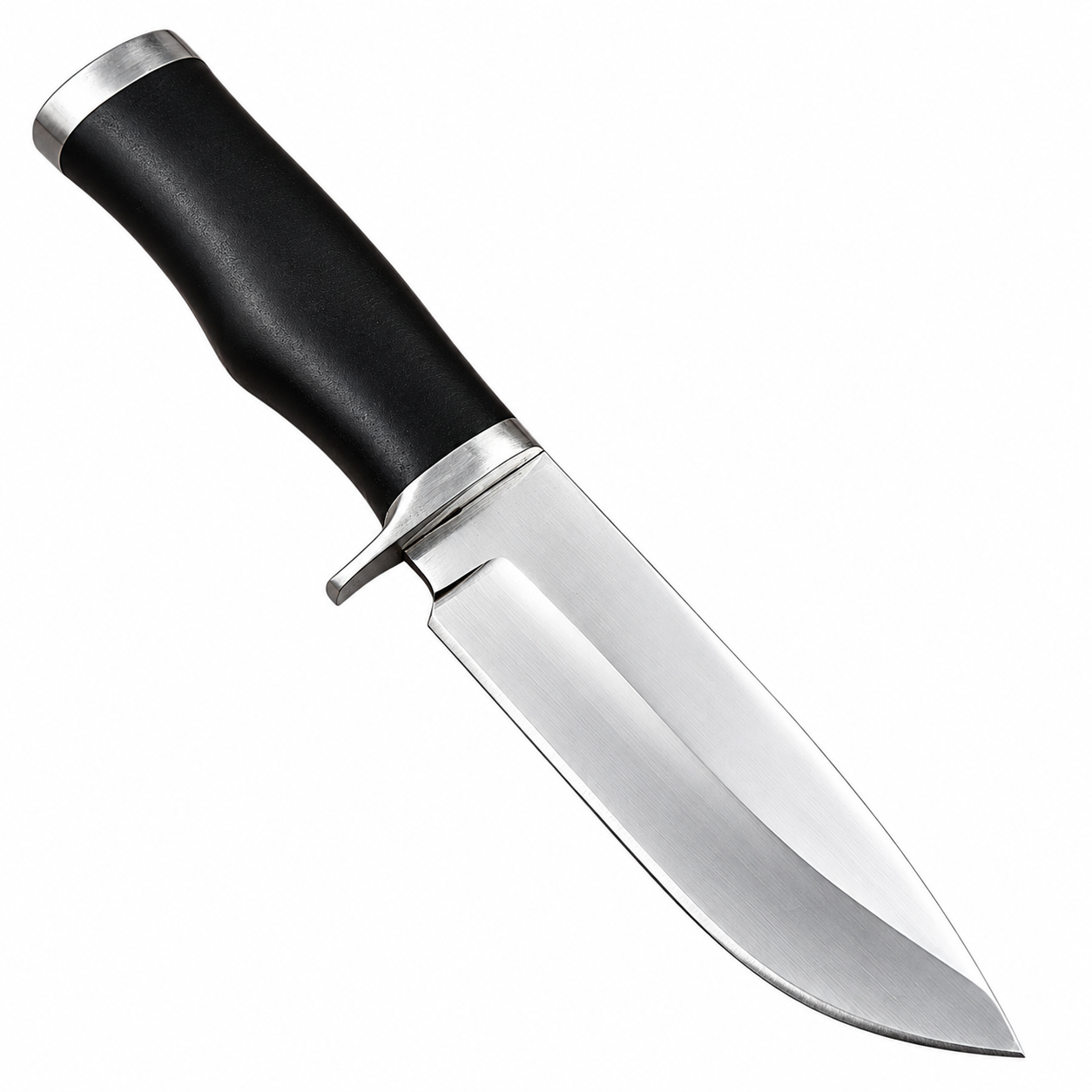
This black handle hunting knife pairs a plain silver-coloured blade with a contoured black grip and matching silver-tone fittings. Its appearance is straightforward: the blade has a satin-like surface, the handle has subtle texture, and the guard creates a clear transition between them.
The fixed-blade profile includes a curved cutting edge and a pointed tip. A broad bevel is visible across the lower blade face, giving the blade definition without decorative patterns or coloured coatings. At the opposite end, a silver-tone cap finishes the handle and echoes the colour of the guard.
For customers who prefer an understated knife, this design offers a clear alternative to brightly coloured handles and patterned blades. The photograph establishes its visible features; exact materials, measurements, construction, and performance specifications remain unverified.
A fixed-blade configuration
The knife shown has a fixed-blade configuration, with the blade extending directly from the handle assembly. There is no visible folding pivot, opening stud, or locking mechanism. The overall shape remains continuous from the handle to the tip.
This layout is familiar in hunting-style knives and other outdoor cutting tools. It gives the design a clearly defined blade section, guard, grip, and rear cap. Each part is visually separate while contributing to a consistent black-and-silver appearance.
The photograph does not show the internal assembly. It therefore cannot confirm full-tang, hidden-tang, or another construction method. Buyers who need a particular tang configuration should obtain that information from the manufacturer rather than relying on the presence of a guard or end cap.
Plain blade with a satin-like surface
The blade has a bright silver-grey appearance with fine directional surface marks. These give it a satin-like finish rather than a mirror reflection. There are no visible decorative engravings, Damascus-style patterns, or printed graphics on the photographed face.
A plain surface makes the blade’s outline and bevel easier to distinguish. The broad lower section reflects light differently from the upper face, creating a clear visual boundary. This contributes to the knife’s restrained, functional appearance.
The finish does not identify the blade’s alloy. Stainless steel, carbon steel, a specific grade, or a protective treatment cannot be confirmed from colour and surface texture alone. Those details should come from a reliable specification sheet for this exact product.
Curved cutting edge and pointed tip
The lower cutting edge follows a broad curve toward the tip. The upper outline also narrows toward the point, producing a tapered profile without a visible gut hook or serrated section. The resulting shape is consistent with a general hunting-style fixed blade.
Customers comparing knives can use this outline to judge their preference for blade shape. The curved forward section differs from a straight utility edge or an angular tanto-style profile, while the pointed tip gives the blade a distinct finish.
The photograph cannot establish tip thickness, cutting angle, or the final edge condition. It also provides no scale reference. Blade dimensions should be checked before deciding whether this profile suits a particular working task, storage arrangement, or personal preference.
A broad, clearly visible bevel
A pronounced bevel occupies much of the lower blade face. Its transition begins near the handle and continues toward the tip, creating a strong line that follows the blade’s shape.
This visible geometry is part of the knife’s appearance, but it does not prove a particular grind type or sharpening standard. A photograph taken from one side cannot reliably establish whether the surfaces are flat, hollow, or subtly convex.
For a practical purchase, ask about the supplied edge condition and any recommended preparation before first use. Terms such as “razor sharp,” “precision sharpened,” or “ready for heavy-duty work” would require evidence beyond the image. The listing therefore describes the visible bevel without promising untested performance.
Contoured black handle
The handle is black with a fine, slightly pebbled-looking surface. Its shape widens through part of the grip and narrows near the front, creating a gentle contour rather than a straight cylindrical profile.
This gives the handle a distinct outline while keeping the appearance simple. There are no visible decorative pins, coloured inserts, or large logos on the photographed side. The dark surface allows the silver-tone fittings to stand out clearly.
The handle material is not confirmed. It could not accurately be labelled rubber, polymer, resin, wood, or another material from this image alone. Similarly, the visible texture does not establish a non-slip rating, cushioning, moisture resistance, or comfort during extended use.
Assessing handle fit
A contoured handle can look comfortable in a product photograph, but actual fit depends on its length, thickness, cross-section, and the user’s hand size. Those measurements are not supplied here.
The image gives a useful side view of the grip’s shape. It does not show the complete circumference or reveal how rounded the back and underside are. Additional photographs from the spine and end would provide a fuller understanding of its proportions.
Customers choosing a working knife may find it useful to compare verified handle measurements with a tool they already enjoy using. That comparison provides a more dependable basis for assessing fit than estimating size from a close-up photograph.
Silver-tone guard
A silver-tone guard sits between the blade and handle, with a short projection extending below the grip. Its surface coordinates with the blade and rear cap, maintaining the knife’s consistent colour scheme.
The guard creates a visible boundary at the front of the handle. Its modest size also suits the overall design, adding a defined junction without introducing a large crossguard or elaborate decoration.
The photograph does not establish its alloy, attachment method, or tested performance. It should not be described as preventing all hand movement or guaranteeing safe handling. What can be confirmed is its position, silver-tone appearance, and projecting shape beneath the blade junction.
Matching rear end cap
A silver-tone cap finishes the rear of the handle. It follows the end’s outline and provides a bright contrast against the black grip, balancing the similar fitting at the front.
This repeated silver tone gives the handle a framed appearance. The cap is visually simple, with no obvious lanyard opening, decorative engraving, or pointed attachment shown. It contributes to the knife’s traditional styling without becoming a dominant feature.
Its internal function is not visible. The cap does not prove a through-tang assembly, and it should not be advertised as a hammering surface or glass breaker. Such features would require explicit manufacturer confirmation for this model.
A restrained black-and-silver design
The knife’s colour scheme is limited to black and silver-grey. This keeps attention on its proportions, blade outline, and handle contour rather than on decorative materials or patterns.
The subtle texture of the grip contrasts with the smoother-looking blade and fittings. That difference gives the design visual interest while preserving its uncomplicated appearance. Customers who prefer plain equipment may find this combination particularly appealing.
There is no visible brand name on the photographed face. This does not establish that the knife is unbranded in every area, but it means the supplied view presents a clean surface without prominent lettering. The reverse side and any packaging have not been shown.
Choosing it for practical use
The product has the appearance of a hunting-style cutting tool. Whether it is suitable for a particular outdoor task depends on verified specifications, including blade steel, heat treatment, hardness, dimensions, and handle construction.
Customers purchasing for hunting, camping, or general utility work should check the manufacturer’s intended applications. These uses can involve different demands, so appearance alone is not enough to confirm suitability.
A plain blade and a substantial-looking handle do not demonstrate edge retention, corrosion resistance, toughness, or balance. Those are performance characteristics that require reliable product information or testing. The visible design provides a starting point for comparison, while technical details should guide the final functional choice.
For collectors and gift buyers
This design may interest collectors who appreciate conventional fixed-blade forms and simple colour combinations. Its plain blade provides a different visual character from decorative or patterned examples, while the silver-tone fittings give the black handle a finished appearance.
For a gift, consider the recipient’s preferred knife type and dimensions. Someone who collects traditional hunting-style knives may value this outline, but a buyer seeking a particular steel or documented maker will need additional information.
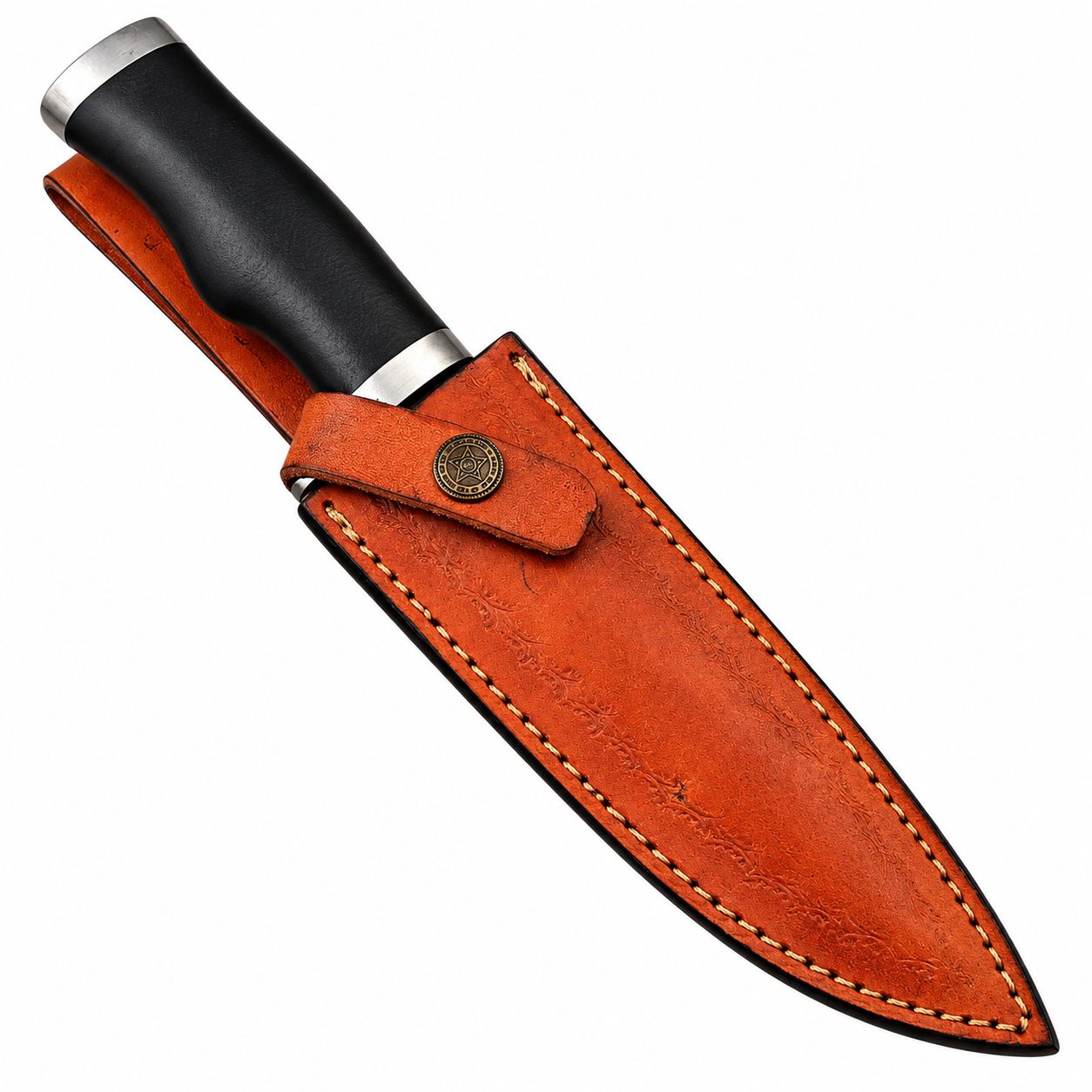
No presentation box, engraving option, certificate, or personalised service is confirmed. A sheath is also absent from the image. Check the actual package contents before arranging a gift so that the delivered product matches your expectations.
Measurements and package contents
Confirm overall length, blade length, maximum blade width, blade thickness, handle dimensions, and weight before ordering. These figures support meaningful comparisons with other knives and help determine appropriate storage.
The supplied photograph shows one knife on a white background. No sheath, case, lanyard, sharpening accessory, or additional item is pictured. The image therefore does not establish that any accessory accompanies the product.
If a sheath is offered separately or included by the seller, check that it is fitted to this exact model. Compatibility depends on the knife’s dimensions and profile, including the guard. A sheath for a similar-looking knife may not provide an appropriate fit.
Care and maintenance information
The correct maintenance routine depends on the blade and handle materials, which are not verified here. A bright blade should not automatically be treated as stainless, and a black handle does not identify a particular synthetic material.
Request the manufacturer’s cleaning, drying, and storage recommendations before applying oils, solvents, polishing compounds, or handle treatments. The appropriate products should match the actual surfaces and finishes.
Sharpening guidance should also relate to the confirmed blade geometry and material. No specific bevel angle or maintenance system is established by the photograph. Having those details available before purchase helps buyers understand the ongoing care the knife may require.
Review the visible features
The image confirms a fixed blade with a curved plain edge, a pointed tip, and a satin-like silver surface. It also shows a contoured black handle, a projecting silver-tone guard, and a matching rear cap.
The steel grade, handle composition, tang construction, hardness, dimensions, and supplied accessories remain unconfirmed. Keeping those details separate from the visible features allows the product to be assessed without relying on assumptions.
Explore the profile, finish, and handle design, then review the verified specifications to decide whether this black handle hunting knife suits your collection or intended use.







Reviews
There are no reviews yet.