


Black Serrated Spine Hunting Knife with Contoured Handle
The Black Serrated Spine Hunting Knife features a distinctive dark-finish blade, an ergonomically shaped finger-groove handle, and a matching black protective sheath. Designed with an outdoor-inspired fixed-blade profile, this knife combines a bold, understated appearance with practical-looking structural details. Its broad blade, notched spine, smooth cutting-edge profile, and contoured grip give it a recognizable design that appeals to knife enthusiasts and collectors.
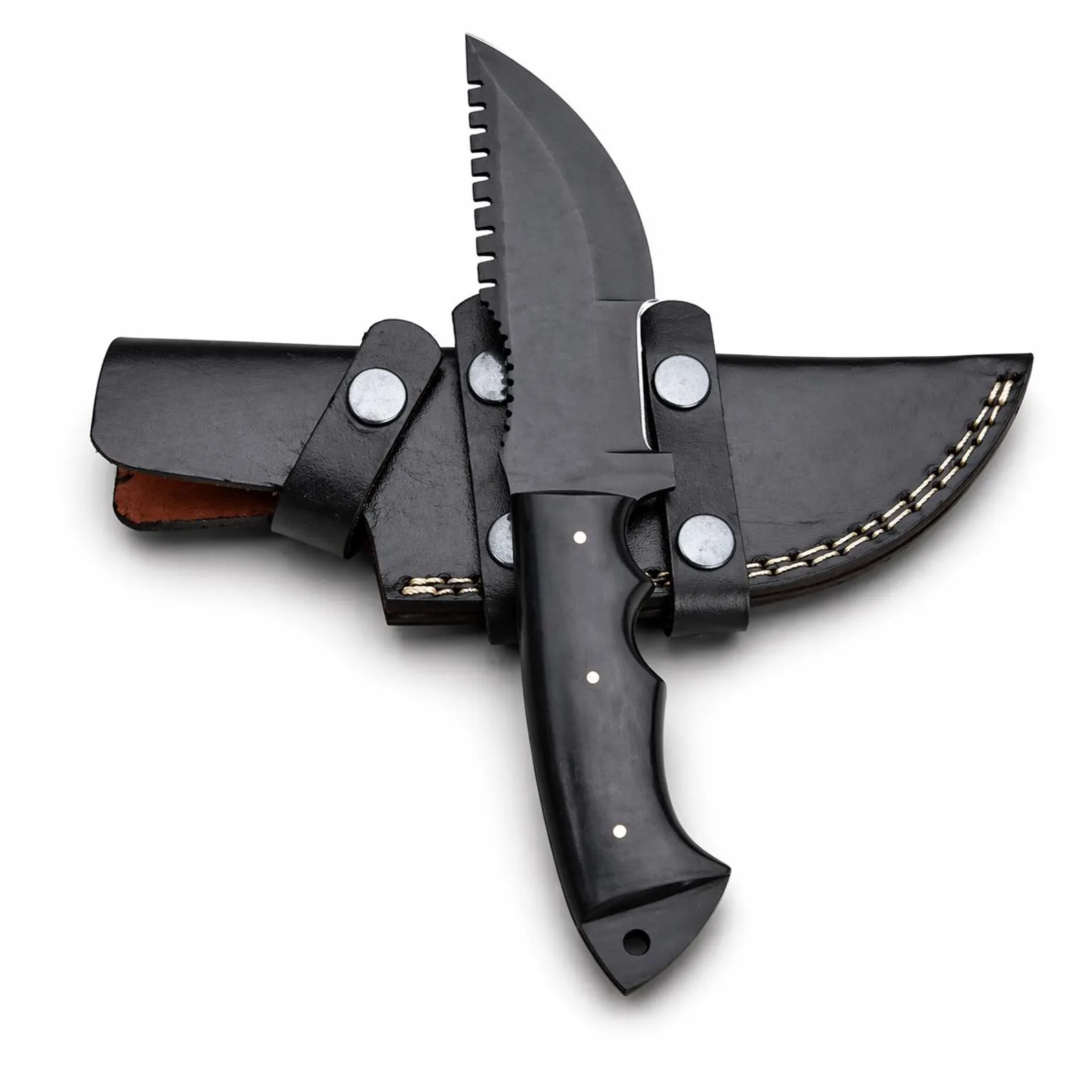
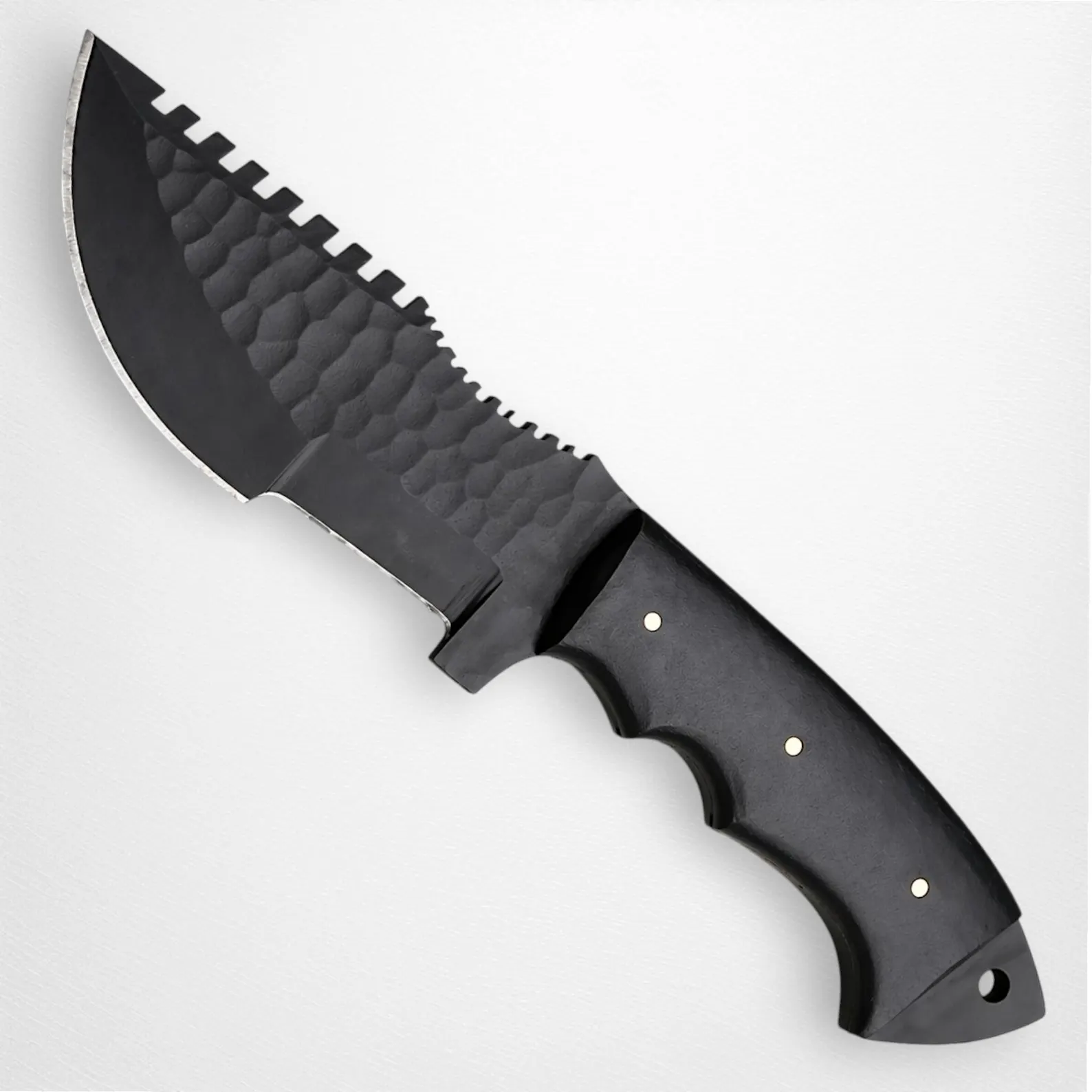
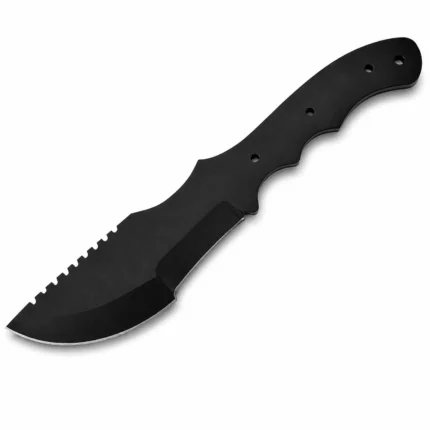
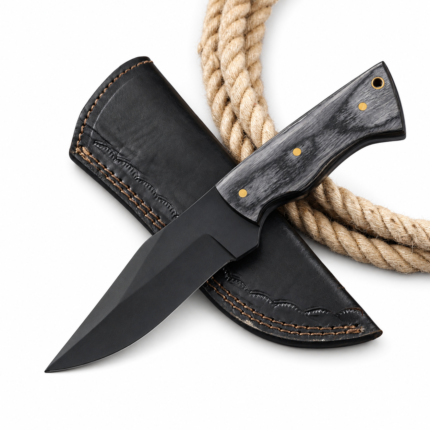
The knife is shown against a clean white background, making its black finish and individual components easy to see. A curved upper blade profile extends toward a pointed tip, while the cutting side has a continuous, plain-edge appearance. Small rectangular notches are visible along the rear section of the blade spine. The handle includes several finger contours, round metal-colored pins, and a hole at the lower end.
Beside and beneath the knife is a black sheath with pale stitching around its curved edge. Multiple straps with silver-colored snap fasteners are visible, giving the sheath a secure, structured appearance.
This combination of contrasting surfaces and carefully arranged components makes the knife particularly noticeable to customers interested in traditional fixed-blade designs with contemporary black styling.
Distinctive Black Blade Finish
One of the most recognizable features of this knife is its dark blade.
Rather than a polished silver appearance, the visible surface has a matte-looking charcoal-black finish. This creates a consistent visual connection with the handle and sheath.
The dark metal surface extends from the blade tip toward the handle, making the knife appear visually unified.
Subtle changes in tone can be seen across the blade face. These tonal differences help define the broad bevel and curved blade profile.
The appearance is relatively simple compared with knives that feature elaborate engravings or decorative multicolor patterns.
This makes the product an appealing choice for customers who prefer minimal dark styling.
The exact finishing process cannot be established from the photograph. The black color may result from coating, oxidation, or another manufacturing treatment.
The manufacturer should confirm the finish before claims are made about corrosion resistance, scratch resistance, or coating durability.
Broad Curved Fixed-Blade Profile
The knife has a broad blade that gradually narrows toward a pointed tip.
Its cutting side follows a curved profile, while the upper section rises more prominently near the tip.
The result is a strong-looking silhouette that differs from narrow utility or fillet knives.
The blade width is especially noticeable close to the handle, where the metal forms a broad transition into the narrower grip.
A continuous cutting edge appears along the underside of the blade.
The curved blade design contributes to the knife’s outdoor-oriented appearance.
However, blade geometry alone cannot establish cutting performance. The actual edge sharpness, thickness, grind, and heat treatment would need to be confirmed through manufacturer specifications or physical inspection.
The image does not provide a reliable measurement of blade length or overall knife size.
Notched Spine Design
The back of the blade includes a row of evenly spaced rectangular notches.
These appear along the section of the spine extending from near the handle toward the upper portion of the blade.
The notches give the knife an immediately recognizable visual detail.
Their repeated spacing creates a textured outline that contrasts with the relatively smooth cutting edge.
This design element is one reason the knife stands out from ordinary plain-spine hunting knives.
Although sometimes described commercially as a serrated spine, the notches should not automatically be advertised as a functional sawback.
Their actual purpose and cutting capability have not been verified.
For accurate product descriptions, the most appropriate terminology is a notched or serrated-style spine.
This distinguishes the visible design from a confirmed saw-tooth cutting feature.
Contoured Black Handle
The knife features a dark, curved handle with pronounced finger-groove contours.
Its profile gradually changes from the upper grip section to the wider lower end.
The curved finger recesses create a distinctive appearance and provide identifiable locations for the fingers.
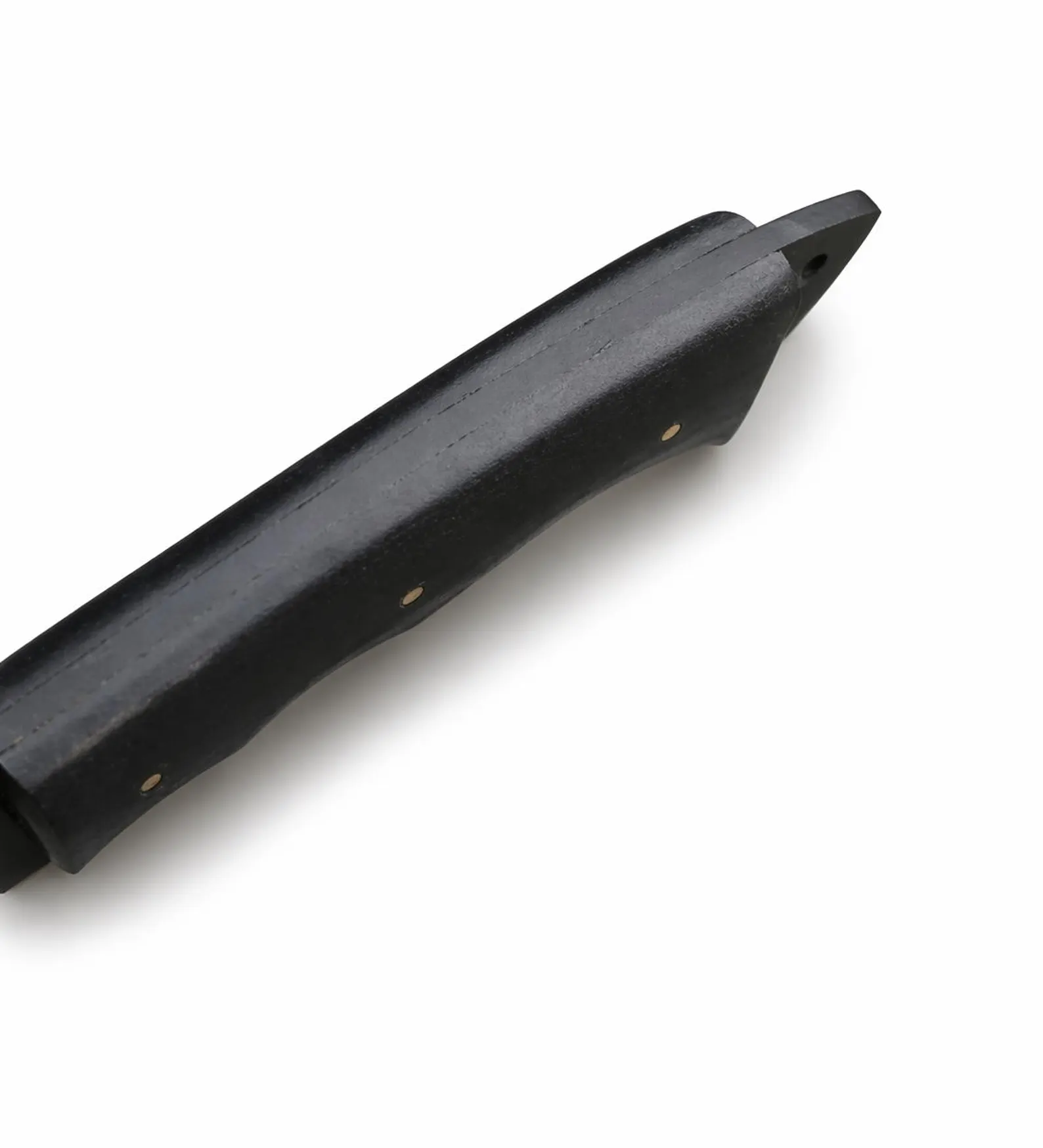
Three small, round, silver-colored pins or fasteners are visible along the handle face.
These add subtle contrast against the black surface.
The handle also has a small opening close to its lower end.
This resembles a lanyard hole commonly seen on outdoor knife designs.
The handle finish appears smooth, with a slight satin-like texture.
The photograph does not establish whether the scales are wood, synthetic material, composite, or another substance.
For that reason, the listing should not claim a particular handle material until it is confirmed.
Finger-Groove Handle Design
Finger grooves are a noticeable element of this knife’s design.
The handle has several curved recesses along one side, creating an asymmetrical profile.
These contours distinguish the product from straight-handled knives.
A raised section near the upper portion of the grip visually separates the handle from the blade.
The lower end curves outward and tapers toward a pointed heel.
This shape provides an interesting combination of straight and rounded surfaces.
While finger grooves are commonly intended to support hand positioning, comfort and suitability vary depending on a user’s hand size and grip preference.
The photograph cannot establish how comfortably the knife fits different users.
Actual grip performance would also depend on handle dimensions, surface texture, weight distribution, and construction.
Visible Handle Pins and End Opening
Three light-colored circular details appear on the handle.
These resemble fastening pins and are spaced along the length of the grip.
Their uniform appearance adds a simple decorative contrast.
The image also shows a small circular hole near the handle’s lower tip.
This may serve as a lanyard attachment point.
However, the exact diameter, construction, and compatibility with specific cords are not confirmed.
The visible handle features make the product easy to distinguish from models with plain, pin-free grips.
The photograph does not reveal the internal tang construction.
Therefore, full-tang construction should not be claimed unless verified through manufacturer documentation.
Black Protective Sheath
A matching black sheath is included in the product photograph.
It has a broad, curved form designed to follow the general outline of the knife.
The sheath’s exterior appears smooth and dark, with a subtle textured finish.
Light-colored stitching runs along the curved outer edge, providing a clear contrast against the black material.
The stitching creates a decorative border around the sheath.
Its curved shape gives the accessory an orderly and coordinated appearance.
Several straps are visible across the sheath, with round silver-colored snap fasteners.
These details suggest a structured retention arrangement.
The exact material cannot be established visually.
Although it resembles leather, the sheath may use natural leather, synthetic leather, or another material.
Until confirmed, it should be described as a leather-style sheath.
Multiple Snap-Fastened Retention Straps
The sheath features several dark retention straps.
Each visible strap is fitted with a round metal-colored snap fastener.
Their placement gives the sheath a detailed, structured appearance.
The straps cross different sections of the sheath rather than appearing as a single decorative band.
This distinguishes it from basic slip-in protective covers.
The presence of fasteners indicates that the sheath includes a closure system.
However, the photograph does not establish the precise method of fastening, belt attachment, or how securely the knife sits when fully inserted.
Any claim about carrying compatibility should be verified by the supplier.
Customers should inspect the sheath and its closures before relying on them for storage.
Matching Dark Color Scheme
The knife and sheath share a consistent black color scheme.
The blade is dark gray to black.
The handle has a deeper black finish.
The sheath has a smooth-looking black exterior with contrasting pale stitching and metallic snap details.
This coordinated appearance gives the product a unified presentation.
The absence of bright decorative colors makes its silhouette and surface details more prominent.
The slight contrasts between matte surfaces and metallic fittings create visual interest without making the design overly elaborate.
Customers who appreciate minimalist outdoor-style knife designs may find this finish attractive.
Its appearance also makes the product readily distinguishable from knives with brightly colored handles, polished decorative blades, or patterned steel surfaces.
Outdoor-Inspired Design
The knife’s proportions and visible structural features resemble designs commonly associated with outdoor fixed-blade knives.
A broad blade, contoured grip, and protective sheath are familiar elements of this product category.
These design features may appeal to customers interested in hunting-style equipment and outdoor accessories.
However, an outdoor appearance does not independently establish suitability for demanding field use.
The steel composition, heat treatment, handle attachment, edge geometry, and sheath construction all affect whether a knife is appropriate for a particular activity.
Those specifications are not available from the photograph.
The product should therefore be described primarily through its visible design until the supplier confirms its performance characteristics.
A Distinctive Collectible Knife
Some customers choose knives for their visual characteristics rather than for demanding practical use.
This design offers several recognizable elements.
The broad dark blade has a pronounced curved shape.
The spine includes repeated rectangular notches.
The handle incorporates finger grooves and contrasting metal-colored pins.
The matching sheath includes multiple retention straps and decorative stitching.
Together, these details create a cohesive fixed-blade design.
Collectors who appreciate black-finish knives may find it an interesting addition to an appropriately secured collection.
The product’s exact collector value, manufacturing origin, and rarity cannot be established from the image.
Those claims should not be added without reliable documentation.
Understanding the Blade Material
The image shows a metal-looking fixed blade with a dark external finish.
It does not establish the alloy used in its construction.
Different knife steels can vary in hardness, toughness, corrosion resistance, and maintenance requirements.
Surface appearance is not a reliable indicator of any specific steel grade.
A dark blade should not automatically be described as carbon steel, stainless steel, or tool steel.
Similarly, a black finish does not confirm protective coating performance.
Manufacturer specifications are needed to identify the material accurately.
Once the supplier provides the steel designation, it can be included in the product attributes and technical description.
Verified information about hardness and heat treatment may also be added where relevant.
Understanding the Handle Construction
The handle’s outer surface has a dark finish.
The visible profile shows several finger grooves and a slightly flared end.
Small circular fittings appear on the grip.
These details can be described confidently, but the underlying construction remains unknown.
The handle might use different materials or assembly methods.
No internal construction is visible in the supplied photograph.
The manufacturer should confirm the handle material, fastening method, and tang configuration.
These specifications are especially relevant to customers comparing fixed-blade knives.
Avoid claiming superior strength, durability, or ergonomic performance without supporting evidence.
Sheath Material and Construction
The sheath appears leather-like, with several snap-fastened straps and contrasting stitching.
Its exterior has a relatively smooth finish.
The inner construction is not visible.
The image does not show any protective lining, reinforcement, or exact belt-loop system.
These details should be checked directly with the manufacturer.
For customers interested in the product’s appearance, the black finish and pale stitching are important distinguishing features.
For customers concerned with carrying and storage, material confirmation and retention details are equally important.
The photograph establishes the presence of the accessory but does not confirm its long-term performance.
Care and Cleaning
Basic care helps preserve the appearance of a knife and its accessories.
After handling, wipe the blade with a soft, clean cloth.
Avoid leaving moisture on the metal surface.
Use cleaning products appropriate for the manufacturer’s confirmed blade material and finish.
Do not use abrasive cleaners that could damage a protective coating.
Clean the handle gently according to the material manufacturer’s recommendations.
The sheath should be stored away from prolonged moisture and excessive heat.
If it is genuine leather, appropriate leather-care products may be suitable.
If it is synthetic, different cleaning methods may be required.
The supplier’s care instructions should take priority.
Storage and Handling
Store the knife in a secure location where accidental contact with the blade is prevented.
Keep it away from children and unauthorized users.
Inspect the sheath for visible damage or loose fasteners before using it for storage.
Avoid touching the blade edge or tip during cleaning and inspection.
If the knife is intended for display, use a suitable enclosure or secure mounting arrangement.
Do not assume that the visible sheath straps provide sufficient protection for every transport or storage situation.
Follow all applicable laws concerning knife possession, sale, and transportation.
Product Specifications to Confirm
Before publishing a complete technical specification table, the supplier should confirm:
- Overall knife length
- Blade length and width
- Blade thickness
- Steel composition
- Blade hardness
- Exact blade finish
- Handle material
- Tang construction
- Handle dimensions
- Total knife weight
- Sheath material
- Sheath retention and attachment method
- Manufacturing origin
- Available packaging
- Intended use and any performance testing
- Available variants and customization options
These details are important because they cannot be established reliably from the image alone.
Why Choose This Black Serrated Spine Hunting Knife?
The Black Serrated Spine Hunting Knife is distinguished by its coordinated dark appearance and clearly defined structural details.
Its broad curved blade provides a recognizable fixed-blade silhouette.
The notched spine adds a distinctive design element.
The contoured handle has pronounced finger grooves, visible circular fittings, and an opening near its base.
The matching black sheath includes light contrasting stitching and several snap-fastened straps.
These features give the product a more detailed appearance than a basic plain-handled knife.
For customers interested in dark-finish knife designs, the combination of the blade, handle, and sheath may be especially attractive.
Explore This Distinctive Fixed-Blade Knife
The Black Serrated Spine Hunting Knife brings together a dark curved blade, notched spine, contoured black handle, and matching stitched sheath.
Its restrained color scheme and identifiable design details make it a distinctive option within the fixed-blade knife category.
Explore this knife’s appearance and request complete manufacturer specifications to determine whether its materials, dimensions, and intended applications meet your requirements.







Reviews
There are no reviews yet.