



Blue Honeycomb Ulu Knife with a Distinctive Crescent Profile
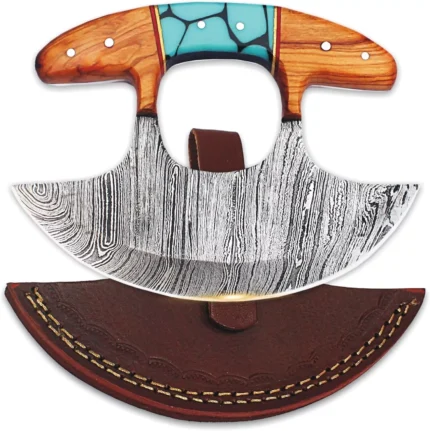
This blue honeycomb ulu knife combines a sweeping crescent-shaped blade, a curved blue handle, and a decorative brown sheath. Its most noticeable feature is the contrast between the vivid handle and the blade’s two-tone appearance. A dark, textured upper surface meets a broad silver-coloured bevel, creating a clear division across the curved blade.
The handle adds another layer of detail through its gold-tone honeycomb pattern and three round matching pins. Behind the knife, the pictured sheath introduces warm brown colouring, decorative impressions, and yellow-orange stitching. Together, these elements create a distinctive presentation for customers who appreciate unusual blade shapes and colourful handle designs.
An Ulu-Style Knife with an Overhead Handle
The knife has an ulu-style arrangement, with the handle positioned above the curved cutting edge. This distinguishes it from a conventional straight knife, where the handle extends behind the blade. The open space between the handle and blade is another defining part of its profile.
Ulu-style knives are associated with a rocking cutting motion. The curved edge allows different portions of the blade to meet a cutting surface as the tool changes angle. That describes the general format rather than verified performance for this particular item. Its suitability for specific cutting tasks depends on confirmed dimensions, materials, edge geometry, and the manufacturer’s instructions.
A Broad, Sweeping Blade
The blade extends in a long crescent, with pointed ends and a continuous curved outer edge. Its shape is more elongated than a compact semicircular ulu, giving the knife a particularly striking silhouette. The inner edge curves inward beneath the handle, leaving a clearly visible opening.
This blade outline is useful when comparing the product with other ulu-style designs. Some have shorter blades, more rounded ends, or different handle positions. Those differences can affect both appearance and handling. The photograph shows this model’s proportions, but without a measurement scale it cannot establish the actual cutting-edge length, overall width, or clearance beneath the handle.
Contrasting Dark and Silver Blade Surfaces
The upper portion of the blade has a dark grey, irregularly textured appearance. The lower section is much brighter, with a broad silver-coloured bevel running along the curved edge. Fine surface lines are visible across the brighter area, while the darker section has a more uneven-looking finish.
This contrast gives the blade much of its visual character. It brings together a rustic-looking upper surface and a cleaner, brighter lower section. However, the finish does not establish how the knife was manufactured. The photograph alone cannot confirm hand forging, a particular heat treatment, or whether the dark surface is a coating, retained scale, or another finish.
A Blue Handle with Depth and Colour Variation
The handle contains shades ranging from deep navy to bright blue and turquoise. These colours appear in irregular patches within the honeycomb design, creating a mottled, almost cloud-like effect. Some sections are darker and quieter, while others catch the light and appear much brighter.
This variation makes the handle more visually detailed than a uniform blue grip. It also creates a strong contrast with the brown sheath and dark blade surface. The photograph suggests a smooth, glossy-looking finish, but it does not establish the handle’s composition. Resin, composite material, and other constructions should remain unconfirmed until the manufacturer identifies the material used in this exact product.
Gold-Tone Honeycomb Detailing
A network of gold-tone hexagonal outlines runs across the visible handle face. The repeated cells form a honeycomb pattern that follows the handle from its rounded lower end toward the blade connection. The blue colouring remains visible inside the individual shapes.
This combination of geometric lines and irregular colour gives the handle two different kinds of detail. The honeycomb provides an organised pattern, while the blue areas create variation within it. It is an important identifying feature when checking supplier matches. A plain blue handle or a different geometric pattern should not be treated as identical simply because the overall colour is similar.
Curved Handle Shape and Round Pins
The handle follows a curved profile and broadens near its upper connection to the blade. Its opposite end is rounded, creating a continuous outline without a square corner. Three round gold-tone pins are visible along the handle face, coordinating with the honeycomb outlines.
The curved shape contributes to the knife’s appearance, but comfort cannot be established from the photograph. Handle thickness, weight, surface feel, and the space available for the hand all influence how a tool handles in practice. Customers with specific grip preferences should review those measurements. The visible pins also do not, by themselves, prove full-tang construction or reveal the complete internal assembly.
A Brown Sheath with Decorative Details
The knife is pictured with a brown sheath shaped around its unusual blade profile. Its surface has a leather-like appearance, with decorative stamped-looking lines near the perimeter. Yellow-orange stitching follows the outer edge, and the darker border provides a clear outline against the white background.
The sheath complements the knife through colour rather than matching it exactly. Its warm brown tone contrasts with the blue handle, while the stitching echoes the warmer metallic colours of the handle details. The photograph shows a coordinated knife-and-sheath presentation. Genuine leather, leather grade, lining material, and construction details still require confirmation rather than being inferred from appearance.
Visible Fastening Strap
A brown strap with a round gold-tone snap-style fastening is visible across the sheath. It sits beneath the handle area in the product photograph and forms part of the sheath’s closure arrangement. Its circular fitting repeats the shape and colour of the handle pins.
The image does not show the knife fully enclosed or demonstrate how the fastening operates. It therefore cannot establish retention strength, fit during movement, or compatibility with another knife. No reverse-side view is available to confirm a belt loop or mounting system. Customers intending to carry the sheathed knife should check those details rather than assuming them from the front view.
Considering the Knife for Food Preparation
The ulu format may interest customers exploring curved knives for rocking-style food preparation. General examples include chopping herbs or cutting suitable foods on a board, where a curved edge offers a different motion from a conventional straight knife. These examples explain the category, not tested applications for this product.
Before selecting this model for kitchen use, confirm that its materials and finishes are intended for food contact. Blade dimensions, edge condition, and clearance beneath the handle are also relevant. The photograph cannot verify those points. A supplier’s instructions for this exact knife should determine its recommended uses, especially where the textured blade surface or decorative handle requires particular care.
For Collectors and Design-Focused Buyers
This design may also appeal to collectors who enjoy distinctive cutting-tool shapes. The crescent blade, overhead handle, blue honeycomb pattern, and decorated sheath provide several features to examine beyond the cutting edge itself. It has a recognisable appearance even when viewed from a distance.
For someone choosing a gift, the visual presentation may be a useful starting point. The recipient’s interest in ulu-style knives, preferred dimensions, and expectations for practical use should also guide the choice. A colourful handle and matching sheath can make an appealing combination, but confirmed construction details remain important for anyone who plans to use the knife regularly.
Measurements That Help with Selection
Actual measurements are essential for understanding how this knife will fit into a collection, storage space, or intended working setup. Useful specifications include overall width, blade height, cutting-edge length, blade thickness, handle length, and total weight. None can be established accurately from the supplied image.
The opening beneath the handle is another measurement worth checking. Its size influences available hand clearance and helps distinguish this design from other ulu configurations. Sheath dimensions matter as well, particularly for storage. A product photograph can show relative proportions, but it cannot replace measurements when a customer needs a knife of a particular size.
Materials and Construction Information
The visible features are clear: a blue patterned handle, gold-tone details, a dark textured blade section, a bright bevel, and a brown stitched sheath. The exact materials behind those features are not confirmed. Steel grade, hardness, handle composition, pin metal, and sheath material should be supplied separately.
Likewise, the appearance does not justify claims such as handmade, hand-forged, rustproof, full tang, or professional grade. Similar designs can be produced using different materials and methods. Keeping those specifications accurate helps customers compare the product fairly and understand what they are buying without relying on assumptions based on colour, texture, or decorative style.
Care, Package Contents, and Final Choice
Care instructions should follow the confirmed materials and the manufacturer’s guidance. A steel that requires regular protective treatment may need different maintenance from a stainless grade, and different handle finishes can respond differently to cleaning products. The sheath’s care requirements also depend on whether it is leather or another material.
The photograph shows one knife and one sheath; it does not show a cutting board, display stand, sharpening tool, or presentation box. Confirm the supplied package contents before ordering. With its elongated crescent blade, rich blue colouring, and gold-tone honeycomb detail, this blue honeycomb ulu knife is worth exploring if you appreciate distinctive designs. Review its confirmed specifications and included accessories to decide whether it suits your intended use.



Reviews
There are no reviews yet.