






Curved Wood Handle Damascus Hunting Knife
A Distinctive Curved Wood Handle Damascus Hunting Knife
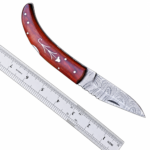
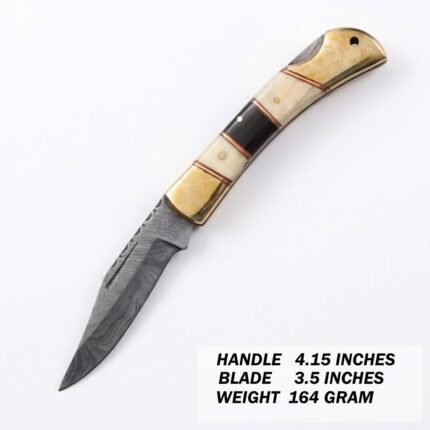
The Curved Wood Handle Damascus Hunting Knife brings together traditional hunting-knife styling, a richly colored handle, and an intricately patterned metallic blade. Its most recognizable feature is the long, upward-curving grip, which gives the knife a distinctive silhouette compared with ordinary straight-handled fixed-blade designs.
The reddish-brown handle has a visible wood-grain appearance, several small round silver-colored fittings, and a decorative light-colored inlay resembling a branching motif. These details contrast with the silver-gray blade, which displays flowing Damascus-style lines across much of its surface.
The blade itself has a pointed tip, a gently curved cutting-edge outline, and a short series of small scalloped notches near the handle. A subtle dark marking is also visible along the blade face.
Together, these features create a knife with considerable visual character.
The Curved Wood Handle Damascus Hunting Knife may appeal to adult collectors interested in traditional-inspired fixed-blade knives, ornamental metal patterns, and unusual handle shapes.
Its actual materials, construction specifications, intended applications, and performance characteristics should be confirmed by the manufacturer before purchase.
Intricate Damascus-Style Blade Pattern
The patterned blade is one of the knife’s main visual features.
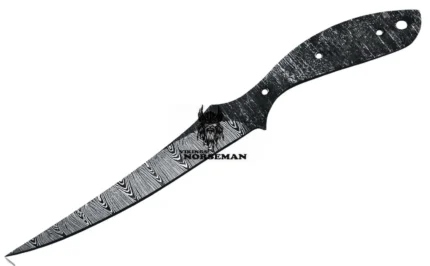
Across the silver-gray metallic surface, a series of curved lines forms flowing, layered-looking shapes. Some markings appear tightly grouped, while others spread into broader waves.
Near the point, the pattern creates irregular curved formations. Closer to the handle, it transitions into longer, more closely aligned lines.
The Curved Wood Handle Damascus Hunting Knife uses this decorative pattern to give its blade an appearance different from that of an ordinary polished steel knife.
The darker lines stand out against the lighter areas, making the design recognizable even in a photograph.
Many knife collectors appreciate these types of patterns for the individual visual character they provide.
However, the image cannot establish whether the blade was manufactured using genuine pattern-welded Damascus steel.
Other manufacturing methods can produce surfaces with similar appearances.
The exact steel composition and patterning process should therefore be confirmed by the supplier.
Until those details are verified, Damascus-style patterned blade is the most accurate description.
Traditional Fixed Blade Profile
The knife has a fixed-blade appearance, meaning the blade is shown extending from the handle rather than folding into it.
Its cutting-edge outline curves gently toward a pointed tip.
The blade widens near the handle and narrows toward the front, creating a recognizable hunting-style profile.
The Curved Wood Handle Damascus Hunting Knife differs from a folding pocket knife because the photograph shows no folding pivot between the blade and handle.
The overall shape also differs from a cleaver or hatchet, which typically features a broader cutting head.
The blade’s flowing lines and slender point contribute to its traditional-inspired appearance.
Although the general knife type can be identified visually, the internal tang construction cannot be confirmed from the photograph.
Full-tang, partial-tang, and other construction methods may look similar when covered by handle scales.
The manufacturer should provide verified construction details.
Beautiful Reddish-Brown Wood-Grain-Look Handle
The handle is one of the most noticeable parts of this knife.
Its surface displays a reddish-brown color with darker grain-like lines.
The color varies naturally across its length, with some areas appearing deeper red and others warmer brown.
The Curved Wood Handle Damascus Hunting Knife combines these tones with a smooth-looking surface and an unusual upward-curving profile.
The darker markings give the handle a traditional wooden appearance.
The overall design complements the silver-gray blade without competing with its decorative pattern.
A wood-grain-look handle also creates a warmer visual impression than a plain metallic grip.
However, the exact material cannot be confirmed from the photograph.
It may be natural wood, stabilized wood, laminated material, or another manufactured component.
Descriptions identifying a particular species, such as walnut, rosewood, or pakkawood, should only be used when supported by manufacturer specifications.
Distinctive Upward-Curved Handle Design
Unlike many straight-handled knives, this design features a handle that curves upward toward its rear end.
The handle has an elongated sweeping shape.
Its broad rear section rises above the lower grip contour, creating a recognizable appearance.
The Curved Wood Handle Damascus Hunting Knife uses this unusual profile as a central part of its visual identity.
The curve becomes more pronounced toward the end of the handle.
This creates a flowing silhouette that complements the lines of the patterned blade.
The shape may interest collectors who appreciate traditional knife profiles with less conventional handle designs.
However, the photograph does not establish the knife’s grip comfort or handling performance.
Those properties depend on actual dimensions, weight distribution, hand size, and surface finishing.
The handle should therefore be described as contoured and upward-curved rather than automatically claimed to provide superior grip security.
Decorative Light-Colored Handle Inlay
A light-colored decorative motif appears across the central portion of the reddish-brown handle.
The marking resembles a small branching design.
Its pale color creates a clear contrast against the darker handle surface.
The Curved Wood Handle Damascus Hunting Knife includes this decorative detail as part of its overall traditional-inspired appearance.
The motif is positioned along the broad face of the handle.
Several sections of the design extend in different directions, giving it an ornamental character.
The photograph does not establish whether the marking is an engraving, an inlay, painted decoration, or another finishing technique.
It should therefore be described as a light-colored decorative handle motif.
Claims involving hand engraving or particular inlay materials require verification.
Small Silver-Colored Handle Pins
Several round silver-colored fittings are visible along the handle.
These small circular details are spaced at different points across the reddish-brown surface.
Their metallic appearance contrasts with the darker background.
The Curved Wood Handle Damascus Hunting Knife uses these visible fittings as additional decorative details.
Similar components are commonly found on many knife handle designs.
However, their precise materials and fastening functions cannot be established from the image alone.
They may be part of the handle assembly, decorative hardware, or a combination of both.
The supplier should confirm how the handle is attached to the blade and which materials are used.
Patterned Blade and Handle Contrast
One of the strongest visual qualities of the product is the contrast between its blade and handle.
The blade has a cool silver-gray color with flowing dark lines.
The handle uses warm reddish-brown tones and darker wood-grain-look markings.
The Curved Wood Handle Damascus Hunting Knife combines these finishes to create a balanced, traditional-inspired appearance.
The decorative handle motif adds another light-colored element.
Silver-colored circular fittings complement the blade’s metallic finish.
This combination makes the knife recognizable without relying on exaggerated ornamentation.
For customers interested primarily in appearance, the contrast between the patterned blade and curved handle is an important distinguishing feature.
Scalloped Notches Near the Blade Handle
A short series of small notches appears along the upper edge of the blade near the handle.
These indentations interrupt the otherwise relatively smooth blade spine.
They provide an additional design detail at the transition between metal and handle.
The Curved Wood Handle Damascus Hunting Knife incorporates these scalloped markings into its overall blade silhouette.
Similar notches may appear on different knife designs for different purposes.
However, the photograph cannot establish whether these notches have a functional role.
They should not automatically be described as a saw edge, thumb traction feature, or cutting serration.
The most accurate visible description is a short section of scalloped spine notches.
Pointed Blade Tip
The knife’s blade narrows gradually toward a defined point.
The tip follows the general curvature of the blade profile.
This pointed outline helps distinguish the design from broad-ended cutting tools.
The Curved Wood Handle Damascus Hunting Knife combines its pointed tip with a gently curved lower edge.
The flowing surface pattern extends close to the tip.
The exact point geometry, sharpening angle, and edge thickness cannot be confirmed from the image.
Likewise, the image does not establish whether the blade was designed for a specific cutting application.
Such claims should only be made using manufacturer information.
Traditional Hunting-Inspired Design
Hunting-style fixed-blade knives are produced in many profiles, handle shapes, and decorative finishes.
Some emphasize practical utility, while others place greater importance on visual appearance and craftsmanship.
The Curved Wood Handle Damascus Hunting Knife has characteristics associated with traditional hunting-inspired cutlery.
Its pointed blade, patterned metallic surface, and wood-grain-look handle give it a recognizable outdoor-style appearance.
The upward-curving handle adds a distinctive element.
Its decorative light-colored motif also contributes to the traditional character of the design.
The product may interest adult collectors of fixed-blade knives.
However, the image does not confirm that it is suitable for field dressing, skinning, camping, survival work, or other specific applications.
Those uses require verified specifications and manufacturer approval.
Decorative Appeal for Adult Collectors
Collectors often appreciate knives for their unusual shapes, decorative finishes, and handle details.
This product presents several such characteristics.
The blade features a flowing Damascus-style pattern.
The handle includes reddish-brown wood-grain-like markings.
The distinctive upward curve creates an unusual silhouette.
The Curved Wood Handle Damascus Hunting Knife may therefore appeal to adults interested in ornamental fixed-blade cutlery.
Its appearance is also suitable for detailed product photography and secure collection displays.
However, the photograph does not establish handmade production, limited availability, historical authenticity, or particular craftsmanship techniques.
These claims should only be included when supported by supplier documentation.
Blade Pattern and Material Verification
The word Damascus is commonly used in product descriptions for knives featuring layered-looking patterns.
However, appearance does not always establish construction.
The Curved Wood Handle Damascus Hunting Knife displays an intricate pattern that resembles traditional Damascus-style metalwork.
Genuine pattern-welded steel may contain multiple metal layers.
Other knives may use surface treatments to create similar markings.
The photograph cannot distinguish these methods reliably.
The supplier should provide the exact steel grade, construction method, and any supporting material specifications.
It is also useful to confirm whether the blade surface has a protective treatment.
Such information helps customers understand maintenance requirements and realistic performance expectations.
Understanding the Curved Handle Profile
The unusual handle shape is central to the knife’s appearance.
Its upper contour rises gradually toward the broad rear section.
The lower contour forms a shallower curve.
The Curved Wood Handle Damascus Hunting Knife uses these lines to create a flowing outline.
The handle appears relatively long in relation to the blade.
However, exact dimensions cannot be confirmed from the photograph.
An adjacent ruler provides a useful sense of scale but is positioned diagonally.
Without a controlled, properly aligned measurement photograph, precise dimensions would be speculative.
The supplier should provide the verified handle length and overall knife length.
Visible Measurements and Ruler Reference
A metal ruler appears beside the knife.
The ruler includes numbered inch markings and smaller subdivisions.
Metric indications are also visible.
This reference helps demonstrate the product’s general scale.
However, the knife and ruler are not perfectly aligned along the same measurement axis.
The photograph may also contain perspective distortion.
Therefore, the Curved Wood Handle Damascus Hunting Knife should not be assigned an exact overall length based only on this image.
A proper technical specification should include manufacturer-measured blade length, handle length, and total length.
Blade thickness and weight are also useful.
These measurements should be supplied in consistent units.
Intended Customers
The knife’s appearance may appeal to several types of adult customers.
Collectors interested in unusual fixed-blade designs may appreciate the curved handle.
Enthusiasts of decorative metallic patterns may be drawn to the silver-gray blade.
Customers who prefer traditional wood-grain styling may find the reddish-brown handle attractive.
The Curved Wood Handle Damascus Hunting Knife combines these visual elements into one distinctive design.
However, intended functional applications must be confirmed separately.
A decorative knife and a task-specific cutting tool can look similar in photographs.
Customers should evaluate verified construction details and manufacturer guidance rather than assuming performance from appearance.
Product Details Worth Confirming
The photograph provides useful visual information, but additional specifications are needed for a complete technical listing.
The supplier should confirm the overall length, blade length, and handle length.
The exact steel composition and Damascus patterning method are also important.
Customers may wish to know the blade thickness, weight, hardness, and edge finish.
The Curved Wood Handle Damascus Hunting Knife also requires confirmation of its handle material and attachment method.
The light-colored decorative motif should be identified accurately.
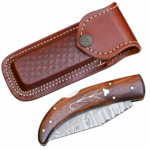
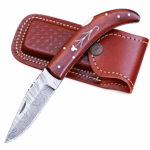
The supplier should explain whether a sheath, protective cover, storage box, or other accessory is included.
None of these accessories is shown in the photograph.
General Blade Maintenance
Suitable maintenance depends on the actual blade material.
After handling or manufacturer-approved use, clean away visible contamination and moisture.
Use cleaning products recommended for the confirmed steel composition.
Avoid abrasive materials that may damage the patterned finish.
The Curved Wood Handle Damascus Hunting Knife has a detailed blade surface that may require careful cleaning to preserve its appearance.
If the manufacturer recommends a protective oil or treatment, follow its instructions.
Do not assume that the blade is dishwasher-safe or corrosion-resistant.
Store the knife in a clean, dry location.
Inspect visible surfaces periodically for damage or discoloration.
Caring for the Handle
The reddish-brown handle should also be maintained according to its confirmed material.
Natural wood, stabilized wood, and synthetic materials may require different care.
The Curved Wood Handle Damascus Hunting Knife has a wood-grain-look surface and decorative light-colored detailing.
Avoid using aggressive cleaning agents without confirming compatibility.
Do not leave the handle exposed to prolonged moisture or excessive heat.
If the handle becomes dirty, follow the manufacturer’s recommended cleaning procedure.
Inspect the visible fittings periodically.
If any component appears loose or damaged, avoid using the knife until it has been assessed appropriately.
Responsible Handling and Storage
Treat every blade edge as potentially sharp.
Keep hands clear of the cutting edge and pointed tip.
The Curved Wood Handle Damascus Hunting Knife should only be used for applications approved by its manufacturer.
Use appropriate protective storage when the knife is not in use.
The photograph does not show a sheath.
If a compatible sheath is supplied, ensure it fits according to manufacturer guidance.
Keep the knife inaccessible to children and unauthorized individuals.
Comply with all relevant local laws relating to possession, transport, and storage.
Why Choose the Curved Wood Handle Damascus Hunting Knife?
The strongest feature of this knife is its distinctive design.
Its long, upward-curving reddish-brown handle creates an unusual silhouette.
The silver-gray blade has a richly detailed Damascus-style pattern.
Small silver-colored pins and a light-colored decorative motif add visual interest.
The Curved Wood Handle Damascus Hunting Knife brings these elements together in a traditional-inspired fixed-blade profile.
For adult collectors who appreciate ornamental knife designs, the combination provides a recognizable appearance.
Its functional characteristics, however, should be judged using verified manufacturer specifications.
Explore This Distinctive Fixed-Blade Knife
The Curved Wood Handle Damascus Hunting Knife combines a patterned metallic blade, pointed profile, decorative handle details, and unusual curved grip shape.
Its warm reddish-brown handle contrasts with the intricate silver-gray blade pattern.
Explore this traditional-inspired knife design and confirm its dimensions, materials, intended uses, and included accessories before ordering.







Reviews
There are no reviews yet.