



Damascus Pattern Chef Knife with Red Wood-Style Handle
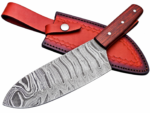
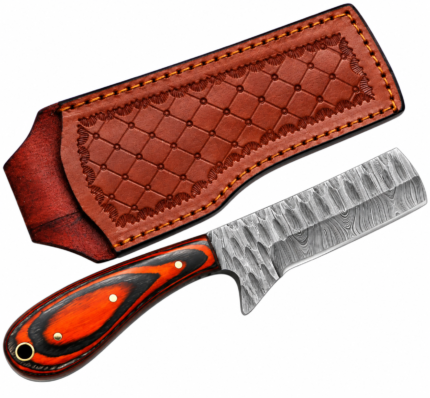
The Damascus Pattern Chef Knife with Red Wood-Style Handle combines a striking patterned blade, a traditional-inspired handle, and a coordinated protective sheath. Designed in the style of a versatile kitchen chef knife, this product features a wide blade profile with a gently curved cutting edge that makes it visually suitable for everyday food preparation.
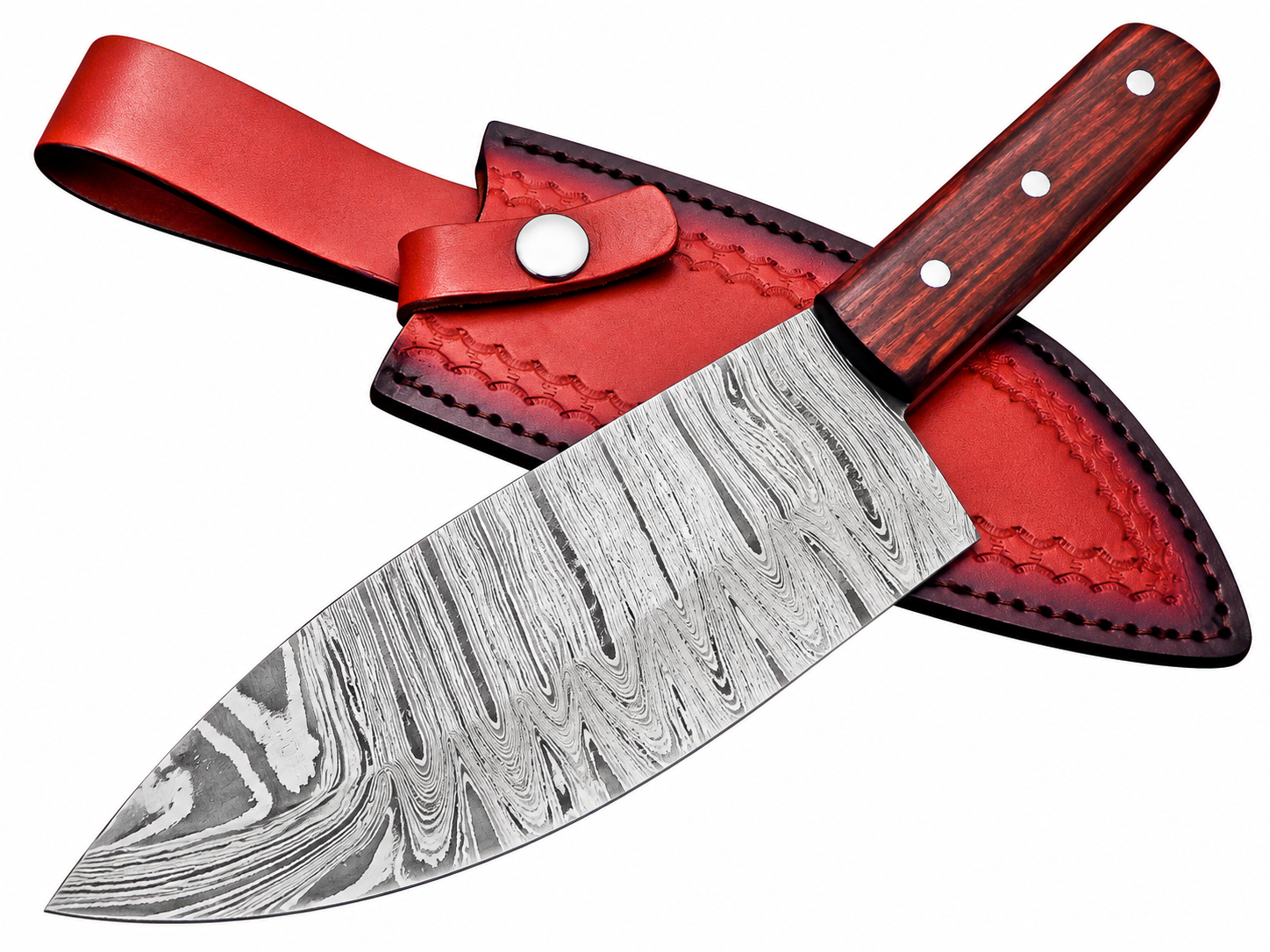
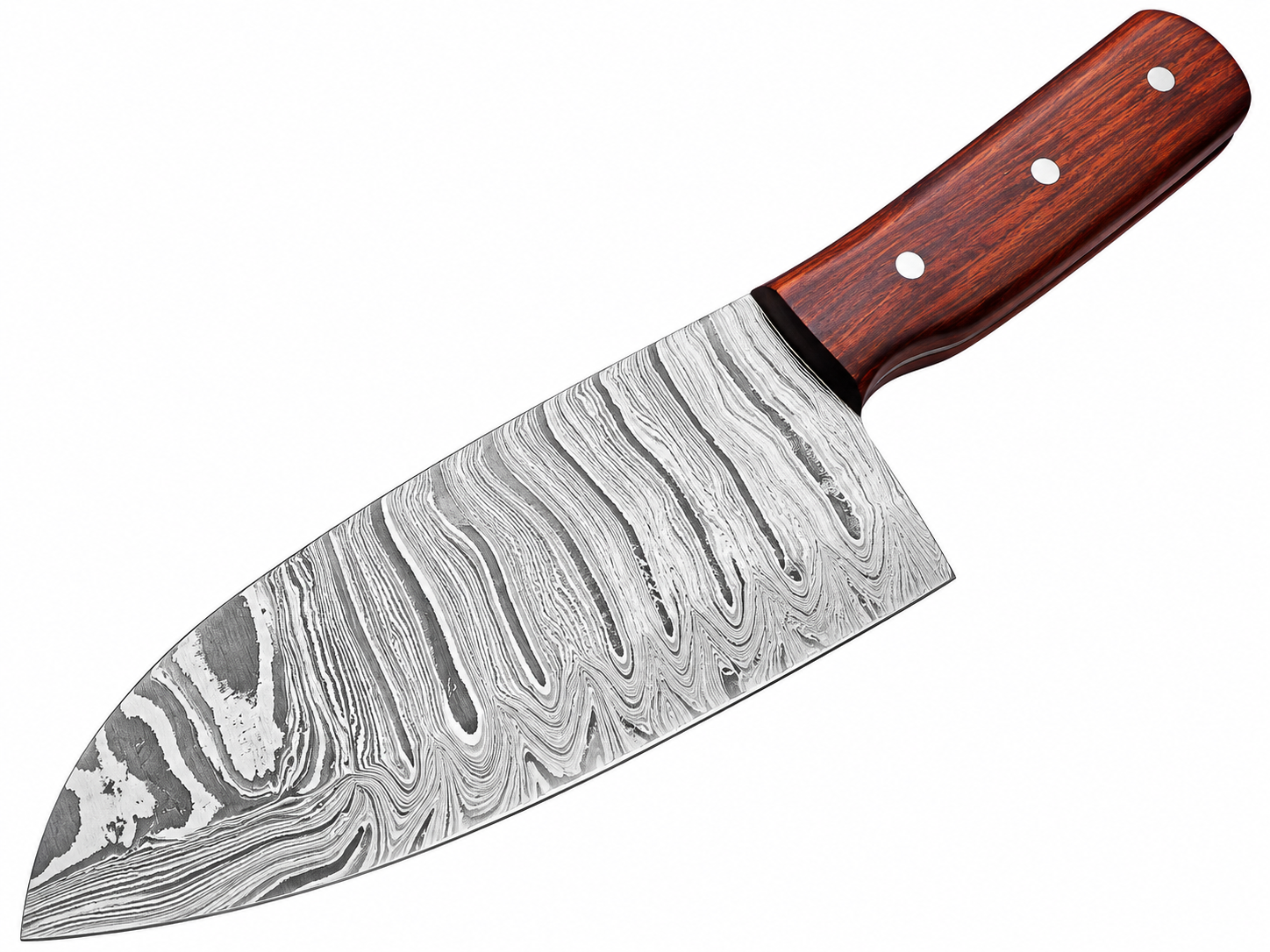
The most noticeable feature is its silver-gray blade with flowing, wave-like Damascus patterns. These distinctive markings extend across the blade, creating an attractive contrast between bright and dark metallic tones. The reddish-brown wood-grain handle adds warmth to the design, while its visible metallic pins give the knife a clean, traditional appearance.
A reddish-brown leather-style sheath accompanies the knife, featuring decorative embossing, contrasting stitching, a carrying loop, and a snap-button strap.
Whether displayed as part of a kitchen knife collection or considered for food preparation, this knife offers a distinctive balance of practical styling and decorative detail.
Distinctive Damascus-Style Blade Pattern
The blade displays a flowing pattern of silver and darker gray lines.
These patterns form irregular curves, layered shapes, and swirling details that resemble traditional Damascus steel.
The design is especially noticeable across the wide blade surface, where the contrasting markings have enough space to remain clearly visible.
Unlike a plain polished kitchen knife, this patterned blade has a more decorative appearance.
Its surface features variations in line thickness, pattern direction, and contrast, creating an intricate visual effect.
Damascus-style blade finishes have become popular among knife enthusiasts because they combine an artistic appearance with a traditional metalworking aesthetic.
However, it is important to distinguish appearance from material composition.
The photograph does not confirm whether the blade is manufactured from genuine pattern-welded Damascus steel, layered steel, etched steel, or another patterned material.
The steel grade and manufacturing process should be confirmed with the supplier before publication as technical specifications.
Broad Chef Knife Blade Profile
The knife has a wide blade that gradually narrows toward a rounded, pointed front section.
Its cutting edge forms a gentle curve, while the upper spine maintains a relatively broad profile before tapering toward the tip.
This shape resembles the general profile of a kitchen chef knife and shares certain visual characteristics with Santoku-style knives.
Chef knives are commonly used for food preparation tasks such as slicing vegetables, preparing fruit, and cutting boneless ingredients.
The wider blade profile can also provide additional surface area for guiding ingredients during preparation.
The exact cutting performance of this particular model has not been tested.
Its suitability for specific kitchen tasks depends on verified blade geometry, steel composition, edge sharpness, and overall construction.
The knife should not be advertised as suitable for bone chopping or other heavy-impact work without supporting manufacturer specifications.
Elegant Silver and Gray Blade Finish
The blade’s metallic appearance creates a distinctive contrast with the reddish handle.
Light silver sections appear alongside darker gray lines, emphasizing the Damascus-style pattern.
The blade has a broad face, making its decorative finish one of the dominant visual features.
A relatively narrow, dark outline is visible along parts of the cutting edge.
The flowing pattern changes direction across different areas of the blade, creating a layered appearance.
This decorative finish makes the knife visually different from standard kitchen knives with uniform stainless-steel surfaces.
It may be particularly appealing to buyers who prefer kitchen accessories with a traditional or artisan-inspired appearance.
Nevertheless, blade durability, corrosion resistance, hardness, and edge retention must be determined from actual product specifications rather than visual appearance.
Red Wood-Grain Handle Design
The knife features a reddish-brown handle with visible dark grain-like markings.
The warm red tones provide a strong contrast against the silver-gray blade.
The handle has a gently curved shape with a slightly widened end.
Three round silver-colored pins are visible along its surface.
The handle appears to consist of fitted side scales attached around the knife’s tang, although the internal tang construction cannot be verified from the image.
Its shape resembles traditional kitchen knife handles designed for handheld cutting tasks.
The wood-like appearance adds an attractive natural character to the overall design.
Actual wood species, resin content, finish treatment, and moisture resistance have not been verified.
The handle should therefore be described as wood-style or wood-grain until the manufacturer confirms the material.
Traditional Handle and Blade Combination
The design combines a decorative blade with a comparatively simple handle profile.
The blade’s silver-gray pattern is detailed and visually complex.
In contrast, the handle’s reddish color, smooth contours, and metallic pins create a more traditional appearance.
The combination avoids excessive decorative components while maintaining a recognizable style.
The handle becomes narrower toward the blade junction, creating a visual transition between the two sections.
A dark spacer or connecting area is visible where the handle meets the blade.
This provides additional contrast without distracting from the patterned steel appearance.
The result is a knife that can fit visually into both rustic and modern kitchen accessory collections.
Matching Protective Sheath
The knife is photographed with a matching reddish-brown leather-style sheath.
The sheath has a decorative outer surface with embossed markings, visible stitching, dark-colored edging, and a retention strap.
Its wide shape appears designed to accommodate the knife’s blade.
The sheath includes a carrying loop extending from the rear section.
A fastening strap with a silver-colored snap button crosses the upper portion.
These details give the sheath a traditional appearance that complements the knife’s reddish handle.
A correctly fitted sheath can help reduce contact with the blade during storage and transportation.
However, fit, retention strength, and carrying compatibility should be checked before use.
The photograph does not confirm whether the cover is genuine leather or synthetic leather.
The material should be verified with the supplier before it is advertised as genuine leather.
Decorative Stitching and Embossing
The sheath has several visible design elements that distinguish it from a simple blade cover.
Dark stitching runs along the perimeter.
Embossed decorative lines appear across sections of the reddish-brown surface.
The outer edges have a darker contrasting finish.
The snap-button strap is positioned to help secure the knife when properly fitted.
These design details contribute to a coordinated appearance.
The sheath can also be useful for maintaining separation between the knife blade and other stored objects, provided it is designed and fitted correctly.
For safe storage, the blade should be cleaned and thoroughly dried before being placed inside the cover.
Suitable for Home Kitchen Collections
Kitchen knives are important tools for food preparation, and their shapes vary according to the tasks they are intended to perform.
The pictured knife resembles a broad general-purpose chef knife.
Knives of this type are often associated with vegetable preparation, slicing, and other ordinary kitchen cutting activities.
Its pointed front section and gently curved edge provide a familiar chef-knife silhouette.
For home cooks, a knife with this general design may be appealing as part of a broader kitchen cutlery selection.
Actual performance should be evaluated after confirming the blade material, edge geometry, and dimensions.
The photograph does not establish that the knife has been tested for professional culinary use.
Attractive for Culinary Enthusiasts
The combination of a patterned blade and reddish handle gives the knife a distinctive appearance that may appeal to culinary enthusiasts.
Some buyers prefer traditional plain kitchen knives.
Others enjoy cutlery with decorative steel patterns and contrasting handle colors.
This product visually belongs to the second category.
Its elaborate blade pattern creates a decorative appearance, while the handle remains relatively understated.
The sheath adds another traditional-inspired element.
For customers who collect patterned kitchen knives, the product may provide an interesting addition to an existing selection.
Before purchasing, buyers should confirm the materials, dimensions, intended use, and maintenance instructions.
A Consideration for Gift Buyers
Decorative kitchen knives are sometimes selected as gifts for adult cooking enthusiasts.
The reddish handle and Damascus-style blade create a distinctive presentation.
The matching sheath provides an additional accessory that contributes to the overall appearance.
The product may appeal to individuals who appreciate unusual kitchen utensils, metalworking-inspired designs, or traditional cutlery.
It could also complement a themed kitchen accessory collection.
The photograph does not show a gift box or dedicated presentation packaging.
These items should not be listed as included unless confirmed by the supplier.
Any personalization or engraving service should also be verified before being offered as a product option.
Blade Cleaning and Maintenance
Proper cleaning is important for maintaining the condition of kitchen knives.
After food preparation, remove food residue from the blade using an appropriate cleaning method for the verified steel.
Handwashing with mild detergent and water is generally a cautious approach for decorative kitchen knives.
Avoid harsh abrasive cleaning pads that could scratch the blade surface.
Dry the knife thoroughly after washing.
Prolonged moisture exposure may affect certain types of steel, particularly when corrosion resistance is limited.
Because the exact steel composition is unknown, dishwasher compatibility should not be assumed.
Do not leave the knife soaking in water.
Follow any manufacturer-specific recommendations for corrosion protection and maintenance.
Handle Care Instructions
The reddish wood-style handle may require special attention depending on its actual construction.
Avoid leaving it submerged in water.
Clean the surface gently with a soft cloth.
Do not expose the handle to excessive heat, strong solvents, or harsh household chemicals.
If the handle is made from natural wood, its maintenance requirements may be different from those of resin or engineered composite materials.
A manufacturer-approved wood conditioner may be appropriate for some natural wood handles, but should not be applied without confirming the actual material.
Regularly inspect the handle for looseness, cracks, or separation from the blade assembly.
Stop using the knife if its handle becomes damaged or unstable.
Safe Kitchen Handling
A kitchen knife should always be handled as a sharp cutting instrument.
Use a stable cutting board and maintain a controlled grip.
Keep fingers clear of the cutting edge.
Avoid using the knife for prying, twisting against hard surfaces, or striking bones.
Do not attempt to catch a falling knife.
When the knife is not in use, place it in a secure location away from the edge of a countertop.
Keep knives out of the reach of children.
Use an appropriate protective sheath or designated knife storage system.
The pictured sheath should only be relied upon after its fit and closure have been checked.
Maintaining the Cutting Edge
Cutting-edge performance depends on blade material, hardness, grind geometry, sharpening, and use.
For general kitchen knives, appropriate sharpening equipment can help maintain a usable edge.
However, the correct sharpening angle and method for this particular product have not been supplied.
Avoid aggressive sharpening techniques until the steel composition and manufacturer recommendations are known.
Repeated contact with hard surfaces can damage some knife edges.
Appropriate cutting boards are generally preferable to glass, stone, or similarly hard preparation surfaces.
After sharpening, carefully remove any metal particles and clean the knife before food preparation.
Important Product Specifications
| Specification | Description |
|---|---|
| Product Type | Broad-blade kitchen chef knife |
| Blade Appearance | Damascus-style silver-gray pattern |
| Blade Profile | Wide, gently curved, pointed |
| Handle Appearance | Reddish-brown wood grain |
| Visible Handle Pins | Three |
| Blade Construction | Fixed blade |
| Sheath Color | Reddish-brown |
| Sheath Appearance | Leather-style, embossed |
| Sheath Closure | Snap button |
| Sheath Carrying Loop | Visible |
| Blade Steel | Not verified |
| Genuine Damascus Steel | Not verified |
| Handle Material | Not verified |
| Sheath Material | Not verified |
| Blade Length | Not verified |
| Overall Length | Not verified |
| Blade Thickness | Not verified |
| Steel Hardness | Not verified |
| Weight | Not verified |
| Food-Contact Compliance | Not verified |
What Makes This Knife Distinctive?
The Damascus Pattern Chef Knife with Red Wood-Style Handle stands out because of its combination of decorative and traditional elements.
The broad blade displays flowing silver-gray markings.
The reddish handle has dark grain-like details and three metallic pins.
The coordinating sheath features ornamental embossing and contrasting stitching.
These elements create a visually cohesive product.
Its overall appearance may appeal to buyers who are interested in decorative kitchen cutlery and traditional-inspired knife designs.
The sheath also gives the product a different presentation from kitchen knives that are supplied without protective covers.
Its appearance is a strong reason to consider the design, while its actual suitability for cooking should be established from manufacturer specifications.
Choosing the Right Kitchen Knife
When selecting a kitchen knife, appearance is only one consideration.
Blade size, steel quality, edge geometry, weight, balance, handle comfort, and maintenance requirements all affect suitability.
The photograph provides useful information about the knife’s visible design but cannot establish its performance characteristics.
Customers intending to use this knife frequently should confirm the precise blade length and steel grade.
They should also review the manufacturer’s recommended cutting applications and care instructions.
The knife should not be assumed to have any particular edge-retention performance or corrosion resistance without supporting documentation.
Final Overview
The Damascus Pattern Chef Knife with Red Wood-Style Handle combines a broad patterned blade, distinctive reddish handle, and matching decorative sheath into one coordinated design.
Its flowing silver-gray blade markings and traditional-inspired appearance make it attractive for adult culinary enthusiasts and collectors of patterned kitchen knives.
Explore this distinctive chef knife design and review the confirmed technical specifications to determine whether it meets your intended kitchen needs.






Reviews
There are no reviews yet.