



Damascus Pattern Hunting Knife with Ivory-Style Handle and Brown Sheath
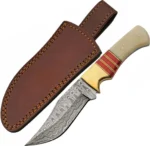
The Damascus Pattern Hunting Knife with Ivory-Style Handle and Brown Sheath brings together an intricately patterned blade, an elegant light-colored handle, and classic outdoor styling. Its curved cutting edge, decorative red spacers, gold-colored bolster, and matching brown sheath make it a distinctive choice for adult hunting enthusiasts and knife collectors.
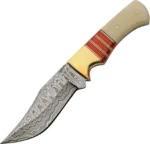
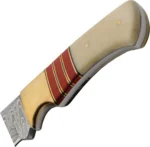
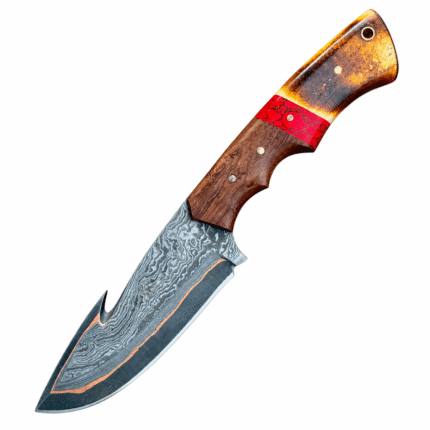
The knife features a fixed blade with flowing grey and silver Damascus-style patterns. A series of oval-like formations runs along the blade, surrounded by closely arranged wavy lines that create a detailed layered appearance.
The handle introduces a contrasting design. Its smooth, ivory-colored rear section features two small gold-colored pins, while red bands with fine contrasting lines separate it from the gold-colored front fitting.
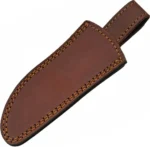
A brown sheath with visible stitching and an extended belt loop completes the traditional presentation.
For customers who appreciate decorative fixed-blade knives, this model offers a recognizable hunting-knife silhouette with distinctive colors and detailing.
Damascus Pattern Hunting Knife with a Distinctive Blade
The most recognizable feature of this knife is its Damascus-style blade pattern.
Flowing metallic lines extend across the blade, creating a mixture of light grey, silver, and darker tones. The patterns form a series of oval and wave-like shapes that give the surface a distinctive appearance.
Damascus-pattern blades are popular among collectors because their layered-looking patterns can make otherwise similar knife designs visually different.
The image shows a particularly prominent pattern along the central portion of the blade. Its curved formations follow the general blade profile toward the pointed tip.
This creates a decorative finish that stands out against the handle’s relatively simple ivory-colored surface.
The blade resembles pattern-welded Damascus steel, but the photograph cannot establish its actual manufacturing process.
Genuine pattern-welded Damascus steel is manufactured using particular combinations of steel and forging techniques. However, visually similar patterns may also be applied through other manufacturing processes.
For accurate product descriptions, this model is therefore identified as a Damascus-pattern hunting knife rather than making an unverified steel-composition claim.
Customers who specifically require pattern-welded steel should request documented material specifications from the supplier.
Traditional Fixed-Blade Hunting Knife Design
The knife uses a fixed-blade configuration rather than a folding mechanism.
Fixed-blade knives are familiar products in hunting and outdoor equipment categories because the blade remains extended and does not require opening or locking before use.
This gives the knife a conventional profile with a clearly defined blade, bolster, and handle.
The photographed model features a patterned metallic blade connected to a contoured handle with several decorative sections.
Its design is more traditional than the angular appearance of many modern tactical-style knives.
Fixed-blade hunting knives are commonly considered for outdoor cutting applications, field equipment collections, and appropriate hunting-related activities.
However, the actual strength and suitability of a knife depend on verified specifications, including blade thickness, steel grade, heat treatment, and tang construction.
These details cannot be established from the uploaded image.
The knife should therefore be selected according to its confirmed technical information and the intended activity.
Curved Blade with a Pointed Tip
The blade features a smooth curved cutting edge extending toward a narrow pointed tip.
Its cutting belly is broader near the middle and gradually tapers toward the front.
This produces a recognizable hunting-knife silhouette with a curved lower cutting edge and a relatively straightforward upper profile.
Curved cutting edges are commonly found on hunting and skinning-style knives because their shape can be useful for controlled slicing movements during appropriate tasks.
The photographed knife has no visible gut hook or serrated cutting section.
Its blade profile is therefore better described as a conventional curved hunting blade rather than a specialized gut-hook or sawback design.
The pointed tip adds to the familiar appearance of traditional fixed-blade hunting knives.
Actual sharpness, edge geometry, and cutting performance cannot be confirmed from a photograph.
Buyers should inspect the product or obtain verified manufacturing specifications before relying on it for demanding applications.
Layered Metallic Blade Appearance
The blade’s silver-grey surface is decorated with intricate flowing lines.
The patterned finish extends across much of the blade, creating a visual contrast between darker and lighter metallic areas.
Several connected oval formations are especially noticeable near the central section.
These are surrounded by narrower wave-like lines that follow the curvature of the blade.
The result is a decorative surface with considerable visual detail.
Unlike plain polished blades, this pattern gives the knife a distinctive identity in photographs and display collections.
The blade’s visual finish also complements the gold-colored bolster and contrasting red handle bands.
Although decorative Damascus-style patterns are frequently associated with traditional forged knives, the image does not establish the number of steel layers, hardness, corrosion resistance, or edge-retention properties.
Those characteristics require accurate information from the manufacturer.
Smooth Ivory-Style Handle
The handle is one of the knife’s defining visual features.
Its rear section has a smooth, light cream or ivory-colored appearance.
This pale color creates a strong contrast with the darker blade pattern and brown sheath.
The handle also differs from ordinary wooden hunting-knife grips, which commonly feature darker natural grain patterns.
Its surface appears relatively uniform, with a gently curved outline and two small gold-colored pins.
The exact material is not confirmed.
Possible materials used in similar knife designs include bone, resin, synthetic ivory-look composites, and other decorative handle materials.
Because these can appear similar in photographs, the handle should be accurately described as ivory-style rather than genuine ivory or bone.
The light-colored finish may appeal to customers seeking a classic decorative hunting knife with a more refined appearance.
Contoured Handle Shape
The grip features a slightly curved profile with a smooth upper edge and a gently shaped lower section.
Its width changes subtly along the handle, creating a recognizable fixed-blade hunting-knife form.
The rear section is rounded rather than sharply angular.
This traditional outline works well with the knife’s decorative bolster and contrasting spacer bands.
A contoured handle can influence how a knife feels during use, but comfort cannot be established from the photograph.
Actual handling characteristics depend on grip length, thickness, surface finish, balance, and individual hand size.
The image also does not establish whether the handle is slip-resistant or ergonomically tested.
Customers who require specific grip dimensions should request measurements before purchasing.
For collectors, the handle’s shape and smooth ivory-style surface contribute to the knife’s traditional appearance.
Red Handle Spacers with Decorative Lines
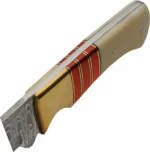
Near the front of the handle are several red decorative spacer bands.
These bands create a strong visual contrast between the pale rear grip and the gold-colored bolster.
Thin gold-colored and dark lines run between the red sections, producing a layered appearance.
The arrangement gives the handle a more detailed finish than a single-piece, plain-colored grip.
The red sections are especially noticeable because most of the surrounding knife features use neutral metallic, cream, and brown tones.
This carefully coordinated color combination is a major part of the product’s visual appeal.
The red bands may be decorative spacers or part of a multi-material handle assembly, but the image does not confirm their composition.
They should therefore be described according to their visible appearance rather than assigned an unverified material.
Gold-Colored Bolster and Front Guard
A prominent gold-colored fitting separates the handle from the blade.
This fitting has a broad, smooth surface and a shaped lower section that extends slightly toward the cutting-edge side.
Its design resembles a traditional knife bolster or front guard.
The metallic color complements the decorative lines in the red spacer bands.
Together, these details create a coordinated transition between blade and handle.
The fitting also provides visual separation between the intricate Damascus-style blade pattern and the smooth handle surface.
Although its appearance resembles brass, the exact material cannot be confirmed from the photograph.
The product should therefore be described as having a gold-colored bolster until verified material information is available.
The visible guard-like shape should not be treated as proof of tested hand protection or impact resistance.
Gold-Colored Handle Pins
Two small circular pins are visible along the ivory-style handle section.
Their gold-colored finish coordinates with the front bolster and decorative spacer lines.
The pins create subtle points of contrast against the pale surface.
Metallic pins are commonly used in knife-handle construction, although the photograph does not confirm their exact material or attachment function.
They may be part of the handle assembly, but the underlying tang structure remains unknown.
For accurate product specifications, the pin material and handle construction should be confirmed by the supplier.
From a visual standpoint, the pins contribute to the traditional styling without overwhelming the handle’s clean appearance.
Traditional Brown Knife Sheath
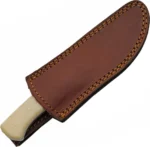
The knife is displayed alongside a brown sheath with contrasting stitching.
The sheath follows the general shape of a conventional fixed-blade knife cover, featuring a wider upper section and a tapered lower portion.
Its warm reddish-brown surface complements the knife’s red handle accents.
A line of visible stitching runs along the sheath’s outer perimeter.
The stitching has a golden-brown appearance that coordinates with the knife’s metallic fittings.
The sheath also includes an extended upper loop resembling a traditional belt attachment.
Its overall design is simple and practical-looking, with decorative details limited mainly to its stitched edges.
Although the material resembles leather, its exact composition has not been verified.
The sheath should therefore be described as leather-style until the supplier confirms genuine leather construction.
Belt-Loop Sheath Design
An extended belt loop is visible at the upper end of the sheath.
This feature is commonly associated with traditional outdoor knife storage.
The loop appears to be constructed from matching brown material and includes visible stitching along its edges.
It provides the sheath with a recognizable hunting-equipment appearance.
The image does not establish the maximum compatible belt width or the strength of the attachment.
Customers planning to use the sheath with a particular belt should verify its dimensions and construction.
The sheath’s retention system and internal lining are also not visible.
Before carrying or transporting the knife, the user should ensure the blade fits securely and is appropriately protected.
Contrasting Sheath Stitching
The sheath features prominent stitching along its edges.
The thread appears warmer and lighter than the brown surface, making the stitched border clearly visible.
This contrast contributes to the accessory’s traditional style.
The rows of stitching follow the curved perimeter of the sheath, emphasizing its tapered outline.
The extended belt loop includes similar decorative stitching.
These details give the sheath a coordinated appearance that complements the knife’s gold-colored fittings.
The photograph does not confirm whether the sheath is handmade, machine-stitched, or manufactured using another method.
Therefore, its appearance should be described without unverified craftsmanship claims.
A Coordinated Knife and Sheath Design
The knife and sheath use a complementary color palette.
The patterned blade combines silver and darker grey tones.
The handle adds a smooth cream-colored section with red decorative bands and gold-colored accents.
The brown sheath provides a warmer background that balances these elements.
Together, they create an attractive traditional outdoor presentation.
The contrast between the elaborate blade pattern and simple handle surface is particularly noticeable.
The gold-colored fitting acts as a visual transition between these two components.
The brown sheath completes the design by providing an accessory with similarly warm tones.
For customers who appreciate coordinated knife designs, this combination is an appealing feature.
Suitable for Hunting-Style Equipment Collections
The knife’s curved blade and fixed construction are consistent with traditional hunting-knife designs.
Hunting knives are commonly used for appropriate cutting activities and included in field equipment collections.
The curved cutting edge may interest customers who prefer a conventional slicing-oriented blade profile.
However, actual suitability for particular activities depends on the knife’s verified specifications and the user’s handling technique.
A decorative blade pattern does not independently establish cutting quality or structural durability.
Customers intending to use the knife for field dressing or other specialized activities should confirm its material, dimensions, edge geometry, and construction.
The model does not have a visible gut hook.
It should therefore be categorized as a standard hunting-style fixed-blade knife rather than a specialized gut-hook model.
An Attractive Option for Knife Collectors
Knife collectors frequently appreciate distinctive blade designs, decorative handles, and coordinated accessories.
This model offers all three visual characteristics.
Its Damascus-style blade features intricate layered-looking patterns.
The light-colored handle provides an unusual contrast with the metallic blade.
The red decorative spacers and gold-colored bolster add visual detail.
The brown stitched sheath completes the traditional presentation.
These features may appeal to adults building collections of patterned fixed-blade knives or classic hunting-knife designs.
The product also provides a different appearance from knives with plain wooden handles or black synthetic grips.
Collectors should verify material composition and manufacturing origin before making assumptions about rarity, authenticity, or value.
Traditional Outdoor Styling
The design draws on several familiar characteristics of classic outdoor knives.
These include a curved fixed blade, decorative bolster, contoured handle, and fitted-looking sheath.
The overall appearance is more traditional than modern tactical equipment.
Its decorative blade pattern introduces complexity, while the smooth handle creates a visually clean contrast.
The red spacer bands bring an additional element of color without changing the familiar hunting-knife profile.
This combination makes the knife suitable for customers who appreciate traditional styling with distinctive decorative details.
The product’s aesthetic character can be described confidently from the image.
Claims relating to handmade production, forging methods, material authenticity, and performance require independent verification.
A Gift Option for Adult Knife Enthusiasts
A decorative fixed-blade hunting knife may be considered as a gift for an adult who appreciates knives or outdoor equipment.
This model has a visually distinctive presentation, featuring a patterned blade, ivory-style handle, red accents, and coordinated sheath.
Its combination of colors gives it a more decorative appearance than many basic utility knives.
For buyers purchasing it as a gift, the manufacturer’s specifications should be reviewed beforehand.
It is particularly important to confirm whether the blade is genuine pattern-welded Damascus steel and what material is used for the handle.
Recipients who collect knives based on particular materials may consider those details important.
Local knife laws, age restrictions, and shipping requirements should also be checked before purchase.
The knife should be stored securely and handled responsibly.
General Blade Cleaning and Maintenance
Appropriate care can help preserve the appearance and condition of the knife.
After use, remove visible dirt and debris carefully.
Clean the blade using products and methods suitable for its confirmed steel composition.
Dry the blade thoroughly before storage.
Pay attention to the area where the blade meets the front bolster, as moisture and residue can collect around component junctions.
Avoid unnecessarily abrasive cleaning methods that may affect the decorative surface pattern.
Certain steels may benefit from an appropriate protective coating, but maintenance requirements depend on the actual material.
If the knife is used for food-related processing, only compatible cleaning and maintenance products should be selected.
Inspect the cutting edge regularly for damage or deterioration.
Sharpening procedures should follow the blade’s actual geometry and manufacturer recommendations.
Caring for the Ivory-Style Handle
The smooth light-colored handle should be cleaned gently to preserve its appearance.
Because its material has not been confirmed, avoid aggressive cleaning chemicals and prolonged soaking unless the manufacturer approves those methods.
A soft cloth may be suitable for ordinary dust removal.
The red spacer bands and gold-colored fittings should also be kept clean and dry.
Some decorative handle materials can be affected by extreme temperatures, moisture, or chemical exposure.
Without confirmed material information, conservative maintenance is recommended.
Check the handle periodically for visible damage or looseness.
The two metallic pins should also be inspected as part of routine knife maintenance.
Sheath Care and Storage
The brown sheath should be kept clean and dry.
Its stitched edges and belt loop should be checked periodically for signs of wear.
If the sheath is genuine leather, an appropriate leather-care product may help maintain its appearance.
If it is synthetic, different care instructions may apply.
Do not use leather conditioners until the material has been confirmed.
Avoid inserting a wet blade into the sheath.
For extended storage, keep the blade clean, dry, and protected according to the confirmed steel type.
The sheath should fit correctly and protect the cutting edge when used.
Because the image does not show the internal construction, retention strength cannot be assessed.
Responsible Handling and Storage
This fixed-blade hunting knife has a pointed tip and a visible cutting edge.
It should be handled as a sharp cutting tool.
Keep hands away from the cutting edge during use and cleaning.
Use the knife only for tasks suitable for its verified construction.
Do not use it for prying, striking, or other high-stress applications unless expressly approved by the manufacturer.
Store the knife securely when it is not in use.
Keep it away from children and unauthorized users.
Ensure that the blade is properly protected during storage or transport.
Buyers should check applicable local regulations before purchasing, shipping, carrying, or transporting the knife.
Key Visible Product Features
- Product type: Fixed-blade hunting knife
- Blade design: Curved cutting edge with pointed tip
- Blade appearance: Silver-grey Damascus-style layered pattern
- Handle color: Ivory or cream
- Handle design: Smooth, gently contoured shape
- Handle accents: Red spacer bands with gold-colored decorative lines
- Bolster appearance: Gold-colored metallic front fitting
- Visible handle hardware: Two small gold-colored pins
- Sheath appearance: Brown leather-style sheath
- Sheath details: Contrasting stitched edges and extended belt loop
- Overall styling: Traditional decorative hunting knife
- Potential buyers: Adult hunting enthusiasts, outdoor equipment collectors, and knife collectors
Exact steel grade, blade dimensions, overall length, weight, hardness, tang construction, handle material, and sheath composition require supplier confirmation.
Why Choose This Damascus Pattern Hunting Knife?
This knife offers a distinctive combination of decorative blade patterning and traditional handle styling.
The curved blade features intricate Damascus-style lines.
The smooth ivory-colored handle provides visual contrast, while the red spacers and gold-colored bolster add character.
The brown stitched sheath complements the knife’s classic outdoor appearance.
For customers comparing hunting-style fixed-blade knives, this model stands apart from plain-blade designs through its distinctive metallic pattern and carefully coordinated colors.
Its appearance may particularly interest adult collectors who prefer traditional knives with decorative detailing.
Practical performance should be assessed using verified material specifications and intended-use information.
Explore a Traditional Decorative Hunting Knife
The Damascus Pattern Hunting Knife with Ivory-Style Handle and Brown Sheath combines an intricately patterned curved blade, contrasting red handle accents, and traditional outdoor styling.
Its coordinated appearance makes it an interesting choice for adult knife collectors and hunting enthusiasts who appreciate decorative fixed-blade designs.
Explore this model if you are looking for a distinctive Damascus-style hunting knife with a smooth light-colored handle and matching brown sheath.





Reviews
There are no reviews yet.