


Multicolor Handle Tanto Knife with Angular Fixed Blade
This multicolor handle tanto knife brings together an angular blade profile, a contoured grip, and a distinctive combination of handle colors. A green accent band separates the lighter front section from the dark rear section, while small gold-tone pins connect the design visually from front to back. The result is a fixed-blade knife with a recognizable outline and plenty of detail to explore.
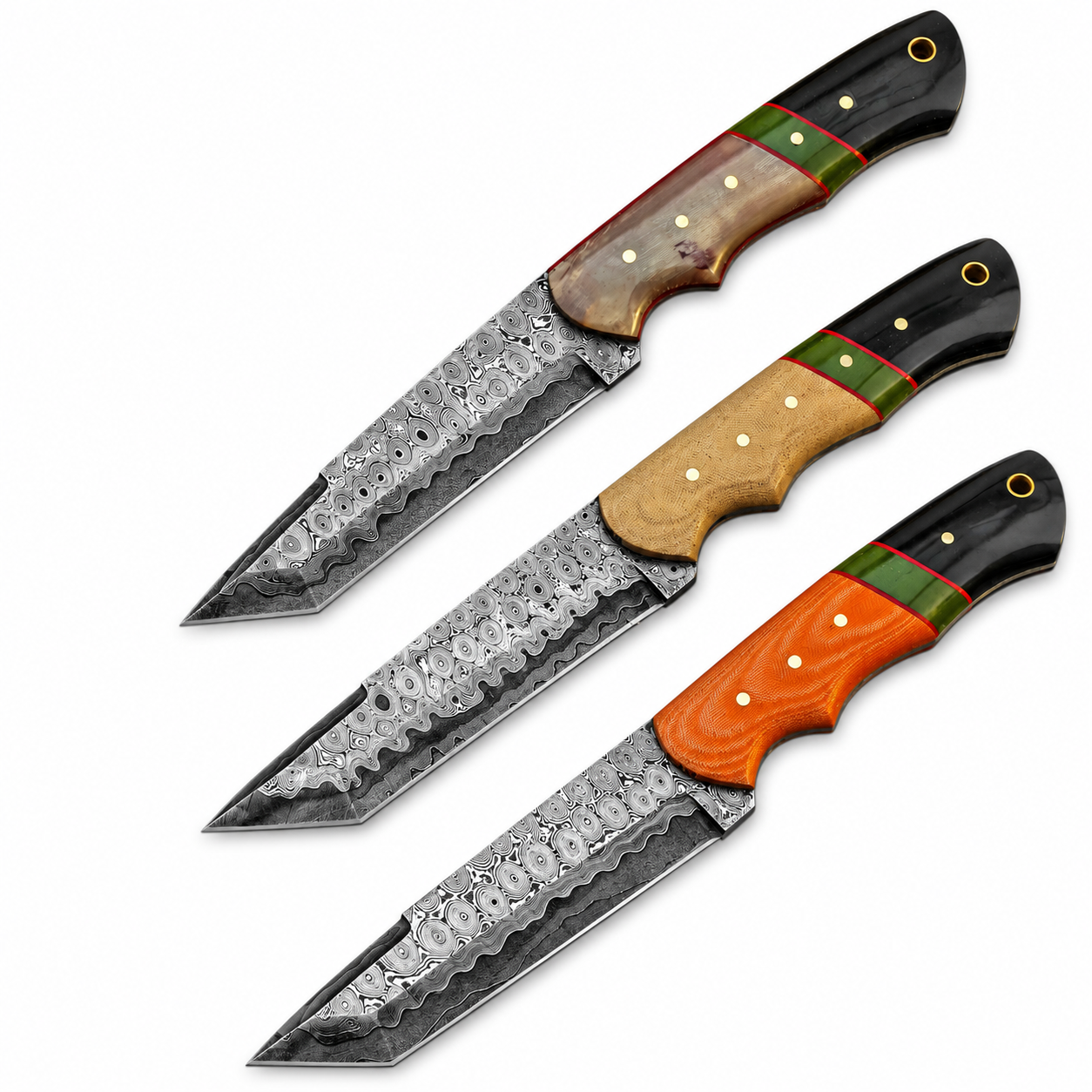
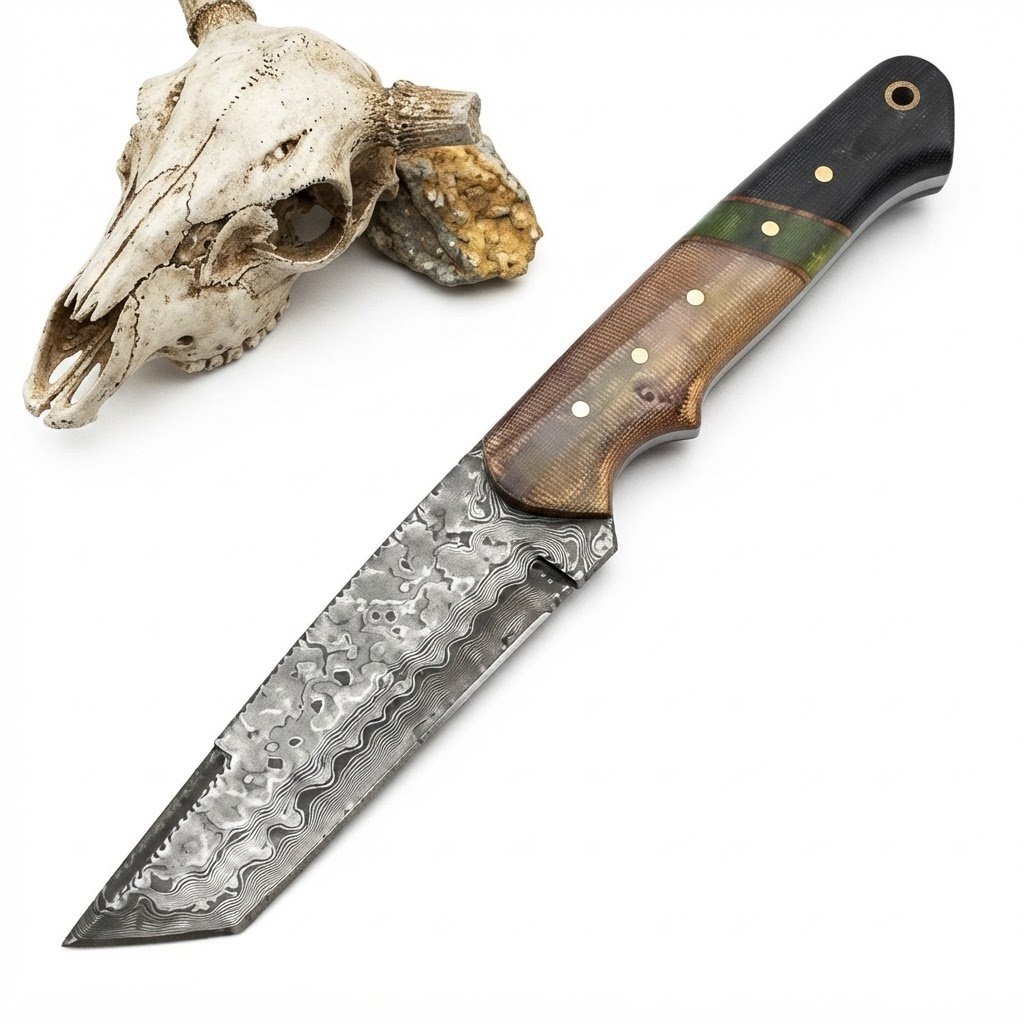
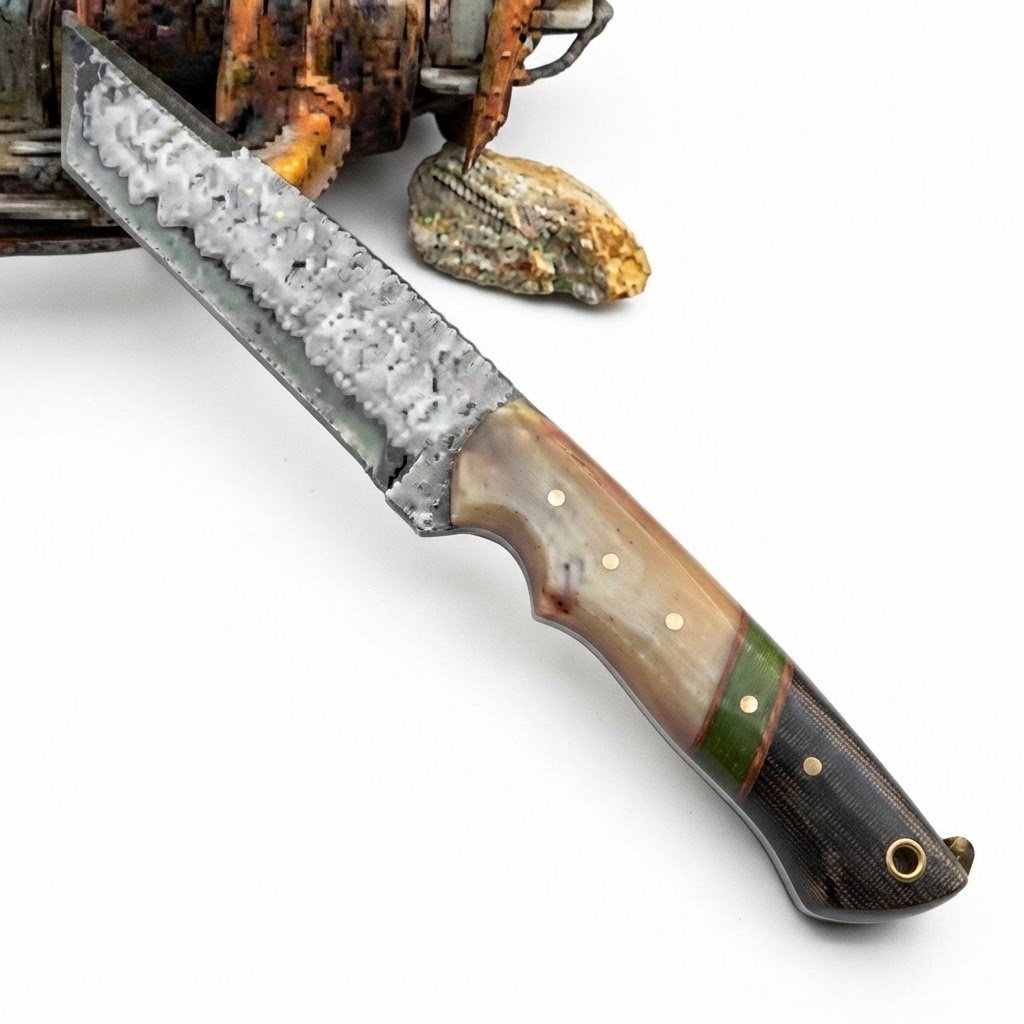
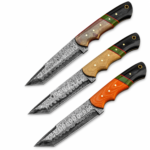
The supplied photographs show related versions of this design. The individual knife has a mottled cream-and-brown handle front and an irregular, textured-looking blade face. The group photograph shows three knives with more clearly defined circular blade patterns and cream-brown, tan, and orange handle fronts. Each retains the green band, dark rear section, and gold-tone fittings.
These differences are part of the product’s visual identity and should guide the choice of image and configuration. The photographs establish appearance, but they do not confirm that every pictured combination is available to order. They also do not establish a three-piece package.
For buyers who appreciate angular blades and contrasting handle sections, this design offers a clear departure from a plain, single-color knife. Its strongest confirmed features are its shape, color arrangement, visible hardware, and decorative surface details. Technical specifications should be checked separately when deciding whether a particular configuration meets your practical needs.
An Angular Tanto-Style Blade Profile
The most recognizable feature is the blade’s angular tip. Rather than following one continuous curve toward the point, the outline changes direction near the front. A longer main edge meets a shorter angled section, producing the distinctive geometric appearance associated with tanto-style knives.
The blade has a broad, elongated face, giving its surface finish a prominent place in the overall design. Its proportions create a visually substantial profile, although the actual blade length and thickness cannot be determined from the photographs.
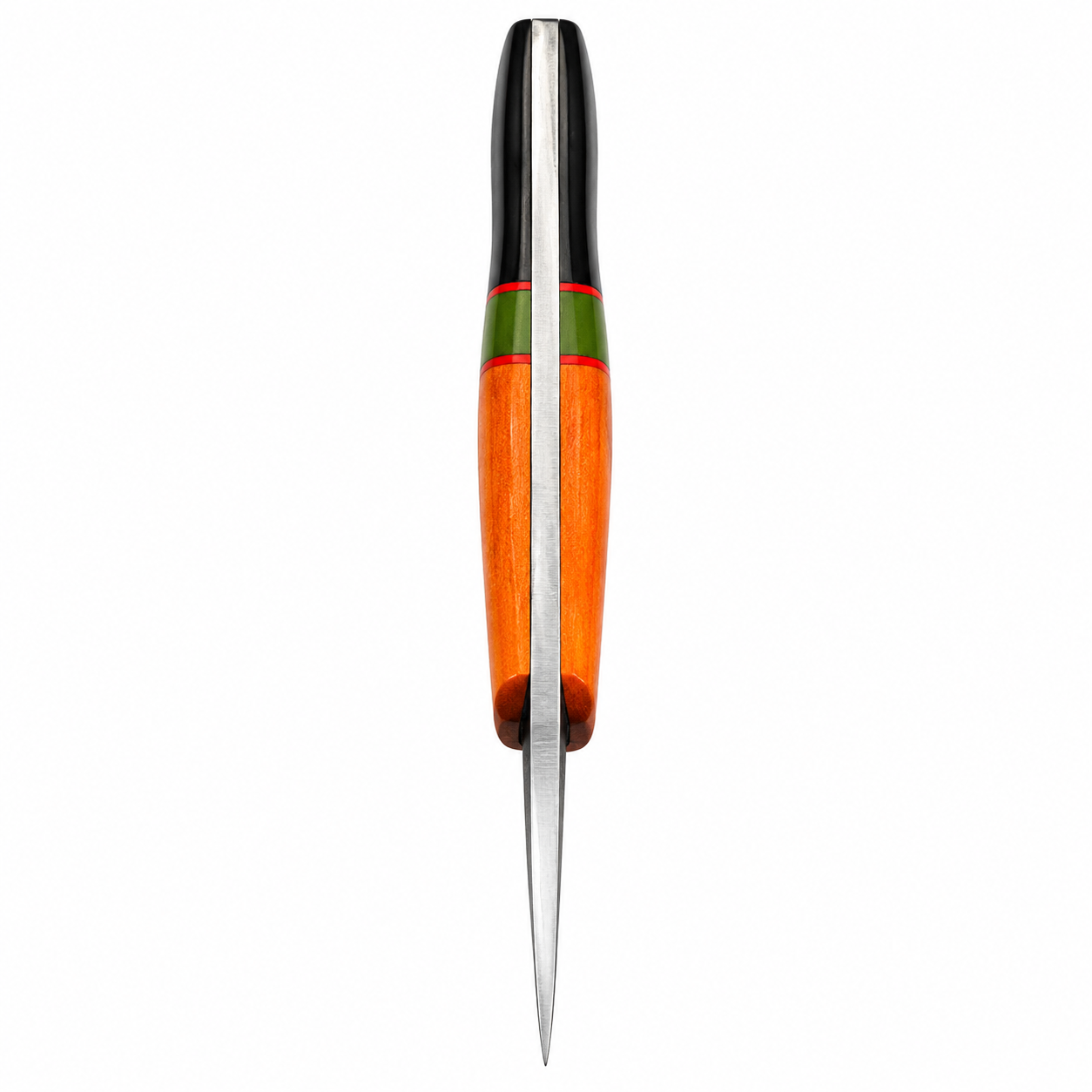
There are no visible serrations along the cutting edge. The main edge appears relatively straight, with a pronounced transition near the tip. This makes the blade silhouette easy to distinguish from a rounded drop-point profile or a narrow fillet-style blade.
“Tanto-style” describes the visible shape here. It does not establish Japanese manufacture, a traditional forging method, a particular steel composition, or a tested level of strength. Those are separate product attributes that require documentation.
If blade geometry is important to your purchase, compare the exact dimensions and edge configuration of the supplied model. The photographs show its general outline clearly, but they do not reveal the sharpening angle, edge thickness, or cutting performance.
Two Different Blade Finishes in the Photographs
The individual knife and the knives in the group photograph do not have the same visible blade finish.
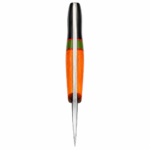
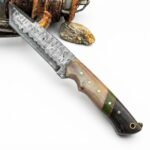
In Image 1, the blade face has irregular pale and dark areas with a rough, textured appearance. The surface looks unevenly mottled, with a darker region closer to the edge. This gives the knife a rustic visual character.
The photograph does not show how that finish was produced. It would therefore be inaccurate to confirm that the blade was hand-hammered, hand-forged, or made using a particular treatment solely from its appearance.
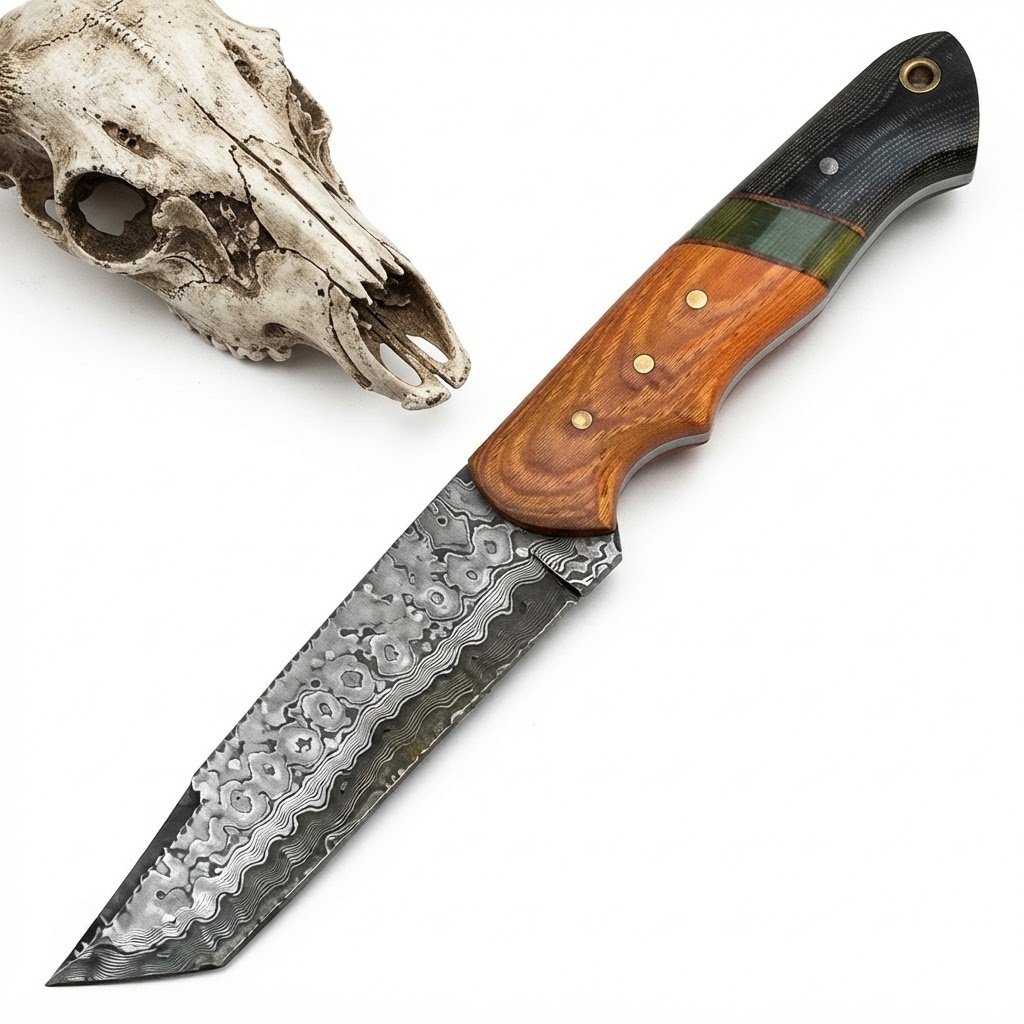
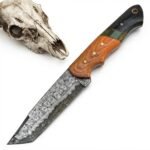
Image 2 presents a different look. The three blade faces have repeated circular and oval markings, surrounded by fine contrasting lines. Near the cutting edge, a darker band is separated from the upper pattern by a wavy boundary.
These markings resemble Damascus-style patterns, but the image alone cannot confirm genuine pattern-welded construction. It also cannot establish a layer count, core steel, heat treatment, or the method used to create the contrast.
For a purchase based on appearance, this distinction is important. The irregular finish in the first photograph and the more defined circular pattern in the second create noticeably different impressions. The image associated with the chosen configuration should represent the finish that will actually be supplied.
A Handle Built Around Three Contrasting Sections
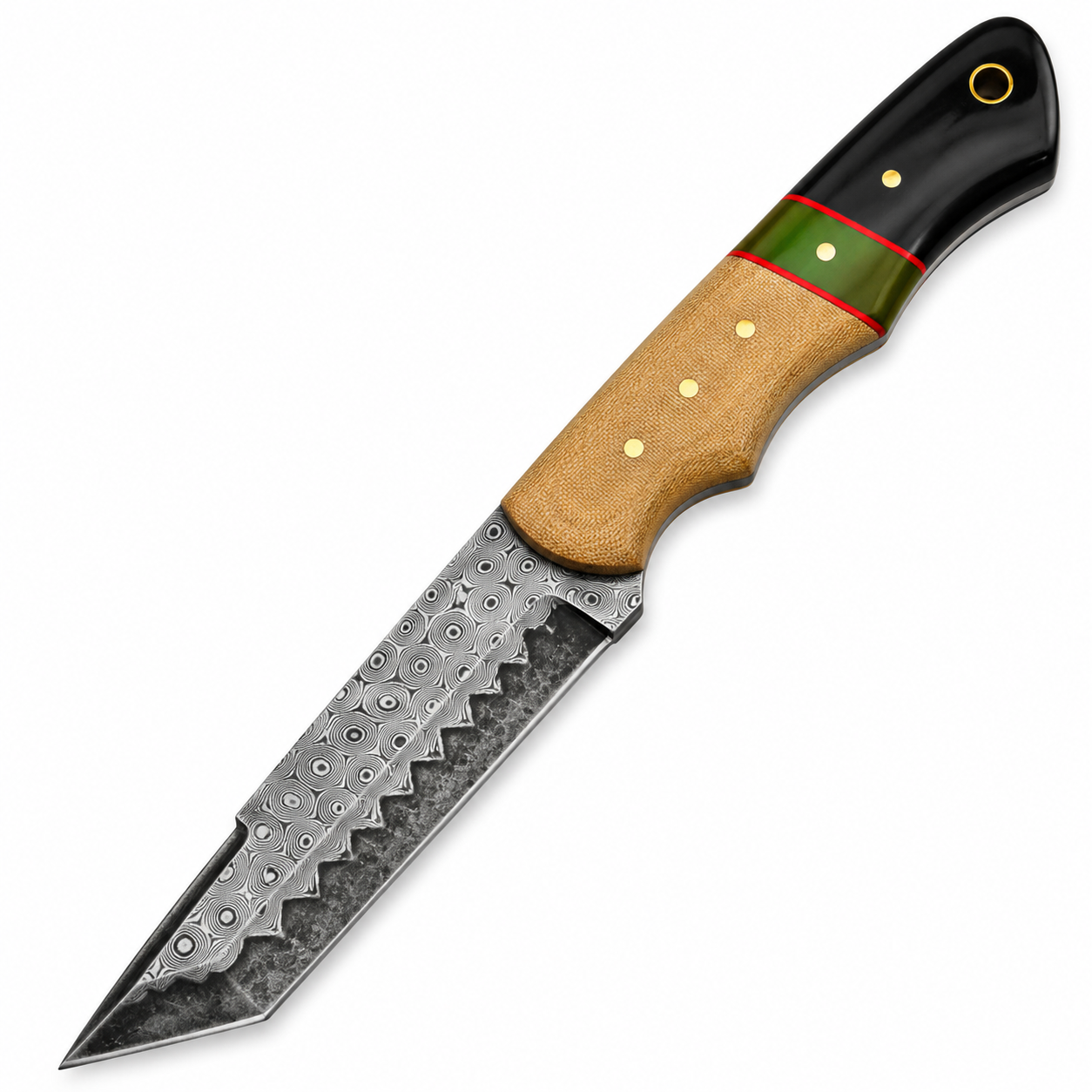
The handle’s color arrangement is a central part of the design. A larger front section leads into a narrower green band, followed by a dark rear section. This division gives the grip a coordinated appearance without relying on a large logo or printed decoration.
The front section occupies most of the area nearest the blade. In the individual photograph, it appears cream, beige, and brown, with darker patches and subtle streaking. Its variation in tone gives it an organic appearance, although the underlying material is not confirmed.
The green band provides a stronger, more concentrated color accent. It stands out against both the lighter front and the dark rear. Narrow reddish or brownish dividing lines emphasize the changes between sections.
At the back, the handle becomes dark brown or black. The individual photograph shows a fine woven-looking texture, while the group photograph shows smoother-looking dark sections with streaks and reflections.
These differences should not be attributed to a specific material without confirmation. Bone, horn, wood, resin, Micarta, and other composites can have overlapping visual characteristics in photographs. The listing therefore describes the colors and visible surface details without assigning an unsupported material name.
Cream-Brown, Tan, and Orange Handle Appearances
The group photograph shows three different front-handle appearances arranged from top to bottom.
The upper knife has a mottled cream-and-brown front section. Its pale base includes darker marks and a slightly translucent-looking visual effect in places. This color combination is the closest to the front section seen in the individual photograph, although that similarity does not prove that the two knives are the same model or specimen.
The middle knife has a more consistently tan or golden-brown front section. Fine surface markings are visible, and the warmer color gives it a different appearance from the paler upper knife.
The lower knife has a vivid orange front section with lighter linear markings. It creates the strongest contrast with the green band and black rear portion, making it the most colorful of the three pictured designs.
All three share a similar arrangement of pins and a lined hole near the handle end. That repeated layout creates a consistent visual theme across the group.
These are pictured color configurations rather than verified stock options. Availability, exact color names, and the ability to select a particular combination need to be confirmed before ordering. The photographs do not establish that colors can be mixed, substituted, or customized.
Contoured Grip with a Defined Front Recess
The handle has a shaped lower edge rather than a simple straight outline. Near the blade, a pronounced inward curve forms a finger recess. Farther back, the grip changes width before broadening toward the butt.
This shaping gives the knife a flowing handle profile that contrasts with the straighter lines of the blade. It also makes the transition between blade and grip visually clear.
The photographs show the contour, but they cannot establish comfort for every user. Handle length, thickness, balance, surface finish, and hand size all affect how a knife feels in use. None of those measurements has been supplied.
For this reason, the grip is described as contoured rather than guaranteed to be ergonomic or non-slip. A surface that looks textured may feel different when handled, and the group image shows a different surface appearance from the individual photograph.
Buyers comparing knives for practical use should check handle dimensions alongside blade dimensions. The shape can help narrow down a preference, but measurements or hands-on experience are needed to assess personal fit.
Gold-Tone Pins and a Lined Lanyard Hole
Five small gold-tone pins are visible on the photographed side of each design. Three are positioned in the larger front section, one sits in the green band, and one appears in the dark rear section.
Their repeated placement helps connect the different handle colors. The warm metallic tone is especially noticeable against the green and black areas, where it creates small points of contrast.
A larger gold-tone ring lines the hole near the butt. This opening is consistent with a lanyard hole, although no cord or lanyard is pictured.
The color of the hardware is visible, but its composition is not. It should not be described as brass, bronze, or another specific metal unless confirmed by the manufacturer.
Likewise, the pins and the metallic-looking strip visible around portions of the handle do not establish the complete internal construction. A full-tang specification should come from documentation or clear construction evidence for the exact model.
The visible fittings contribute to the appearance of a finished knife, but they should not be used to infer untested strength, impact resistance, or durability.
How the Blade and Handle Work Together Visually
The appeal of this design comes from the relationship between its angular blade and more curved handle. The blade gives the knife a geometric outline, while the grip introduces softer curves and several contrasting colors.
The green band serves as a visual link across all the pictured configurations. Whether the front section is pale, tan, or orange, the band remains a consistent feature. The dark rear portion provides a second point of continuity.
On the patterned versions, the circular markings across the blade add another layer of detail. Their small, repeated forms contrast with the larger blocks of color in the handle. On the individual knife, the irregular blade texture gives the overall appearance a rougher character.
These are aesthetic differences rather than quality rankings. A buyer may prefer the more rustic look of the first image or the more defined blade pattern in the second. Neither appearance, on its own, demonstrates better cutting performance.
When choosing between the pictured designs, consider which combination of blade finish and handle color you prefer. Confirming that exact combination is more useful than selecting only a broad color name.
Who May Appreciate This Design
This knife may appeal to collectors and enthusiasts who enjoy decorative fixed-blade designs. The angular tip, segmented handle, contrasting pins, and visible blade finish provide several details to compare with other pieces.
It may also interest shoppers looking for a visually distinctive gift for someone who already appreciates knives. The cream-brown and tan versions have a more muted appearance, while the orange version offers a brighter option.
No gift box, display stand, certificate, or presentation case is shown. The objects behind the individual knife are part of the photographic setting and should not be treated as included accessories.
For customers seeking a working outdoor knife, the photographs provide an initial design reference. Suitability for camping, hunting, bushcraft, or other tasks must be assessed using the exact model’s specifications and manufacturer guidance.
The product should not be selected for demanding tasks solely because it has a broad blade or angular point. Appearance is one part of the decision; documented construction and intended use are equally important.
Specifications That Help You Make a Useful Comparison
The most useful measurements to confirm are overall length, blade length, blade thickness, handle length, and weight. Together, these provide a clearer idea of the knife’s size than a photograph without a scale reference.
Steel information is another important part of the specification. The blade’s pattern or texture cannot establish whether it is stainless steel, carbon steel, a laminated construction, or another material. Hardness and heat-treatment claims also need to apply to the exact product.
Handle material should be confirmed for each section if different materials are used. This is particularly relevant here because the front, center, and rear have visibly different appearances.
If internal construction matters to your selection, request a clear tang specification. Do not assume it from the presence of pins or a visible perimeter strip.
Finally, confirm the finish and color configuration that will be supplied. The two uploaded images show enough differences that a clear product selection is necessary. The individual textured knife should not automatically be represented by the patterned group image.
What the Photographs Show About Package Contents
The first image contains one knife. The second contains three knives arranged together. Neither photograph includes a sheath, storage case, sharpening tool, or lanyard.
A group photograph can illustrate several designs without defining the quantity included in an order. For that reason, the second image should not be described as a three-piece knife set unless the seller confirms that the three pictured knives are supplied together.
The same care applies to the individual image. Its decorative background objects are not evidence of included accessories, and the small visible details around the handle do not establish a separate attachment package.
Before purchasing, check the stated selling unit and package contents. A clear listing should specify whether the order contains one selected knife, multiple knives, or another agreed configuration.
No accessory is promised in this description beyond the knife design being discussed.
Care and Maintenance Information
The photographs do not provide manufacturer-approved care instructions. Cleaning, sharpening, corrosion prevention, and storage recommendations depend on the actual blade and handle materials.
A decorative blade finish may require different treatment from a plain polished surface. Until the finish is identified, avoid assuming that a particular polishing compound, abrasive, or cleaning chemical is appropriate.
The same applies to the handle. Its contrasting sections may have different care requirements, especially if they are made from different materials. Material-specific instructions are more reliable than advice based only on color or appearance.
Dishwasher suitability, water resistance, and corrosion resistance have not been verified. No such claims are included here.
For sharpening, follow guidance for the actual edge geometry and steel once those details are available. The angular tip creates a visible change in edge direction, but the correct sharpening angle cannot be measured reliably from the supplied photographs.
Store the knife securely with an appropriate edge cover and keep it out of children’s reach. A compatible cover or sheath is not shown and would need to be confirmed separately.
Frequently Asked Product Questions
Is the blade genuine Damascus steel?
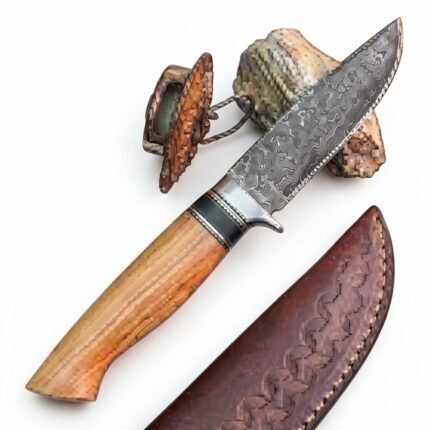
The blades in Image 2 have a Damascus-like circular pattern. Genuine Damascus construction, steel composition, and layer count cannot be confirmed from appearance alone. Image 1 has a different, irregular textured finish.
Is the handle made from bone, horn, or Micarta?
The exact materials are unverified. The photographs show contrasting colors and textures, but those appearances are not sufficient to identify the materials accurately.
Are all three knives included?
The group photograph shows three knives, but it does not confirm a three-piece package. Order quantity and the selected configuration must be stated separately.
Does the knife come with a sheath?
No sheath is visible in either uploaded image. Sheath inclusion should not be advertised without confirmation.
Are the pins brass?
The pins and lanyard-hole lining appear gold-tone. Their metal composition is not established.
Can I choose a different color or blade pattern?
The images show several appearances, but they do not confirm customization or current availability. Check the exact configuration offered before ordering.
Choose the Appearance That Matches Your Preference
The multicolor handle tanto knife combines an angular blade with a more detailed, contrasting grip. Its green accent band, dark rear section, gold-tone fittings, and shaped handle provide a consistent design theme across the photographs.
The differences remain important: one image shows a single knife with an irregular textured blade, while the other shows three circular-patterned examples with different front-handle colors. Matching the selected photograph to the supplied product will help ensure that your choice reflects what you receive.
Explore the pictured finishes and color combinations, review the confirmed specifications and package contents, and select the configuration that suits your preferences and intended use.








Reviews
There are no reviews yet.