









Purple Handle Ring-Pommel Knife – Decorative Metalwork and Design Reference
Introduction
The Purple Handle Ring-Pommel Knife is a distinctive example of contemporary fixed-blade design. Its appearance brings together a patterned silver-gray blade, a purple handle with visible wood-grain-like markings, four gold-colored circular pins, and an oversized decorative ring at the handle’s end.
The object differs visually from many conventional straight-handled knife designs because of its circular terminal feature and curved blade profile.
The accompanying photographs show the object from several perspectives, including a complete side view, a close-up of the ring and handle, a repeated five-view arrangement, and presentations featuring a tan-brown sheath.
These images provide information about the object’s visible construction, decorative patterning, surface textures, and color relationships.
However, the photographs do not establish exact materials, manufacturing processes, physical dimensions, or mechanical specifications.
1. Overall Design and Appearance
The knife has a fixed-blade configuration. Its blade remains extended from the handle rather than folding into it.
The elongated blade has a gently curved silhouette and a broad, rounded-looking front profile.
The purple handle connects the patterned blade to a large circular metal ring.
This ring is one of the most recognizable elements of the overall design.
The combination produces a long horizontal silhouette in the repeated-view photograph.
In the individual images, the knife is positioned diagonally to show the relationship between its blade, handle, and circular terminal.
2. Damascus-Style Blade Pattern
The blade displays numerous dark and light metallic lines.
These lines run across the blade surface in irregular, flowing arrangements.
Some areas contain fine, parallel-looking bands, while other sections form more complex organic patterns.
The appearance resembles the characteristic surface patterns associated with Damascus-style metalwork.
It is important to distinguish this visible appearance from a confirmed material specification.
A Damascus-style pattern does not independently establish that the blade was manufactured using pattern-welding techniques.
The exact alloy and production process would need to be verified using reliable technical documentation.
3. Curved Blade Silhouette
The blade has a long, comparatively narrow form with a rounded front section.
Its upper outline contains a gentle curve.
The lower profile also changes gradually along the blade length.
Near the handle, an angular transition separates the decorated blade from the purple grip.
The general outline is visible in both the full-length and repeated-view photographs.
These images establish the external shape but provide no calibrated measurements.
Consequently, the blade length, width, thickness, and overall object weight remain unknown.
4. Pattern Variation Across the Blade
The decorative metallic pattern changes across the blade.
Near the handle, several lines appear comparatively straight and closely spaced.
Toward the rounded front section, some of the patterns become more irregular.
A combination of lighter silver-gray and darker gray lines creates visual depth.
The pattern appears across much of the visible blade face.
This surface decoration is a major part of the object’s visual identity.
5. Purple Handle Coloration
The handle has a violet-purple color with variations in intensity.
Some sections appear lighter lavender, while others are a deeper purple.
The surface also displays numerous elongated lines resembling wood grain.
These lines follow the handle’s general length.
The resulting appearance suggests a layered or textured decorative material.
However, the photographs do not establish whether the handle is wood, stabilized wood, resin, or another composite.
The accurate description is therefore a purple handle with wood-grain-like texture.
6. Handle Contour and Shape
The handle has a shaped underside rather than a completely straight profile.
A distinct inward curve appears near the front portion.
The handle becomes broader as it approaches the circular terminal.
Its upper edge is relatively straight across most of its length.
These external contours contribute to the object’s recognizable profile.
The photographs document appearance but cannot establish ergonomic properties or internal structural construction.
7. Gold-Colored Circular Pins
Four small circular details appear along the purple handle.
They have a warm gold or brass-like coloration.
The circular details are positioned at intervals.
Their repeated shape contrasts with the irregular purple surface markings.
They resemble fastening pins, but the exact construction is not visible.
It would be inaccurate to identify their metal composition or internal attachment method without manufacturer specifications.
8. Decorative Circular Ring
The ring at the handle’s end is a particularly distinctive feature.
It forms a large circular opening surrounded by a silver-gray metal band.
The outer and inner surfaces display decorative concentric patterns.
These patterns resemble the swirling and layered appearance of the blade.
The repeated circular motifs create a visual relationship between the blade and the ring.
The ring’s exact dimensions, material, and manufacturing method remain unverified.
9. Ring Surface Pattern
The metal ring features numerous small, curved decorative forms.
Some resemble concentric circles.
Others appear as irregular bands or wave-like markings.
The pattern covers much of the ring’s visible surface.
This ornamentation gives the terminal more visual detail than a plain metal ring.
The close-up image provides the clearest view of these markings.
The visible pattern may resemble Damascus-style metalwork, although its manufacturing technique cannot be confirmed from photographs.
10. Relationship Between Ring and Handle
The decorative ring forms the final component of the handle silhouette.
Its silver-gray finish contrasts with the purple coloration.
The circular opening creates negative space within the otherwise solid-looking object.
The transition between purple handle and patterned metal ring is visible in several photographs.
The combination of a rectangular handle section and a circular terminal creates a distinctive geometric contrast.
11. Violet and Metallic Color Composition
The knife’s primary colors are violet-purple and silver-gray.
Small gold-colored circular details introduce warmer accents.
The purple handle visually separates the patterned blade from the patterned terminal ring.
Because both metallic sections have gray decorative patterns, they appear related in style.
The gold-colored pins provide additional contrast without dominating the design.
This limited color palette helps make the object’s main components easy to distinguish.
12. Handle Texture and Decorative Layering
The purple handle has a directional surface pattern.
Fine lines extend along its length, creating a wood-grain-like appearance.
Different shades of violet add visual variation.
In the close-up photograph, the grain-like pattern appears particularly prominent.
Some regions have darker streaks, while others reflect light more strongly.
These observations are descriptive rather than evidence of a specific material.
13. Tan-Brown Sheath
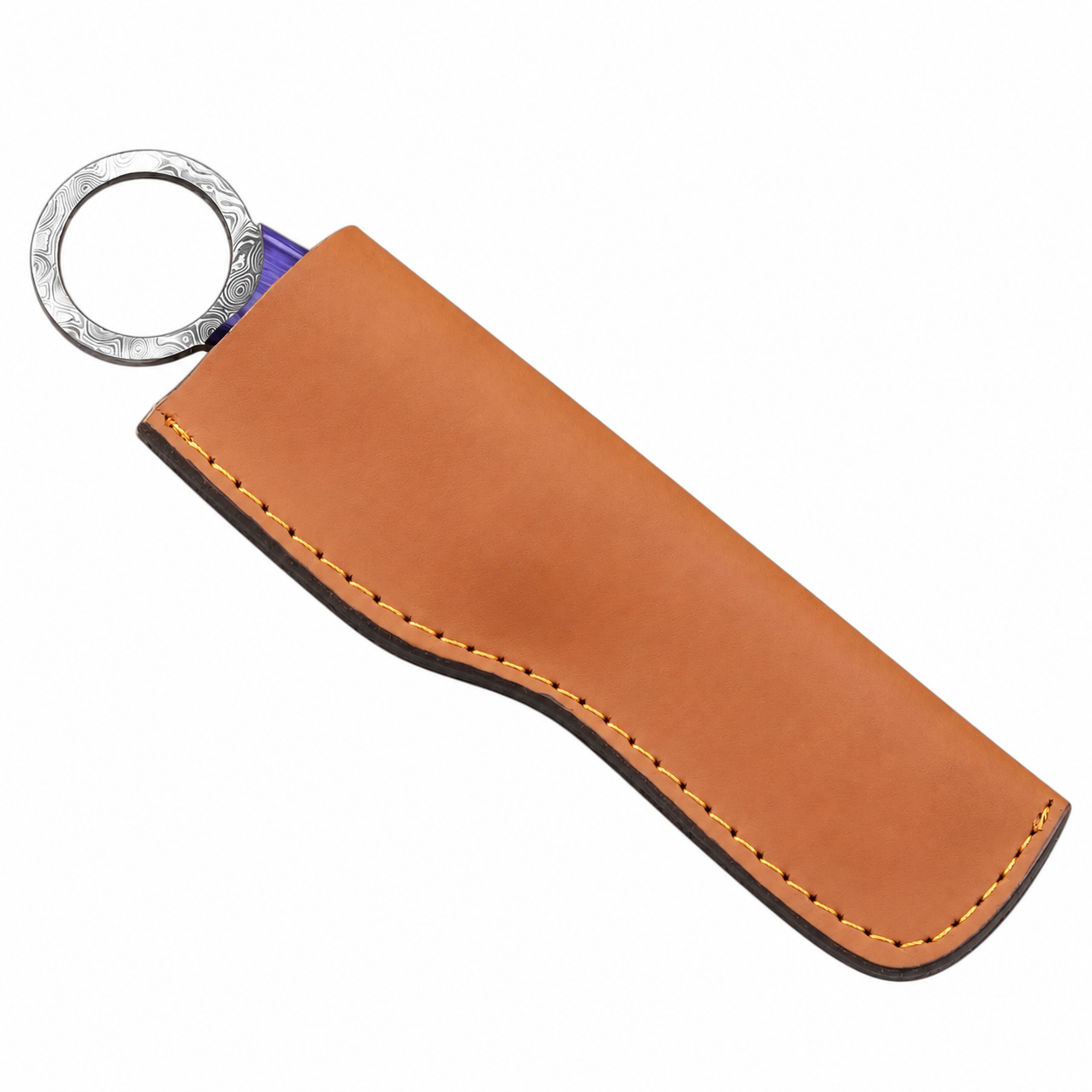
Two of the photographs include a tan-brown sheath.
The sheath has a smooth, leather-like surface with darker edge trim.
Yellowish stitching follows much of its perimeter.
Its outline is comparatively rectangular with gently rounded corners.
The first photograph shows the knife largely enclosed, with the circular ring remaining visible.
Another photograph shows the knife placed diagonally across the sheath.
These views document the relationship between the objects.
14. Contrasting Sheath Stitching
The sheath’s yellow-colored stitching forms a narrow decorative border.
Individual stitches are visible along its outer edge.
This line contrasts with the tan-brown surface.
A dark border adds definition to the perimeter.
The combination creates a relatively traditional-looking appearance.
The exact sheath material and thread composition remain unknown.
15. Sheathed Presentation
The first photograph shows the knife within its sheath.
Most of the object is covered.
The circular metal ring remains clearly visible above the sheath opening.
A small section of the purple handle can also be seen.
This image emphasizes the ring’s size and decorative pattern.
It also documents the sheath’s color and visible construction.
16. Repeated Five-View Arrangement
The second photograph contains five horizontal repetitions of the knife design.
Each view highlights the patterned blade, purple handle, metallic pins, and circular ring.
The repeated composition makes the object’s proportions easier to compare visually.
It also shows how consistently the main decorative elements are represented.
However, this image does not necessarily establish that five distinct manufactured objects were photographed.
It may be a digitally composed arrangement.
17. Full-Length Side View
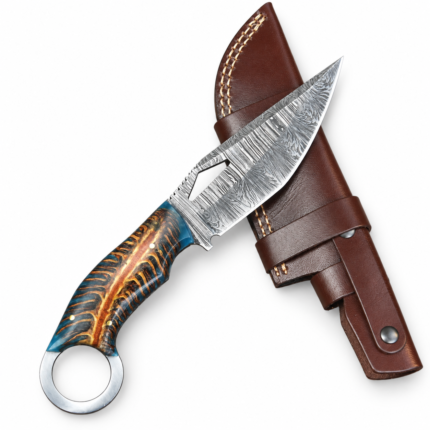
The third photograph presents the complete knife diagonally against a white background.
The circular ring appears toward the lower left.
The patterned blade extends toward the upper right.
The purple handle forms the central section.
This image provides a clear view of the complete silhouette.
Its plain background makes the different materials and decorative features easier to distinguish.
18. Knife Displayed with Sheath
The fourth photograph shows the knife positioned across the tan-brown sheath.
The blade extends toward the lower left, while the ring appears toward the upper right.
The brown sheath provides a contrasting background.
Its simple surface allows the knife’s patterned metal sections and purple handle to remain prominent.
This composition documents both objects together without providing technical specifications.
19. Ring and Handle Close-Up
The fifth image focuses on the purple handle and ring.
The four circular metallic details are visible.
The handle’s grain-like markings can be examined more closely.
The ring displays numerous decorative circular patterns.
The image also reveals the relationship between the purple material and the silver-gray metal.
These features help document the object’s appearance.
20. Decorative Metalwork Traditions
Patterned metallic surfaces have appeared in many craft traditions.
Different processes can create visible contrasts between regions of metal.
Such patterns may resemble waves, lines, concentric circles, or irregular bands.
The blade and ring shown here resemble this broader decorative approach.
Their patterns introduce visual complexity into otherwise simple geometric forms.
Determining their actual manufacture would require independent evidence.
21. Contemporary Handle Design
Colored handles have become a recognizable element in contemporary decorative object design.
Different colors and surface patterns can make objects visually distinctive.
The violet-purple finish shown here is particularly prominent.
The wood-grain-like markings create additional surface detail.
The gold-colored pins add small metallic accents.
Together, these features distinguish the handle from a plain, single-color example.
22. Geometric Contrast
The design combines several contrasting shapes.
The blade is elongated and curved.
The handle is comparatively straight with a contoured lower edge.
The terminal is circular.
The pins are small and round.
These shapes create a recognizable relationship between long, narrow forms and repeated circular elements.
The design’s appearance depends on this contrast as much as on its coloring.
23. Surface Finish and Lighting
The blade and ring have a muted silver-gray appearance.
The purple handle displays visible variations in brightness.
The gold-colored pins provide small reflective highlights.
The sheath has a comparatively smooth brown surface.
Lighting influences how each component appears.
As a result, slight differences between photographs should not automatically be interpreted as changes in material or finish.
24. Material Specifications Requiring Verification
A complete technical catalog record would require further information.
Important unverified details include:
- Manufacturer and model
- Blade alloy
- Blade manufacturing method
- Handle material
- Handle fastening construction
- Ring material
- Overall dimensions
- Blade dimensions
- Object weight
- Sheath composition
- Country of manufacture
- Production date
The photographs alone cannot reliably establish these specifications.
25. Accurate Descriptive Terminology
For an informational reference, visible features should be described without unsupported assumptions.
“Damascus-style patterned blade” accurately communicates the blade’s appearance.
“Purple wood-grain-like handle” describes its coloration and texture.
“Gold-colored pins” avoids claiming a specific metal composition.
“Decorative circular ring” identifies the prominent terminal feature.
“Tan-brown leather-like sheath” describes the accompanying accessory without assuming genuine leather construction.
Such language helps maintain accuracy.
Conclusion
The Purple Handle Ring-Pommel Knife combines a curved Damascus-style patterned blade, a textured violet-purple handle, four gold-colored circular details, and a large patterned metal ring.
Its distinctive design is defined by the contrast between elongated and circular shapes.
The tan-brown sheath provides a separate accessory with visible stitching and dark perimeter trim.
Across the five photographs, the object is documented from complete, close-up, repeated-view, and sheathed perspectives.
The images provide a detailed visual reference, while the exact materials, dimensions, origin, and manufacturing processes remain unverified.






Reviews
There are no reviews yet.