

Green Band Tanto Knife with Black and Brown Handle
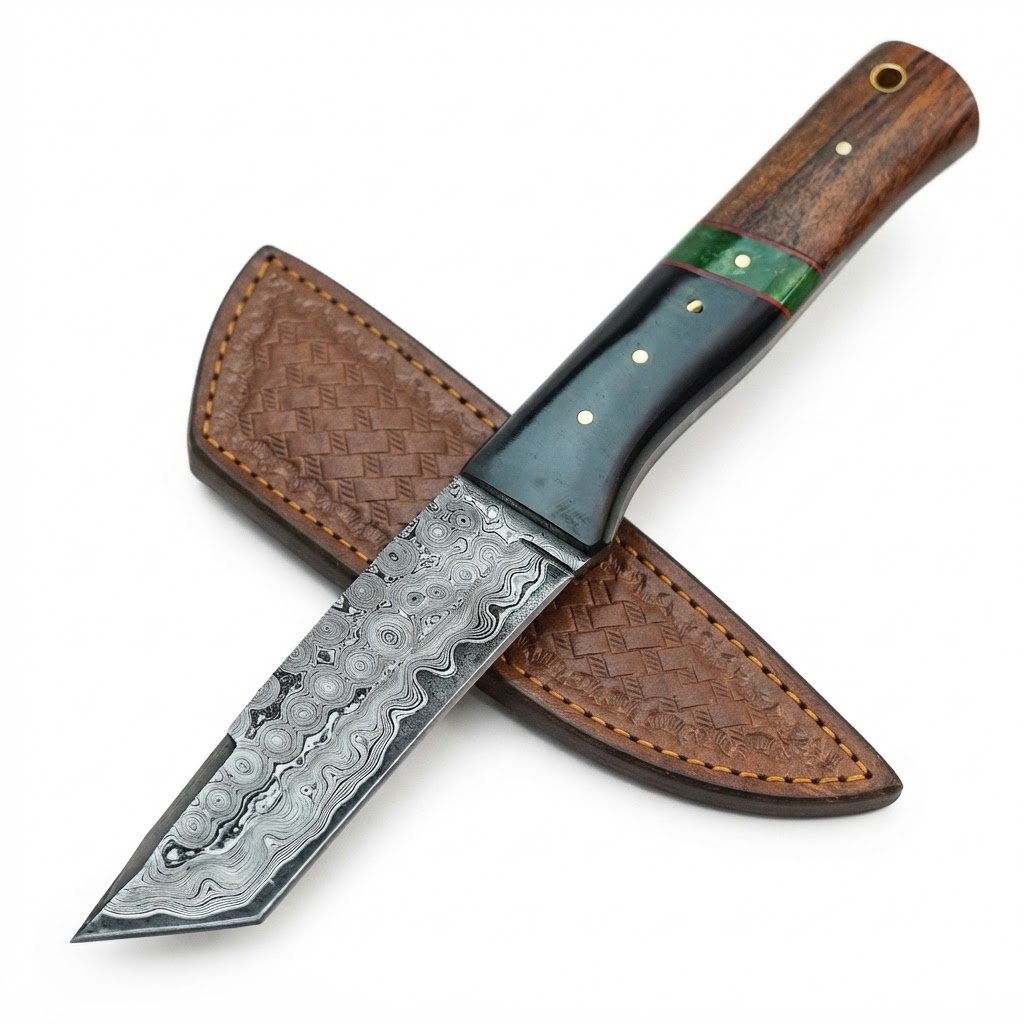
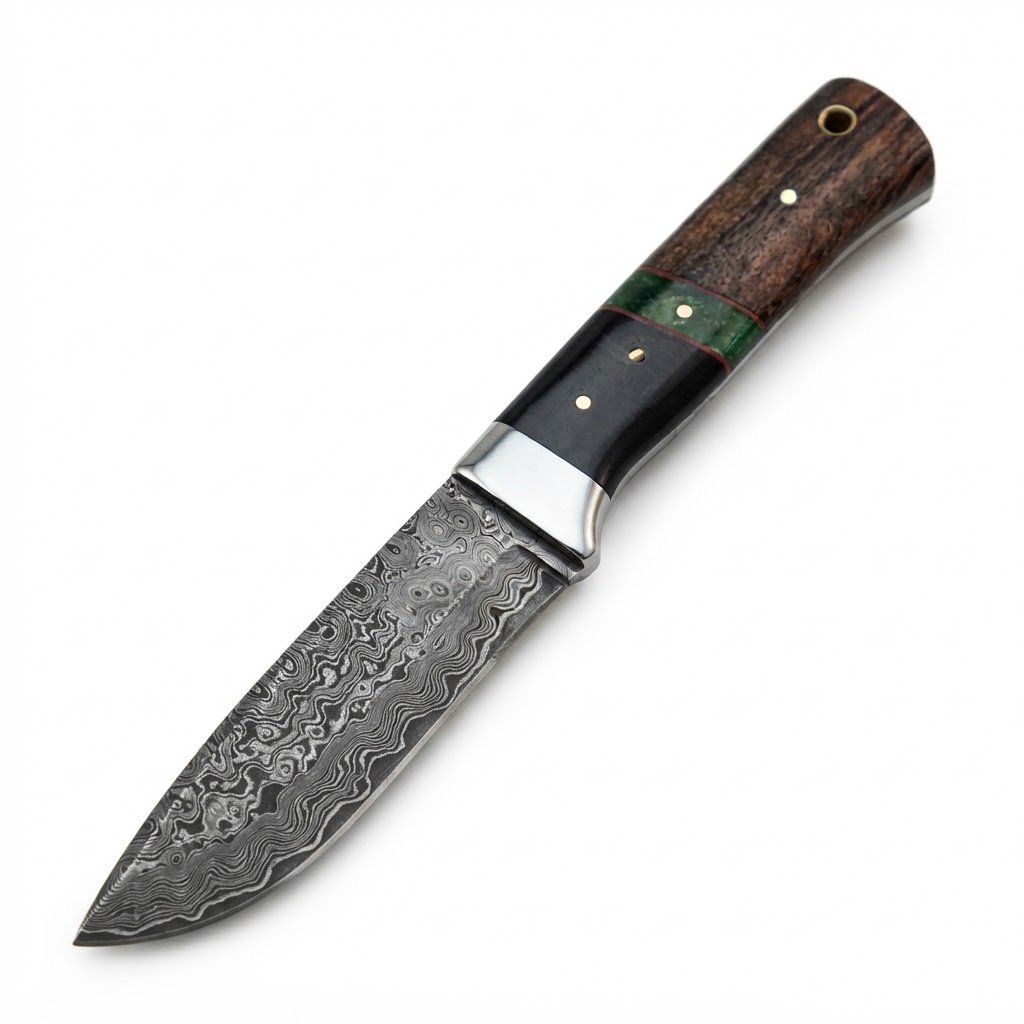
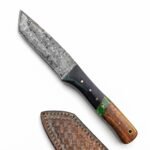
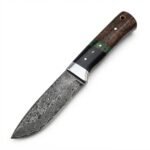
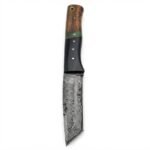
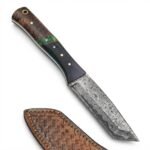
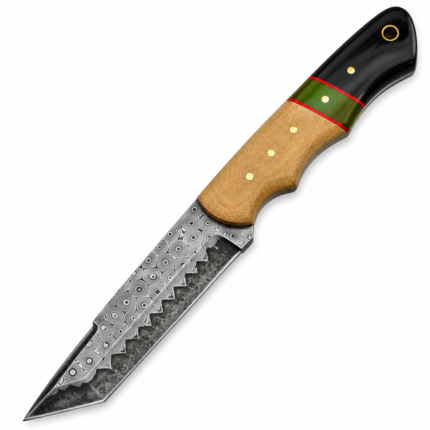
This green band tanto knife combines an angular patterned blade with a contrasting black-and-brown handle. A narrow green section separates the darker front grip from the warmer wood-grain appearance at the rear, giving the knife a recognizable color arrangement. Small gold-tone pins and a lined lanyard hole add further detail without distracting from the overall shape.
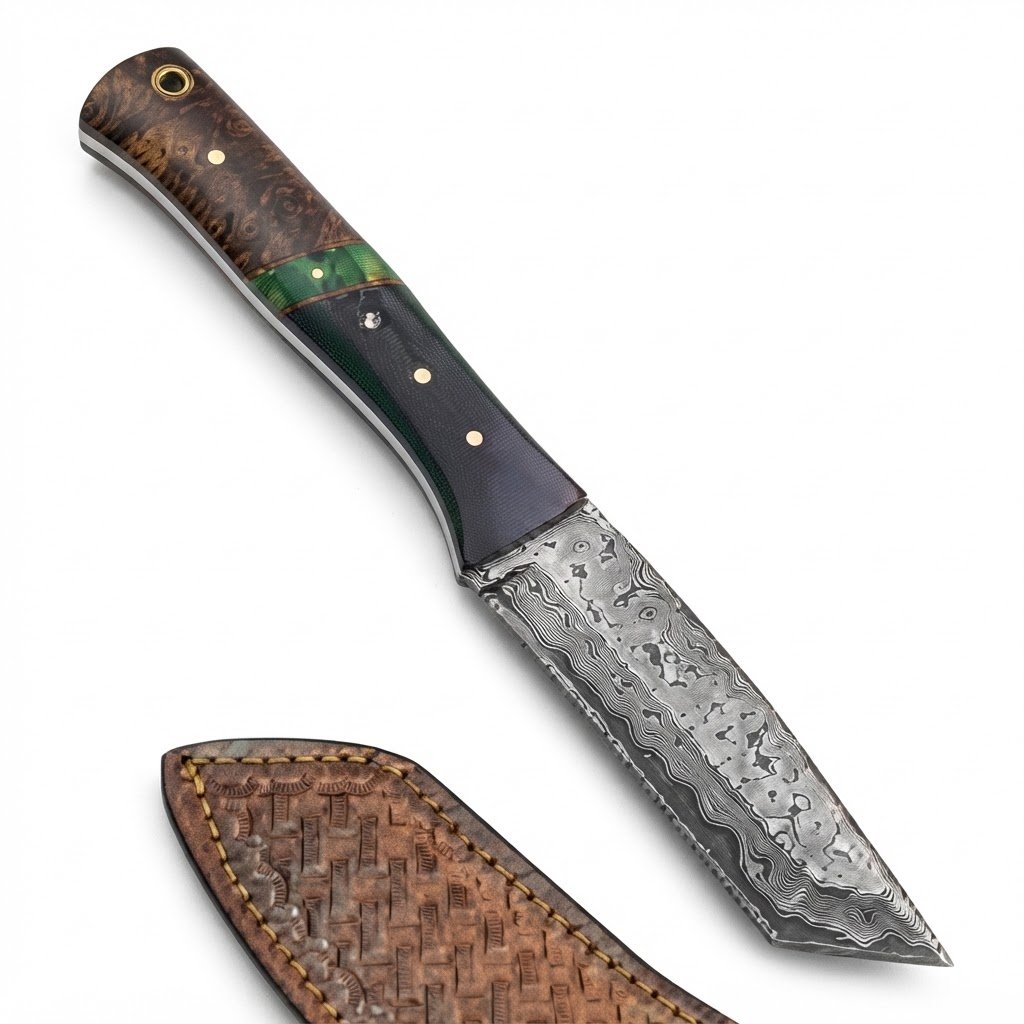
The blade features circular markings across its upper face and flowing lines closer to the cutting edge. Its angular tip gives the knife a geometric outline, while the handle introduces softer curves and a rounded end. A brown sheath with a basket-weave-style surface and contrasting perimeter stitching is pictured beneath it.
The design may appeal to buyers who appreciate decorative fixed-blade knives with a restrained color palette. Black, brown, green, and silver-gray form the main combination, supported by small warm metallic accents. Each section has a different appearance, yet the limited colors keep the presentation coordinated.
The photograph provides useful information about the design, but it does not establish the knife’s technical specification. Material composition, exact measurements, manufacturing method, and performance should be confirmed for the product supplied. The description below focuses on what is visible and explains the details that matter when making a buying decision.
A Distinctive Tanto-Style Blade
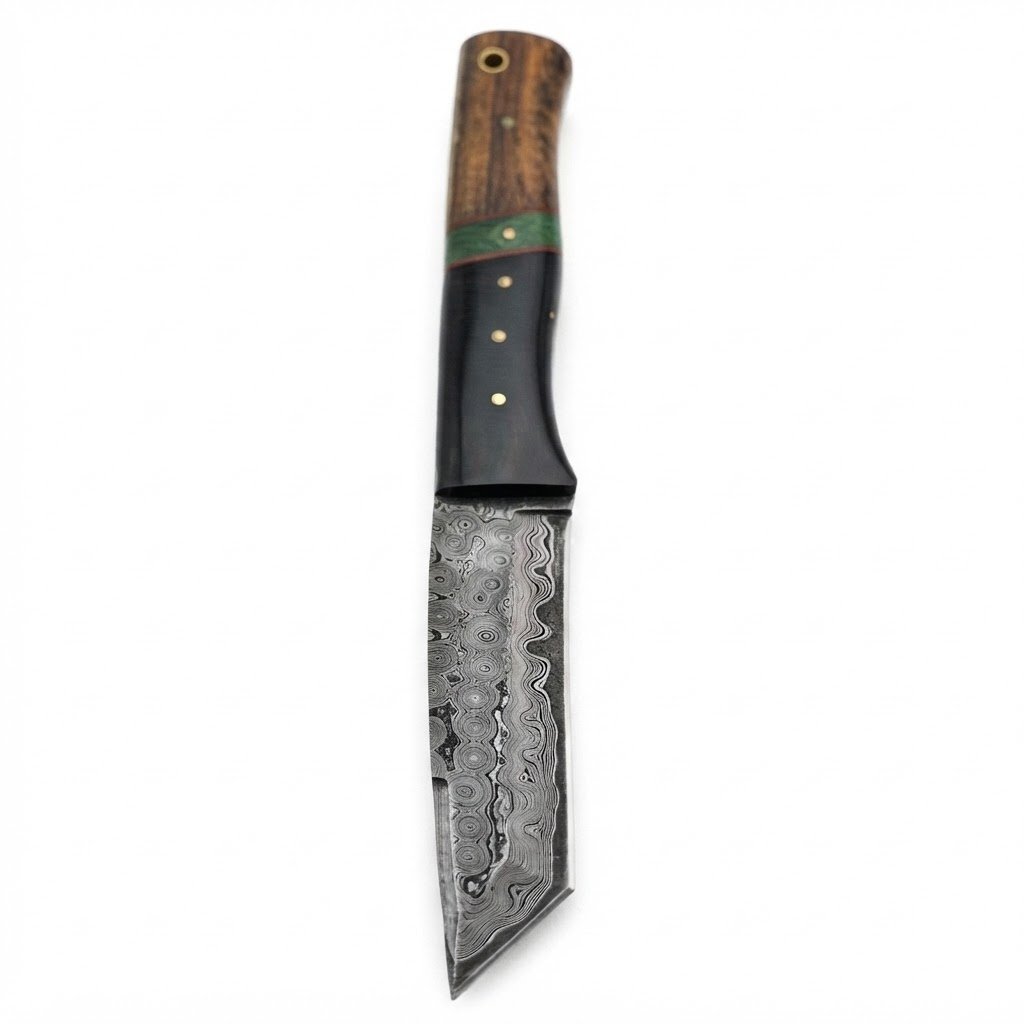
The blade’s most recognizable feature is its angular point. A longer main cutting edge meets a shorter angled section near the tip, creating a clear change in direction. This supports describing the profile as tanto-style.
The main blade section is elongated and relatively broad, providing a large surface for the visible pattern. Its outline remains straightforward through much of its length before narrowing into the angular front.
There are no visible serrations or a gut hook. The cutting edge appears continuous along the main section and angled tip. The photograph does not, however, establish the sharpening angle, edge thickness, or current sharpness.
“Tanto-style” describes the shape shown here. It does not imply Japanese manufacture, a traditional forging process, or any particular performance standard. Those attributes require separate documentation.
For customers comparing blade profiles, this angular outline is an important design distinction. It offers a different visual character from a rounded drop-point blade or a slender fillet-style knife. Practical suitability depends on the complete specification rather than the outline alone.
Circular and Flowing Blade Markings
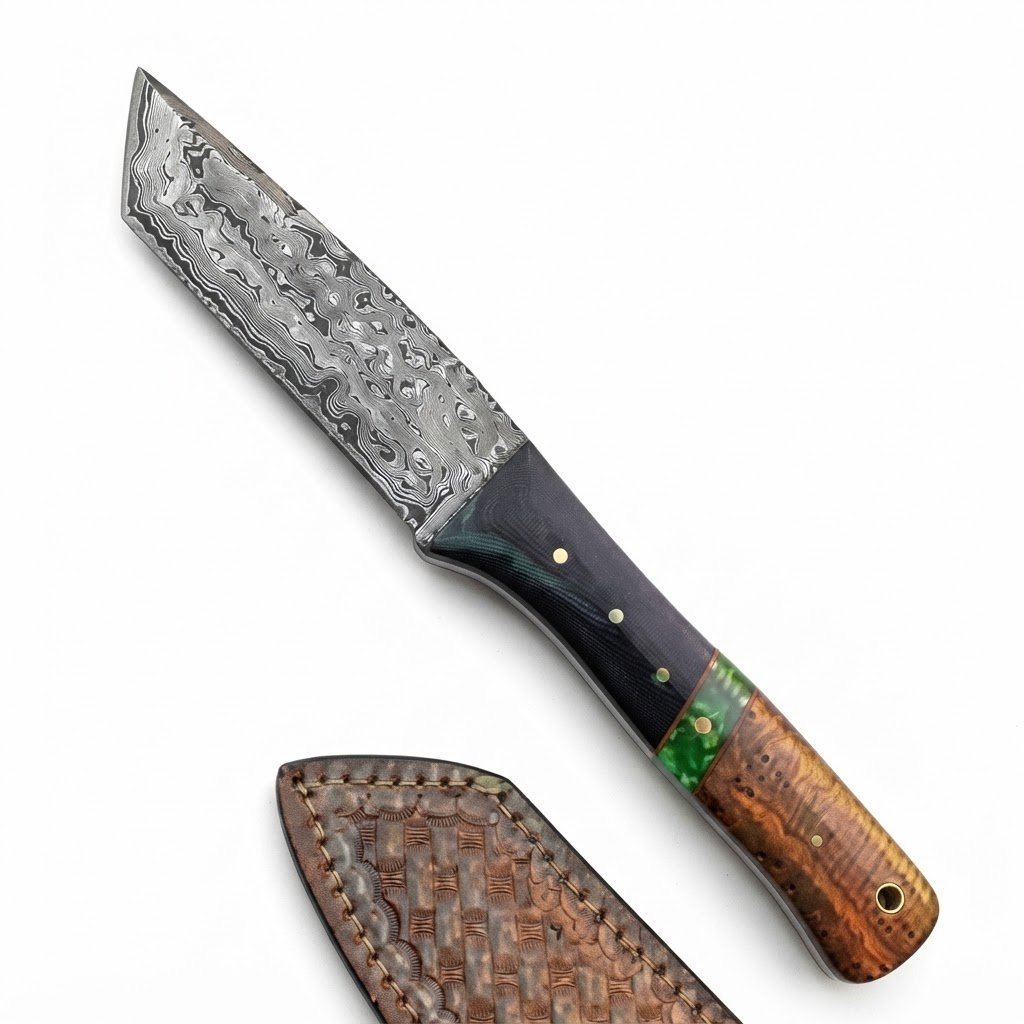
The blade face contains a high-contrast pattern of light and dark markings. Rounded forms with fine concentric lines appear across the upper portion, while longer waves follow the lower part of the blade toward the tip.
The pattern changes along the blade rather than repeating as a simple straight stripe. Some areas contain closely grouped circles; others have more stretched or irregular shapes. This variation gives the surface a detailed appearance.
A darker band near the cutting edge helps distinguish the blade’s outline from the patterned face. The lighter markings remain visible against it, especially where the flowing lines approach the angled tip.
This appearance resembles Damascus-style patterning. The photograph alone cannot establish whether the blade is pattern-welded, laminated, etched, or finished by another method. It also cannot confirm a layer count or identify the steels involved.
For that reason, “patterned blade” is the supported product description. Genuine Damascus construction should only be added when confirmed for this exact knife.
The pattern can be appreciated as a visible design feature while steel composition and performance are assessed separately. Decorative appearance does not establish corrosion resistance, hardness, edge retention, or toughness.
A Handle with Three Contrasting Sections
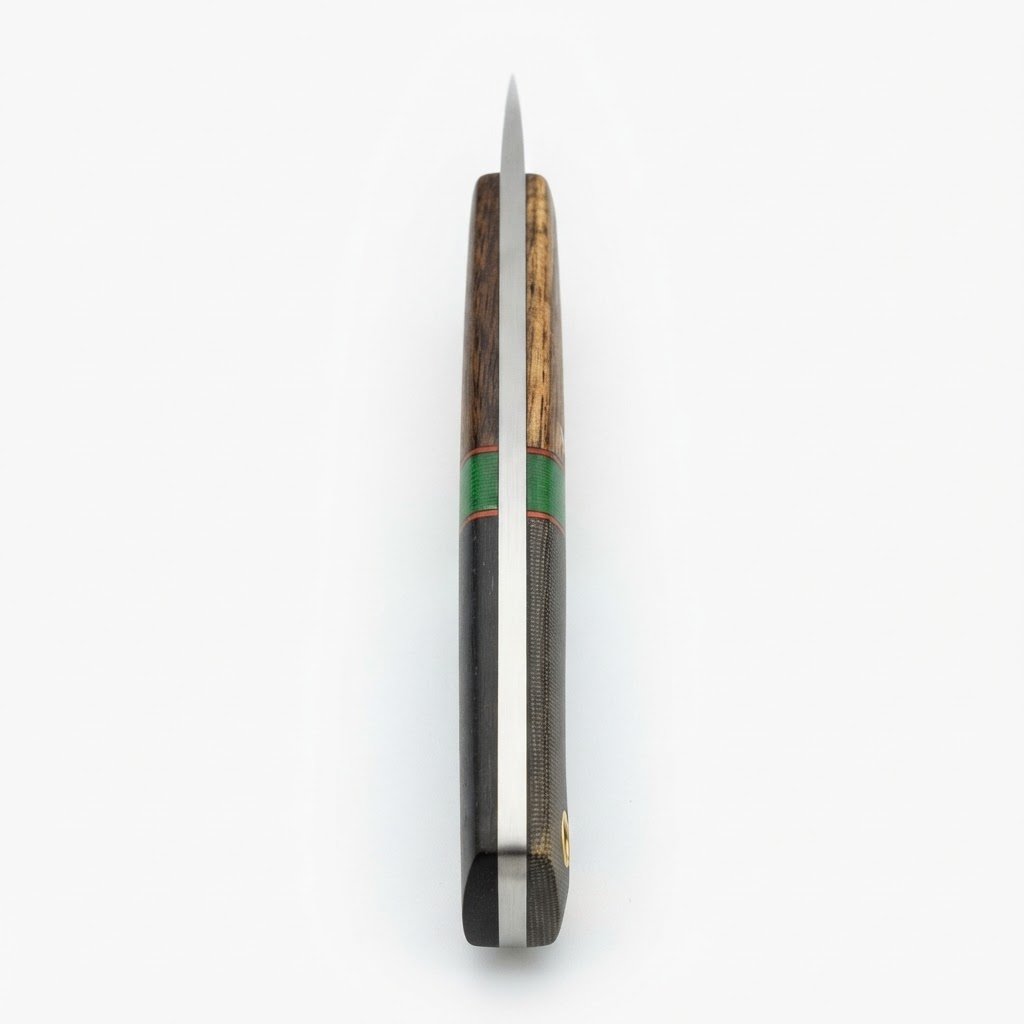
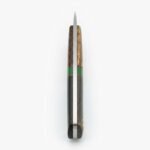
The handle is divided visually into three areas: a larger black front section, a narrow green band, and a brown rear section with grain-like markings. This arrangement is central to the knife’s appearance.
The black section begins immediately behind the blade and occupies much of the front grip. Its dark surface contrasts with the silver-gray pattern and creates a clear transition from blade to handle.
The green band introduces a concentrated accent between the two larger sections. It is bordered by thin reddish lines that make its boundaries more noticeable.
At the rear, the brown section adds warmth and a wood-grain appearance. Darker streaks run along its length, creating a different texture from the smoother-looking black front.
The photograph does not identify the materials used in these sections. Black does not confirm horn or resin, green does not confirm stone, and a wood-grain appearance does not establish a wood species. The colors and markings can be described accurately while the material specification remains open for confirmation.
Black Front Grip with a Shaped Lower Edge
The front grip has a black or very dark charcoal appearance with lighter reflections across its surface. Three small gold-tone pins are visible along this section.
Its lower edge curves inward before meeting the blade, giving the grip a shaped profile. The front of the handle is broader than the narrower area farther back, creating a gentle contour rather than a straight rectangular outline.
This shaping is visible, but it does not establish how the knife will feel in every hand. Handle thickness, length, surface finish, weight distribution, and personal grip preference all affect comfort.
The accurate description is therefore a contoured grip. Claims such as non-slip, fatigue-reducing, or ergonomically tested would require evidence beyond the photograph.
The black finish also provides a relatively plain visual area beside the detailed blade. This separation allows the blade pattern to remain prominent while the handle retains its own distinctive color arrangement.
For buyers who prefer darker grips but want some variation, the black front offers a subdued foundation for the green and brown sections behind it.
Green Accent Band with Reddish Dividers
The green band sits across the handle near its rear portion. Its color is deeper than a bright lime green, with lighter and darker areas visible within the section.
Thin reddish-brown lines border the band on both sides. These dividers add a subtle warm contrast and help define the change between the black front and brown rear.
A single gold-tone pin is visible in the green section. Its color matches the other handle pins, helping connect the separate sections visually.
The photograph does not establish whether the green component is resin, dyed wood, stone, or another material. It should be described by its color and location until the supplier provides a precise specification.
This small band is also a useful identifying detail when comparing similar knives. Products with the same general blade shape may use a different accent color, a wider band, or no dividing section at all.
When confirming an order, the pictured arrangement should be matched to the supplied knife. A general description such as “multicolor handle” would not fully communicate this particular combination.
Brown Rear Section with Grain-Like Markings
The rear handle section has a warm brown appearance with darker streaks running toward the rounded butt. The markings resemble wood grain and give the handle a more natural-looking finish.
This section contrasts with the black front without introducing a sharply different texture throughout the whole grip. It adds warmth near the end while keeping the overall palette restrained.
One small gold-tone pin is visible within the brown area. A larger lined opening sits closer to the butt, providing a second circular detail.
The exact material is unverified. The image does not support naming rosewood, walnut, hardwood, stabilized wood, or any other specific material. Even where the surface strongly resembles wood, a supplier specification is needed to identify it accurately.
The rear section’s visible pattern may be an important part of a customer’s preference. However, the photograph does not establish whether every supplied knife will have identical markings.
If consistency matters for an order, confirm whether the pictured knife is the exact item offered or an example of a design. That distinction is especially useful for products whose appearance may vary.
Five Gold-Tone Pins and a Lanyard Opening
Five small gold-tone pins are visible on the photographed side of the handle. Three are positioned in the black front section, one in the green band, and one in the brown rear.
Their spacing creates a repeated detail along the grip. Because the same tone appears in all three sections, the hardware helps the different colors feel connected.
Near the rounded butt, a larger circular opening has a gold-tone lining. Its position and form are consistent with a lanyard hole. No cord or lanyard is shown.
The fittings’ color is visible, but their composition is not confirmed. They should not be called brass or bronze without supporting information.
Their presence also does not independently establish the tang construction or fastening method. A narrow metallic-looking strip is visible along part of the handle perimeter, but the full internal structure cannot be assessed from this view.
For customers who intend to attach a cord, the hole diameter and manufacturer’s guidance should be checked. The photograph shows the opening but does not provide dimensions or accessory compatibility.
Brown Sheath with Basket-Weave-Style Decoration
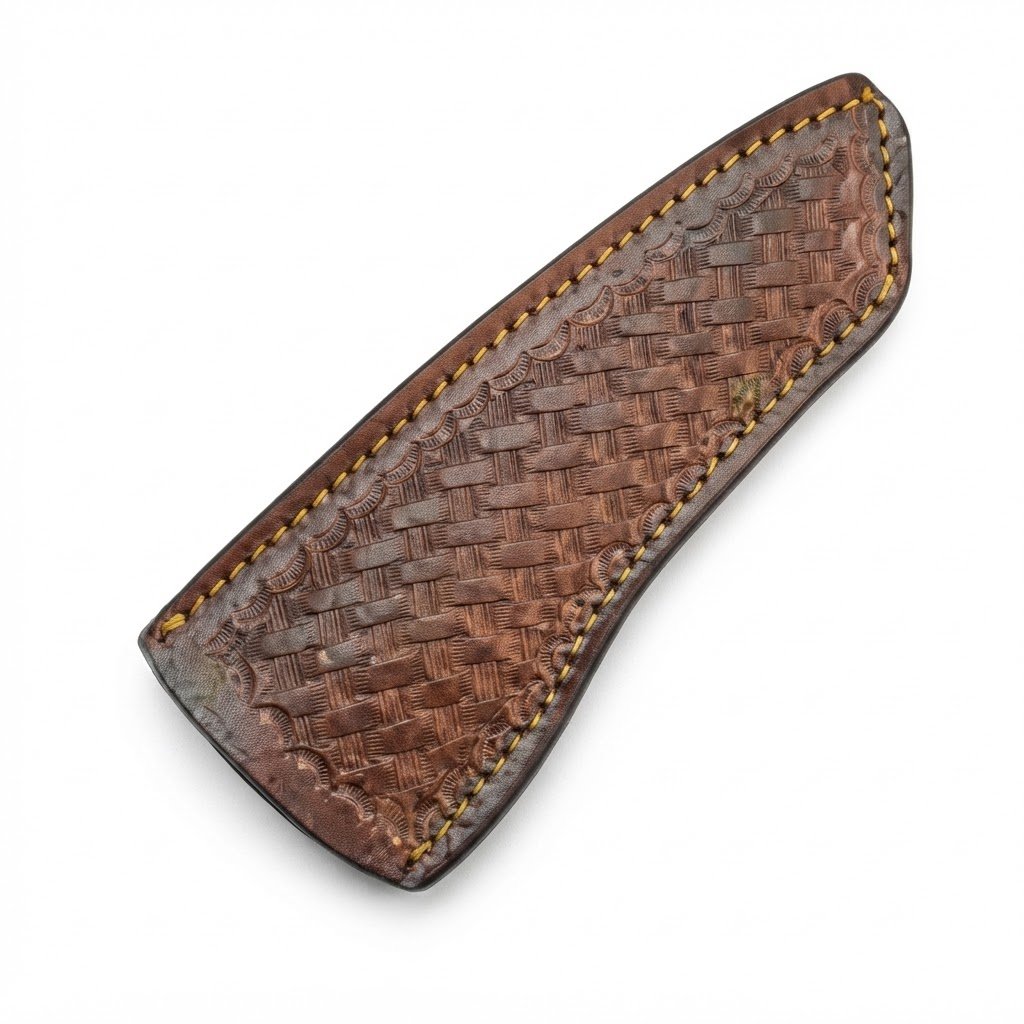
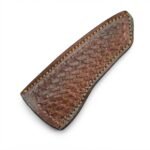
The sheath beneath the knife has a brown surface decorated with a repeated basket-weave-style pattern. This geometric texture gives it a different character from the circular and flowing markings on the blade.
Golden-brown stitching follows the perimeter. The thread contrasts with the body of the sheath and makes its elongated outline easy to see.
The sheath has a tapered shape and a darker edge. Some of its center is obscured by the knife, so the photograph does not show every construction detail.
Its surface has a leather-like appearance, but genuine leather, leather grade, lining, and manufacturing method remain unconfirmed. It should be described as a brown decorated sheath rather than assigned a specific material.
No belt loop, closure system, or retention feature is clearly established in the visible view. These should not be assumed from the sheath’s general shape.
The image shows the sheath as part of the product presentation. Whether it is included with the knife must be confirmed before the listing promises a knife-and-sheath package.
Sheath Fit and Storage Considerations
The knife is resting across the sheath rather than seated inside it. This means the photograph does not demonstrate fit, coverage, or retention.
If the sheath is included, confirm that it is intended for this exact model. Similar-looking knives can differ in blade width, tip shape, handle transition, and overall proportions.
An image showing the knife inserted would help establish how much of the blade and handle are covered. A reverse-side view would also clarify any attachment features that are not visible here.
For a customer who needs a carry system, the attachment method and dimensions are important. The decorative face alone does not establish belt compatibility or carry orientation.
The sheath’s pictured appearance is a clear aesthetic feature. Its practical suitability should be judged through fit information and manufacturer guidance.
This keeps the presentation accurate while allowing customers to appreciate the coordinated brown finish and stitching.
A Balanced Mix of Pattern and Plain Surfaces
The blade carries the most detailed pattern in the image. Its circles and waves contrast with the larger, simpler color sections of the handle.
The black front grip provides a darker area next to the blade, while the green band adds a narrow accent. The brown rear then connects visually with the brown sheath beneath it.
This creates a consistent color relationship across the pictured items. The knife and sheath do not use identical decoration, but their tones work together.
Gold-tone pins and golden-brown stitching introduce small warm details in both parts of the presentation. These accents remain secondary to the blade shape and handle colors.
For customers who prefer decorative knives without a very bright palette, this combination may be appealing. It has several points of interest while remaining primarily black, brown, green, and silver-gray.
The photograph remains the reference for appearance. Lighting, reflections, and screen settings can affect how each tone looks, so exact color matching should not be assumed from one image alone.
For Buyers Who Appreciate Tanto-Style Designs
This knife may interest collectors and enthusiasts who prefer angular blade profiles and contrasting handle sections. The tanto-style point is its clearest shape feature, while the green band provides a recognizable color detail.
The patterned blade also gives buyers something to compare beyond the outline. Its combination of circular and flowing markings differs from simpler straight-line or uniformly polished finishes.
For gift shopping, the design offers a coordinated appearance with a pictured sheath. However, no presentation box, certificate, display stand, or additional accessory is visible.
The photograph also does not establish a brand, maker, country of origin, or handmade production. These details may matter to a collector and should be verified separately.
If craftsmanship or provenance is central to the purchase, request documentation for the exact knife. An attractive finish can establish visual appeal, but it cannot establish who made the product or how it was produced.
Assessing Practical Suitability
The fixed-blade format and tanto-style profile make this knife relevant to shoppers comparing outdoor-style cutting tools. Specific suitability for camping, hunting, carving, food preparation, or other activities remains unverified.
For practical use, begin with the manufacturer’s stated application. Then compare the blade dimensions, steel composition, edge geometry, handle measurements, and construction with your requirements.
The angular tip should not be treated as proof of exceptional strength or suitability for demanding tasks. Its performance depends on the complete design and material specification.
Similarly, the shaped handle does not guarantee comfort for every user. Measurements and handling experience are more informative than appearance alone.
If a sheath is required, its fit and retention belong in the same assessment. The knife and sheath should be evaluated together once their compatibility is confirmed.
This approach allows you to choose the design for its appearance while checking practical requirements through reliable product information.
Specifications to Confirm Before Purchase
The most useful measurements are overall length, blade length, blade thickness, handle length, and weight. These establish the actual size and proportions that the photograph cannot provide.
Blade composition should be stated separately from the pattern name. If the supplier identifies the blade as Damascus steel, the information should apply to this model rather than to a general product category.
Each handle section should also be identified by material if different components are used. Black, green, and brown describe the colors, not the composition.
Tang construction and fitting materials should be confirmed if they are presented as selling points. Pins and visible perimeter metal are not sufficient evidence for a complete structural specification.
Finally, check package contents and the exact configuration supplied. The photograph shows one knife and one sheath, but it does not establish alternative colors, custom engraving, or a range of selectable materials.
These details would complete the technical information needed for a confident comparison.
Care and Maintenance
Manufacturer-specific care instructions are not available from the photograph. Cleaning, polishing, sharpening, and storage guidance should follow the confirmed blade, handle, and sheath materials.
The blade’s decorative pattern should not be assumed to tolerate abrasive polishing or particular cleaning chemicals. Appropriate treatment depends on how the finish was created.
The handle’s three sections may also have different care requirements. A wood-grain appearance or glossy black surface is not enough to determine the correct treatment.
Dishwasher suitability, corrosion resistance, and water resistance are unverified. These should not be advertised as product benefits without supporting information.
For sharpening, follow the recommended method and angle for the supplied blade. The angular edge transition is visible, but its precise geometry cannot be measured reliably from the image.
Store the knife securely with an appropriate edge cover and keep it out of children’s reach. If the pictured sheath is supplied, follow the maker’s guidance for its intended storage or carry use.
Explore the Design and Confirm the Right Fit
The green band tanto knife brings together an angular blade, detailed surface markings, and a three-section handle. Its black front grip, narrow green accent, and brown rear give it a clear visual identity.
The pictured basket-weave-style sheath complements that appearance through its warm brown finish and contrasting stitching. Together, the image presents a coordinated design with several distinctive details.
Review the confirmed measurements, materials, and package contents, then choose this knife if its appearance and intended use match your requirements.







Reviews
There are no reviews yet.