




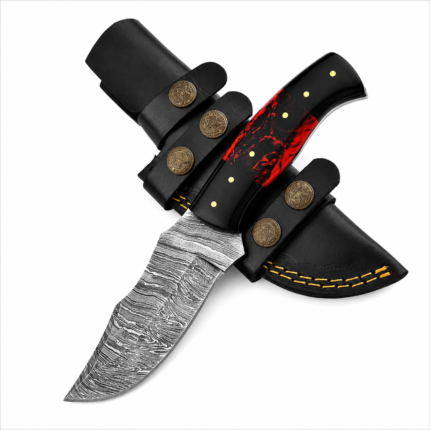
Sawback Fixed Blade Knife with Patterned Blade and Contoured Handle
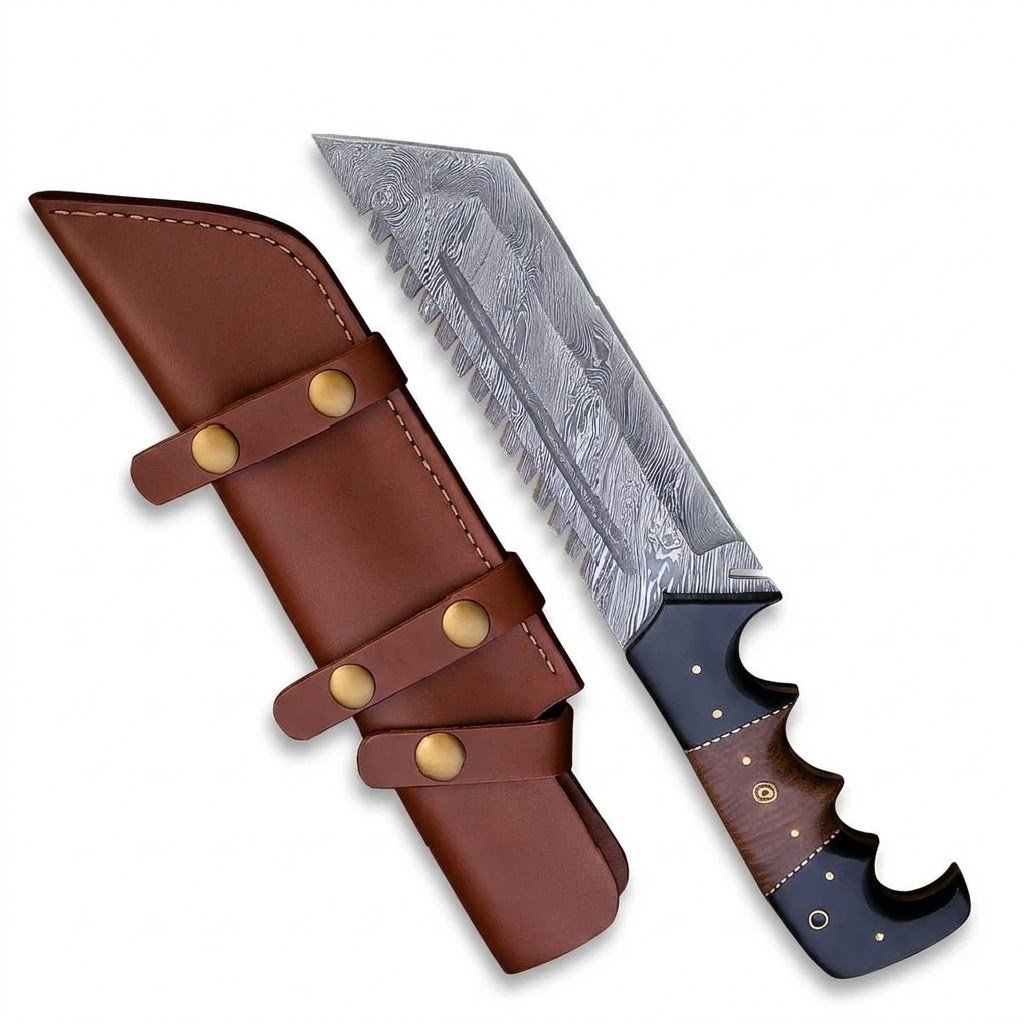
The Sawback Fixed Blade Knife combines a broad, angular blade with a distinctive patterned finish, a deeply contoured black-and-brown handle, and a matching brown sheath. Its unusual design brings together several recognizable features of hunting-inspired and outdoor utility knives, including a fixed-blade construction, prominent blade spine teeth, pronounced finger grooves, and a substantial-looking cutting profile.
The most striking feature is its silver-gray blade, which displays flowing, layered patterns across much of the surface. These patterns resemble those commonly associated with Damascus-style knife blades. The blade also features a long, narrow groove and a row of pronounced teeth along part of its upper edge, giving it a rugged, technical appearance.
The handle is equally distinctive. It combines smooth black sections with a warm brown center that has a wood-like grain pattern. Gold-colored circular fittings and contrasting decorative lines add detail to the grip. Deeply shaped finger recesses create a sculpted appearance that sets it apart from conventional straight-handled knives.
A brown stitched sheath is displayed alongside the knife. Its multiple retaining straps and gold-colored snap buttons complement the blade and handle design, creating a coordinated outdoor-style presentation.
This model may interest knife collectors, fixed-blade enthusiasts, and buyers looking for distinctive hunting-style cutlery. Its suitability for specific outdoor cutting tasks depends on technical specifications that must be confirmed with the manufacturer.
Distinctive Sawback Fixed Blade Knife Design
The Sawback Fixed Blade Knife has a recognizable silhouette that differs from traditional narrow hunting knives.
Its blade begins with a relatively broad section near the handle and extends into an angular profile. Instead of a conventional symmetrical spear-point shape, it features a straight-looking lower section that meets a sharply angled end.
A row of teeth runs along part of the upper blade edge. These teeth give the knife its sawback appearance.
The combination of a broad blade, angular end, decorative patterning, and sawback detail produces a visually distinctive design.
The blade is shown in an extended, non-folding configuration. No pivot, hinge, or folding mechanism is visible.
This makes it appropriate to classify the product as a fixed-blade knife.
The design also has certain similarities to tracker-style outdoor knives, although the precise blade geometry differs from many standard tracker models.
The overall appearance may appeal to customers who prefer unconventional outdoor knife designs over traditional drop-point or clip-point patterns.
Patterned Silver-Gray Blade Finish
One of the defining visual features of the knife is the flowing pattern across its blade.
The surface contains light and dark lines arranged in irregular, layered formations.
Some areas show narrow curved lines, while other sections display broader swirling patterns.
This creates a textured appearance even though the blade surface looks relatively smooth.
The visual effect resembles Damascus steel, a term commonly associated with patterned or layered knife blades.
However, the image alone cannot establish whether this knife uses genuine pattern-welded Damascus steel, an etched decorative pattern, or another finishing method.
For an accurate product description, the pattern should be identified as Damascus-style or layered-looking until the manufacturer provides reliable material information.
The silver-gray finish contrasts with the darker handle and warm brown sheath.
The blade also appears to have different polished sections, with changes in reflection across its surface.
These details create an attractive combination of decorative metalwork and traditional fixed-blade styling.
Collectors who appreciate unusual blade finishes may find the pattern particularly appealing.
Broad Angular Blade Profile
The blade has a broad, substantial-looking profile.
Its general shape is more angular than a conventional curved hunting knife.
The lower cutting edge appears relatively straight through much of its length.
Toward the front, the edge transitions into a sharply angled terminal section.
This angular appearance is one of the model’s most recognizable features.
The blade also shows a defined bevel and a separate surface near the spine.
These visible transitions create depth in the metalwork.
Unlike a simple utility knife, this model combines several different visual design elements across a single blade.
Its broad profile may attract customers who prefer larger fixed-blade designs.
However, the actual dimensions cannot be determined accurately from the photograph.
There is no ruler or other reliable scale reference.
The blade length, overall knife length, width, thickness, and weight must be obtained from the supplier.
The image also does not verify blade sharpness, steel hardness, or cutting performance.
These specifications are important for customers evaluating the knife for practical use.
Distinctive Sawback Spine Detail
The upper portion of the blade includes a series of pronounced tooth-like projections.
These form the sawback section.
The teeth are positioned along the spine rather than the main lower cutting edge.
Their repeated spacing creates a serrated visual profile.
Sawback designs are associated with some survival-style and outdoor knives.
However, the effectiveness of a particular sawback depends on its tooth geometry, spacing, hardness, and intended application.
These properties cannot be confirmed from a photograph.
The presence of teeth should therefore not be interpreted as proof that the knife is suitable for sawing wood, bone, rope, or other materials.
The manufacturer should specify whether the teeth are functional or primarily decorative.
For website categorization, the visible feature supports the use of the term “sawback knife.”
This is a more accurate description than simply calling the blade serrated, because the main cutting edge appears separate from the spine teeth.
The sawback detail is especially noticeable when the blade is viewed from the side.
It contributes significantly to the knife’s unconventional outdoor-inspired appearance.
Decorative Blade Groove
Another noticeable feature is the elongated groove visible along the side of the blade.
It begins near the handle and follows part of the blade’s length.
The groove is narrow and relatively straight.
Its position creates a distinct linear detail against the flowing blade pattern.
This feature adds visual contrast to the surface.
The surrounding patterned metal makes the recessed-looking line more noticeable.
Grooves on knife blades can serve different design or manufacturing purposes, depending on construction.
However, the specific function of this groove cannot be determined from the image.
It should not be described as reducing weight, improving balance, or providing a particular structural advantage without confirmation.
For this listing, it is identified as a visible decorative or recessed-looking blade groove.
Together with the sawback section and angular tip, it gives the knife a distinctive profile.
Contoured Black and Brown Handle
The handle features a combination of dark black sections and a contrasting brown central area.
The brown section displays visible wood-grain-like lines.
Its warmer color creates a natural-looking contrast with the black portions.
Several small gold-colored fittings are distributed across the grip.
A circular decorative fitting is also visible near the center.
The handle has multiple pronounced finger recesses along its lower edge.
These recesses create a sculpted shape.
Rather than following a simple straight line, the gripping surface curves inward and outward at several points.
This is a visually distinctive approach to handle design.
Finger-contoured handles are commonly associated with knives intended to provide defined hand-positioning areas.
However, the actual ergonomic suitability of this handle cannot be confirmed from the photograph.
Hand size, grip technique, handle thickness, and surface material all affect comfort.
The photograph also does not establish whether the brown section is natural wood, stabilized wood, laminate, or another material.
It should therefore be described as having a brown wood-grain appearance unless the supplier confirms its composition.
Deep Finger-Groove Styling
One of the handle’s most recognizable features is its pronounced series of finger recesses.
The front portion near the blade has a large curved cutout.
Additional curved recesses appear along the lower gripping surface.
The rear portion curves inward again, forming a hook-like shape.
These details give the knife a distinctive silhouette.
The finger recesses also create a strong visual separation between the upper and lower handle edges.
This is different from the relatively smooth handles found on many everyday utility knives.
The curved shape may appeal to customers who prefer highly contoured designs.
However, an attractive ergonomic profile does not automatically guarantee comfortable handling.
A handle that suits one person’s hand may not suit another.
Customers considering the knife for practical use should review its dimensions and, where possible, assess the physical product.
The visible design should not be presented as proof of superior grip strength, slip resistance, or fatigue reduction.
Such claims require appropriate testing or manufacturer documentation.
Contrasting Handle Sections
The handle appears to contain several different sections.
The front area is black and extends toward the blade.
The central brown portion displays a grain-like appearance.
The rear section returns to a dark black finish.
These contrasting areas create a layered design.
Small light-colored lines appear at the transitions between some handle sections.
The decorative separation adds detail without changing the overall dark color scheme.
Gold-colored pins provide additional contrast.
The handle’s visual construction may resemble combinations of wood and synthetic handle materials, but the exact components remain unverified.
The manufacturer should confirm each material before the website lists them as specific technical specifications.
This distinction matters because different handle materials have different cleaning and maintenance requirements.
Natural wood, stabilized wood, and engineered composites can look similar in photographs.
Accurate material identification helps customers understand what they are purchasing.
Gold-Colored Decorative Fittings
Several small circular fittings are visible along the handle.
Their warm metallic color contrasts with the black and brown surfaces.
A larger decorative circular detail appears around the center of the grip.
These fittings add a traditional handcrafted-style appearance to the overall design.
The fittings could be pins, rivets, decorative inserts, or a combination of components.
Their exact construction cannot be established visually.
They should not be described as solid brass unless confirmed by the supplier.
Likewise, their presence does not establish the knife’s tang construction.
Although fixed-blade knives can feature full-tang designs, the photograph does not show enough internal detail to verify that this model is full tang.
The seller should obtain confirmation of the handle attachment method.
Accurate information about tang design, materials, and assembly can help customers compare different models.
Until that information is available, the product description should focus on the visible decorative fittings.
Traditional Hunting-Inspired Appearance
The knife combines modern-looking blade details with a traditional brown sheath.
Its silver-gray blade pattern resembles decorative metalwork often found on custom-style hunting knives.
The black-and-brown handle provides a darker color scheme.
Gold-colored fittings introduce a classic accent.
The brown sheath completes the design with a traditional outdoor appearance.
Together, these details create a recognizable product for collectors and knife enthusiasts.
The design is more elaborate than many plain fixed-blade utility knives.
Its sawback section and pronounced handle contours make it particularly distinctive.
The knife may suit customers who appreciate visually unusual cutlery.
However, the appearance does not establish whether it is handmade, custom forged, or manufactured using a particular traditional process.
These claims should only be used if supported by the supplier.
Brown Sheath with Multiple Retaining Straps
The uploaded image shows a brown sheath positioned alongside the knife.
The sheath has a leather-like appearance and a smooth reddish-brown surface.
Visible stitching follows the outer edge.
Several retaining straps are arranged across the sheath.
The straps have gold-colored snap fasteners that coordinate with the decorative fittings on the knife.
This arrangement gives the sheath a distinctive appearance.
Compared with a simple single-strap knife sheath, the pictured accessory contains several visible closure points.
The straps appear designed to wrap across sections of the sheath.
However, their precise retention function and adjustment capability cannot be established from the photograph.
The sheath’s reverse side is not visible.
Therefore, its belt-attachment system, if present, cannot be confirmed.
The photograph also does not prove whether the sheath is genuine leather or a synthetic alternative.
The final package contents should be verified before the website promises that the sheath is included with every order.
Sheath Stitching and Finish
The sheath features a clean brown surface with lighter-colored stitching.
The stitching follows the long edge and curves around the pointed lower section.
This provides a contrasting border.
The visible seams contribute to the accessory’s finished appearance.
Several straps cross over the sheath body.
Their rounded ends and metallic-looking snap buttons create additional decorative detail.
The warm brown color coordinates well with the center section of the knife handle.
This connection makes the knife and sheath appear visually consistent.
The sheath may be attractive to customers who prefer traditional-looking outdoor accessories.
Nevertheless, the photograph cannot verify leather thickness, thread material, seam strength, or closure durability.
These specifications require direct supplier information.
For practical storage and carrying, the sheath must fit the blade correctly and protect the cutting edge.
Customers should confirm that the supplied sheath is compatible with the exact knife model.
Product Category and Intended Audience
The knife is best described as a sawback fixed-blade model with hunting-inspired styling.
It may be organized under hunting knives, fixed-blade knives, or outdoor knife collections.
Its appearance may interest several customer groups.
Knife collectors may appreciate the patterned blade and unusual handle shape.
Outdoor equipment enthusiasts may be interested in its distinctive sawback design.
Customers browsing decorative or traditional cutlery may appreciate the contrast between the patterned metal, contoured handle, and brown sheath.
For practical outdoor applications, users should confirm the blade material and construction specifications.
The image does not establish that the knife is suitable for demanding survival tasks, chopping, prying, or other heavy-duty activities.
Product classification should therefore be descriptive rather than making unsupported performance promises.
The knife is also not a folding pocket knife.
It has a visibly fixed blade and should be categorized accordingly.
A Distinctive Option for Knife Collectors
Collectors often focus on design details that distinguish one knife from another.
These may include blade shape, surface finish, handle materials, decorative fittings, and matching accessories.
This model offers several visually unusual characteristics.
The broad angular blade is particularly noticeable.
Its patterned surface creates visual movement across the metal.
The sawback teeth add another design feature.
The deep handle grooves create a recognizable gripping profile.
The brown sheath completes the presentation.
For collectors interested in patterned blades, the knife may be worth considering after its construction details have been confirmed.
However, the photograph does not establish rarity, collectible value, or a specific manufacturer.
Any description claiming that the product is limited edition, historically significant, or individually hand-forged would require evidence.
The knife can be presented as a distinctive fixed-blade design without making those assumptions.
Understanding Damascus-Style Blade Patterns
The blade displays wavy lines resembling those associated with Damascus-style cutlery.
Damascus is a widely used term in modern knife marketing.
However, visually similar patterns can be produced through different materials and manufacturing techniques.
Some blades are made from pattern-welded layers.
Others use decorative finishing or etching.
A photograph alone is not sufficient to distinguish reliably between these processes.
For this reason, the product should not be described as genuine Damascus steel until the supplier provides the relevant specifications.
The steel composition is particularly important.
Different alloys can have different properties regarding hardness, corrosion resistance, sharpening, and maintenance.
The visible pattern is a legitimate design characteristic.
It can be described accurately without assuming a particular metallurgical structure.
This approach provides customers with a clearer and more trustworthy product description.
Blade Material and Technical Information
The blade appears silver-gray with a layered-looking surface.
It is not possible to determine the exact steel grade from its color or pattern.
The following information should be obtained from the manufacturer before publishing detailed specifications:
Blade Material: Not verified
Steel Grade: Not verified
Hardness: Not verified
Blade Thickness: Not verified
Blade Length: Not verified
Overall Length: Not verified
Knife Weight: Not verified
Tang Construction: Not verified
Manufacturing Method: Not verified
Handle Composition: Not verified
Sheath Material: Not verified
These details matter when comparing different fixed-blade knives.
For example, blade thickness can influence the geometry of a knife, while steel composition affects maintenance requirements.
However, no specific performance conclusions should be drawn until the actual specifications are available.
The product’s visual appearance is not a reliable substitute for documented technical data.
Fixed-Blade Construction Characteristics
A fixed-blade knife has a blade that remains extended rather than folding into the handle.
This model clearly follows that configuration.
There is no visible folding pivot or hinge.
The blade connects directly to the gripping section.
The handle appears to be assembled from multiple visible materials or colored sections.
The internal construction remains concealed.
The image cannot establish whether the blade tang extends fully through the handle.
It also cannot confirm how the visible fittings attach the handle components.
Customers who prioritize construction details should request a manufacturer specification sheet.
For retail listings, verified information about tang design can help distinguish different models accurately.
Until those details are available, describing the knife as a fixed-blade model is sufficient.
Comparing This Knife with Traditional Hunting Knives
Many traditional hunting knives have smooth curved cutting edges and relatively simple handles.
This model differs in several noticeable ways.
Its blade has an angular silhouette.
The spine includes a series of teeth.
The patterned metal surface is visually elaborate.
The handle contains multiple deep finger recesses.
The sheath has several retaining straps.
These features give the product a distinctive appearance.
Customers comparing knives may prefer one design over another for aesthetic reasons.
However, visual complexity should not be confused with functional superiority.
A knife with more features is not automatically more durable or better suited to a particular task.
Actual suitability depends on material, dimensions, geometry, construction, and testing.
The most reliable comparisons use verified manufacturer data.
Outdoor Use Considerations
Fixed-blade knives are commonly associated with camping and outdoor activities.
However, individual designs have different capabilities.
A knife intended for light utility tasks may not be suitable for demanding field work.
Similarly, the presence of sawback teeth does not establish reliable sawing performance.
For this product, the exact steel grade, edge geometry, and construction specifications are unknown.
Customers should therefore avoid assuming that it has been tested for heavy chopping, prying, or other demanding applications.
Before practical use, the knife should be inspected for secure handle fittings and visible damage.
The manufacturer’s intended-use guidance should be followed.
Appropriate protective equipment and safe handling practices are important.
This knife should only be used for lawful purposes in suitable environments.
Any marketing description of its cutting capabilities should be supported by verified technical information.
Blade Cleaning and Maintenance
Routine maintenance can help preserve the appearance of a knife blade.
After appropriate use, remove visible dirt and residue.
Wipe the metal with a clean, soft cloth.
If cleaning with water is suitable for the confirmed material, dry the blade thoroughly afterward.
Avoid leaving moisture on the surface for extended periods.
The correct cleaning products depend on the steel composition and finish.
Because those details remain unverified, harsh chemicals and abrasive cleaning methods should be avoided.
Some blade materials may require additional protection against corrosion.
The manufacturer should provide the appropriate care instructions.
The patterned surface should be treated carefully to avoid unnecessary scratching.
For long-term storage, keep the blade clean and dry.
Inspect it periodically for signs of rust, staining, or damage.
Caring for the Contoured Handle
The handle contains several curved recesses and contrasting surface sections.
These areas may collect dirt during handling.
Use cleaning methods appropriate to the confirmed handle materials.
A soft cloth can help remove light surface residue.
Avoid prolonged soaking or exposure to strong cleaning chemicals.
Do not apply wood oils or synthetic-material conditioners until the handle composition is verified.
Different materials can react differently to moisture, temperature, and chemical treatments.
The visible fittings should also be inspected periodically.
If a handle component becomes loose or damaged, discontinue use until the issue has been assessed.
Store the knife away from excessive humidity and heat.
Proper care should be based on the supplier’s confirmed construction details.
Maintaining the Brown Sheath
The pictured sheath has several straps and snap fasteners.
These components should be inspected for wear.
Check the visible stitching and strap attachment points.
Ensure that any closure used to secure the knife operates properly.
If the sheath becomes damaged or no longer covers the blade safely, it should be repaired or replaced as appropriate.
The exact material is not confirmed.
Genuine leather and synthetic leather may require different maintenance products.
Avoid applying material-specific conditioners until the sheath composition is known.
Keep the sheath dry and away from excessive moisture.
For long-term storage, consult the manufacturer’s recommendations regarding whether the knife should remain inside the sheath.
Safe Storage and Handling
The knife has a pointed blade and visible cutting edges.
It should always be handled carefully.
Keep fingers away from the blade during handling.
Use an appropriately fitted protective sheath when the knife is not in use.
Store the knife securely and away from children.
Inspect the blade, handle, and fittings before practical use.
Do not use the knife if components are damaged or loose.
Avoid applications beyond the manufacturer’s intended specifications.
The sawback teeth and angular blade profile require particular care during cleaning and storage.
Customers should also check applicable local laws regarding knife possession, transportation, and importation.
Responsible storage and handling are essential regardless of the knife’s intended use.
Product Photography and Presentation
Clear product photography is important when selling a knife with detailed decorative features.
The supplied image shows the blade and matching sheath against a white background.
This makes the main design elements easy to identify.
Additional photographs would provide a more complete view.
A close-up of the blade could help customers inspect the patterned finish.
A photograph of the sawback section could show the tooth arrangement.
A side view of the handle could reveal its contours and decorative fittings.
The reverse side of the sheath would help establish whether a belt loop or other attachment feature is present.
A measurement photograph could confirm the knife’s overall size.
Such images would help customers compare the product with other models more confidently.
The final photographs should represent the actual item accurately without exaggerating its appearance.
Important Details to Confirm Before Ordering
Customers evaluating this knife should review the supplier’s specifications.
The steel grade is particularly important.
The material used for the patterned blade should be clearly identified.
The handle composition and tang construction also require confirmation.
Measurements such as overall length, blade length, thickness, and weight can help establish the product’s size.
The sheath material should be specified.
Customers should also check whether the sheath is included in the final package.
The warranty, manufacturing origin, and availability of replacement accessories may be relevant.
For wholesale purchasing, minimum order quantities and customization options should be discussed directly with the supplier.
These considerations can help prevent confusion between visually similar products.
Why Choose This Sawback Fixed Blade Knife Design?
The Sawback Fixed Blade Knife stands out because of its combination of visual details.
The broad silver-gray blade has an elaborate layered-looking pattern.
The upper edge contains pronounced sawback teeth.
The blade also features a distinctive elongated groove.
The handle combines black sections with a brown wood-grain appearance.
Deep finger recesses create a sculpted profile.
Gold-colored decorative fittings provide contrast.
The brown sheath adds a traditional presentation with multiple visible closure straps.
Together, these characteristics produce a recognizable hunting-inspired knife design.
Collectors and outdoor knife enthusiasts may appreciate its unconventional appearance.
Customers seeking a practical cutting tool should review the manufacturer’s verified material and construction specifications before purchasing.
Final Overview
The Sawback Fixed Blade Knife offers an unusual combination of decorative blade patterning, angular geometry, pronounced spine teeth, and a deeply contoured handle.
Its black-and-brown color scheme is complemented by gold-colored fittings and a matching brown sheath.
These features give the knife an appearance that differs from conventional fixed-blade hunting models.
The design may appeal to collectors and customers who appreciate distinctive outdoor cutlery.
Although the image clearly shows its main visual features, technical claims about steel grade, hardness, construction, and practical performance require supplier verification.
Explore the Sawback Fixed Blade Knife for its patterned blade, sculpted handle, and traditional brown-sheath styling.






Reviews
There are no reviews yet.